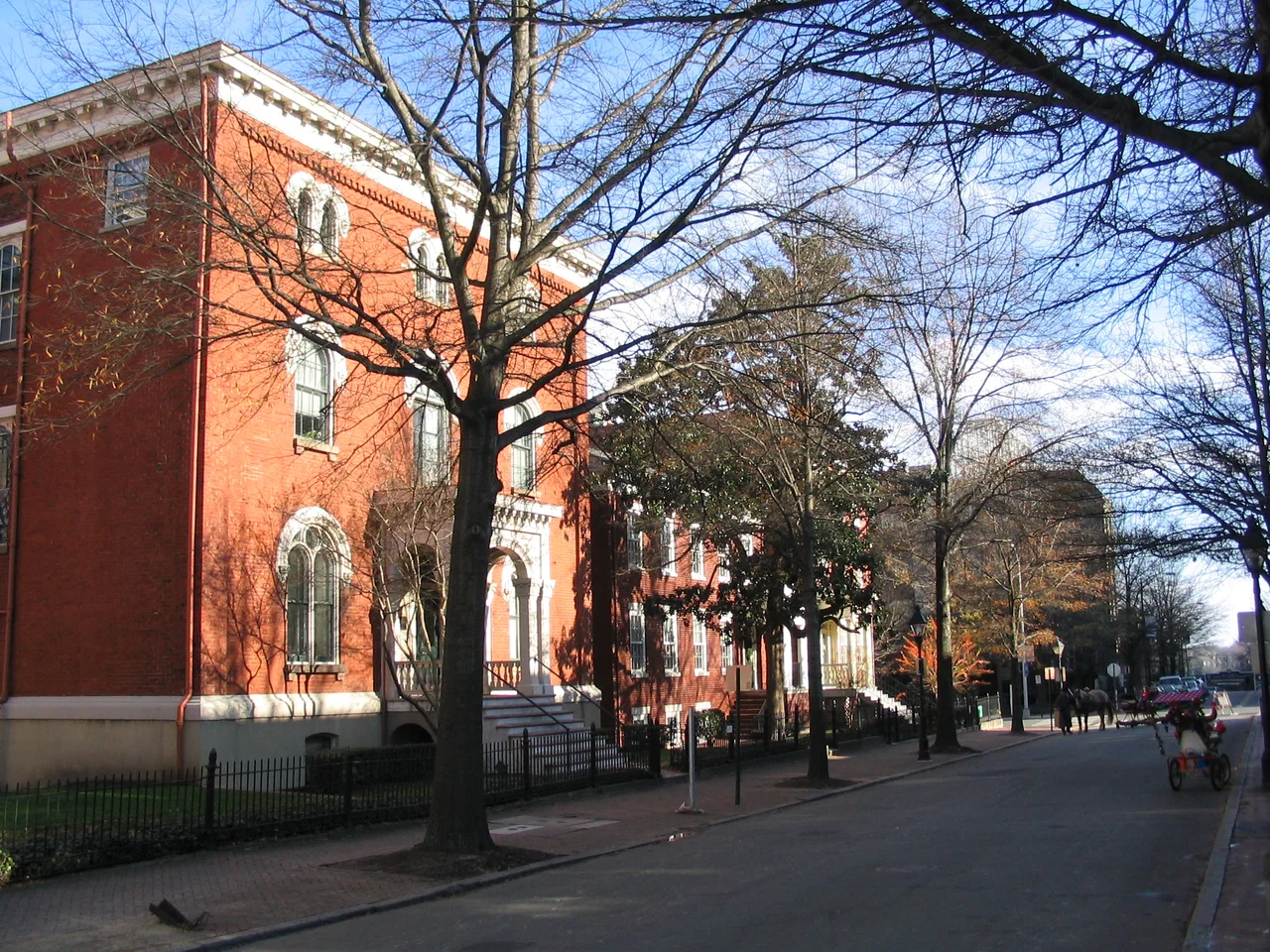

Court End
When Virginia moved its capital from Williamsburg to Richmond in 1780, the wealth followed. By the 1780s a new neighborhood was taking shape on the northern slope of Shockoe Hill, close enough to Thomas Jefferson's new Capitol that the lawyers and merchants and politicians who needed to be there every day could walk. They called it Court End, and within two generations it had become Richmond's most prestigious address - the home of Chief Justice John Marshall, the residence of Confederate President Jefferson Davis, the place where Robert Mills designed Monumental Church over the ashes of seventy-two theater-fire victims. The neighborhood that grew up between 7th Street and 14th Street, between Grace and Jackson, became a layered record of Federal architecture, Civil War memory, and twentieth-century medical campus expansion. Remarkably, most of it is still standing.
Before the Elite Arrived
Court End wasn't always polite. Before the Federal-era mansions went up, the same blocks held a vibrant theater district and a large outdoor market. Both burned out, in their different ways. The Richmond Theatre fire of December 26, 1811 destroyed most of the Theater Block and killed seventy-two people, including the Governor of Virginia - one of the worst urban disasters of its era. Robert Mills, who would later design the Washington Monument in DC, was hired to build Monumental Church on the ruined ground as both a sanctuary and a memorial. The market on Shockoe Hill never recovered either, eclipsed by the better-located First Market in Shockoe Bottom. With the entertainment and commerce gone, the neighborhood could remake itself as something quieter. According to historian Mary Wingfield Scott, the elite moved in during three distinct waves: the 1780s, the 1810s, and the 1840s. By mid-century the Court End was wall-to-wall mansions, churches, synagogues, and the academic buildings of the Richmond Female Institute and Hampden-Sydney Medical College.
The Confederate Years
When Richmond became the Confederate capital in 1861, Court End housed the new government. Jefferson Davis and his family moved into the Brockenbrough-Crenshaw House at 12th and Clay Streets - the building that would later be renamed, in the 1890s, the White House of the Confederacy. Confederate Vice President Alexander Stephens lived briefly in the Bruce-Lancaster House on the opposite corner. The wealth that had concentrated here over three generations stayed in place, but now it served a different government. After Appomattox, Davis's house became the military headquarters for federally occupied Virginia, then for the next twenty years served as Richmond Central School - the city's first public school, operating in the rooms where the Confederate cabinet had once met. The architectural fabric absorbed each new use the way old neighborhoods do, accumulating meaning rather than replacing it.
Medical Campus, House Museums
Two parallel projects reshaped Court End starting in the 1890s. The first was consolidation: the small medical colleges that had begun in the neighborhood merged into the Medical College of Virginia, which grew into a major research and trauma center and merged with VCU in 1968. MCV's expansion swallowed block after block of Court End. The second project was preservation. In 1890 the Confederate Memorial Literary Society formed to save Davis's old residence from demolition; in 1896 it opened as what is now the Museum of the Confederacy. In 1892 the Valentine family started a non-profit to preserve local history, opening the Valentine Richmond History Center in 1898. In 1911 the Association for the Preservation of Virginia Antiquities saved the John Marshall House. The two projects - expanding hospital and preserved past - existed in tension for over a century. VCU has since saved a number of historic buildings within its medical footprint, including the William Beers House, the Egyptian Building, First Baptist Church, the Putney Houses, the William H. Grant House, and the Leigh House.
Court End Today
Mary Wingfield Scott's 1950 prediction that 'all traces of Richmond's past will soon disappear from this, the most historic of its many old neighborhoods' has come partly true and partly not. Court End is no longer residential; most of it is institutionally owned by VCU, the Commonwealth, and the City. But the John Marshall House still stands. So does Monumental Church. The Egyptian Building - Thomas Somerville Stewart's astonishing 1845 Egyptian Revival lecture hall for the Hampden-Sydney Medical College - is still in use. The Valentine, the White House of the Confederacy, and the Wickham House have all been restored to their original appearances and remain open to the public. Each December the neighborhood opens its buildings for Court End Christmas. The Court End Passport, sold by the Valentine, packages the major museums together. The free attractions include the Library of Virginia and the Richmond City Hall Observation Deck. The neighborhood that the Federal era built is still here, working a different shift.
From the Air
Coordinates 37.5439 N, 77.4314 W, in downtown Richmond just north of Capitol Square and East Broad Street. Best viewed from 1,500-2,500 ft AGL. Identify the Virginia State Capitol's distinctive Jeffersonian portico to the south; Court End is the dense block of mixed historic and medical buildings immediately to its north, bounded roughly by 7th Street west, 14th Street east, Grace Street south, and Jackson Street north. The Egyptian Building's row of stylized columns is visible from low altitude. Richmond International Airport (KRIC) lies 6 miles east; Chesterfield County (KFCI) is 9 miles south.
Nearby Stories
- Kings Dominion 8.4 km away
- Battle of Hatcher's Run 9.7 km away
- Francisco's Fight 14 km away
- Piney Grove at Southall's Plantation 17 km away
- Jamestown Settlement 19 km away
- Battle of Amelia Springs 22 km away
- Menokin 29 km away
- Highland (James Monroe House) 42 km away