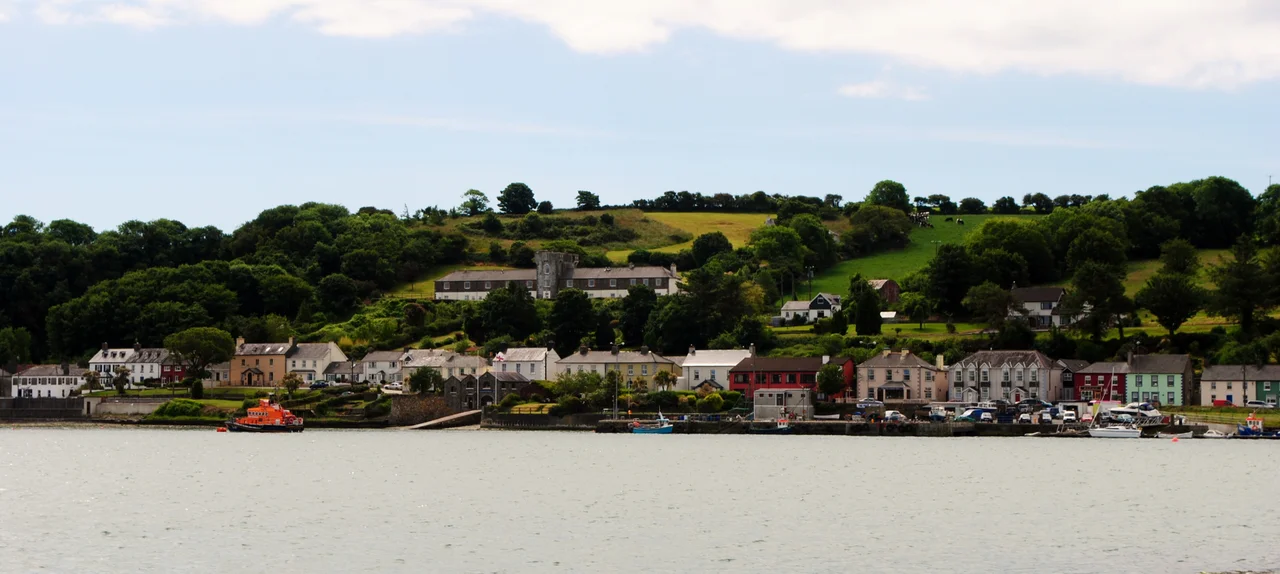

Courtmacsherry
Locals just call it Courtmac. The whole village is essentially one long street running along the southern shore of Courtmacsherry Bay, with thick woods rising behind it and continuing eastward all the way to Wood Point - planted by the Earl of Shannon in the late 18th century and never quite cut down. Between the village and the Point, the trees come right to the water, and small natural coves open every few hundred metres. By the numbers it is unassuming: a population in the hundreds, a hotel, a caravan park, a few pubs. By the climate it is unique. Courtmacsherry is the mildest place in Ireland, with a mean annual temperature of 11 degrees Celsius - a maritime sweet spot where palms can be made to grow and the bay only rarely sees frost.
Hodnetts Who Became MacSherrys
The name is older than the village. Around the Norman invasion, the major townships in this corner of West Cork were Timoleague, Lislee, Barryroe and Dunworly. Norman settlers - the de Barrys and the Hodnetts - built fortified houses and castles, and one branch of the Hodnetts did what so many Anglo-Norman families ended up doing in Ireland: they 'degenerated into mere Irish', as the disapproving chroniclers put it. They changed their name to Mac Seafraidh - son of Geoffrey - which was later anglicised to MacSherry. The bay and the village took the new name with them. Today there are still Barrys and Hodnetts living in the district, but no MacSherrys at all. One descendant of those vanished local Hodnetts, Patrick McSherry, emigrated in 1745 and founded McSherrystown in Adams County, Pennsylvania - so the family name persists, just on the wrong side of the Atlantic.
Planted Woods, Planted Earl
In 1760, Henry Boyle, the First Earl of Shannon, inherited the Boyle estate that included Courtmacsherry. His grandson, the Third Earl, built Courtmacsherry House in the 1840s as the family residence. Before that the village had been a small cluster of houses near Wood Point, shown that way on the Grand Jury Map of County Cork in 1811. What survives most visibly from the Shannon period is not architecture but landscape - the long band of woodland behind the village, planted as a private estate amenity in the late 18th century and now a public scenic backdrop. The Earls eventually moved on; the trees stayed. They are the reason a single-street fishing village still feels enclosed, sheltered, almost theatrical: a thin ribbon of houses between water on one side and a wall of trees on the other.
Antarctic Son
Patrick Keohane was born in Courtmacsherry in 1879. He joined the Royal Navy, and in 1910 he sailed south with Robert Falcon Scott on the Terra Nova Expedition. He was part of the second supporting party on the polar journey, turning back at around 87 degrees south while Scott and four others pressed on toward a death the village would not learn of until much later. Keohane survived, served in the First World War, and lived until 1950. A boy from a small Irish seaside village had stood within 350 miles of the South Pole. Courtmacsherry has not forgotten him; the village still claims him as its own, alongside the lifeboat coxswains, the GAA players, and the writers who passed through. Robert Gookin, who died in 1666 or 1667 and was an Anglo-Irish captain in the Parliamentary army, is the older name in the same memorial roll - reminder that this village has been giving sons to wider history for a long time.
Bells, Boats, and Bass
The lifeboat is the village's beating heart. Courtmacsherry had one of the first three lifeboats in Ireland in 1825, lost it to neglect by 1840, got a proper station back in 1867, and has been answering the bell ever since - through the wreck of the Faulconnier on the Seven Heads, the slow row toward the sinking Lusitania in 1915, the rescues of torpedoed sailors during the Second World War, and the night they brought three yachtsmen off the Supertaff in 70-knot wind in 1998. The 2.6-million-euro Shannon-class Val Adnams sits on station today. Around her, the village does what it has always done: angles for record bass and pollack, fills the hotel and caravan park with Cork-city visitors in summer, runs a horse race on the strand each year, and quietly enjoys the warmest little patch of weather on the island. The Timoleague-Courtmacsherry railway ran here from 1891 until 1961, with three locomotives named Slaney, St. Molaga and Argadeen - now gone, but their route survives as a coastal walk that ends, predictably, at the lifeboat slipway.
From the Air
Located at 51.63 N, 8.71 W on the southern shore of Courtmacsherry Bay. The village is a single ribbon of buildings along Sea Road, easily picked out against the long band of estate woodland behind it. Best viewed at 1,500-3,000 ft. Cork airport (EICK) lies 22 nm to the northeast; the Old Head of Kinsale lighthouse, 9 nm east, is the prominent coastal landmark on approach.
Nearby Stories
- Ballymaloe House 1.3 km away
- Ballincollig Castle 2.8 km away
- Skibbereen 9.8 km away
- Ballyvourney 10 km away
- Ballycotton 27 km away
- HMHS Llandovery Castle 53 km away
- Wolfpack Prien 74 km away
- SM U-27 85 km away