
Coventry Colliery
The road that turns off Wheelwright Lane in Keresley End is named Winding House Lane, and that small piece of nomenclature is the most honest history lesson the place offers. The winding house is long gone. So is the headgear, the pithead baths, the colliery club, and the twin shafts that once dropped 720 yards into the Warwickshire Coalfield. What stands here now are warehouses of the kind that distribute Britain's online shopping, branded in the muted greens of Prologis. For most of the twentieth century, however, this was Coventry Colliery, the deep mine that fed the city's car factories and aircraft works with the heat they needed to bend metal.
Sinking the Shafts
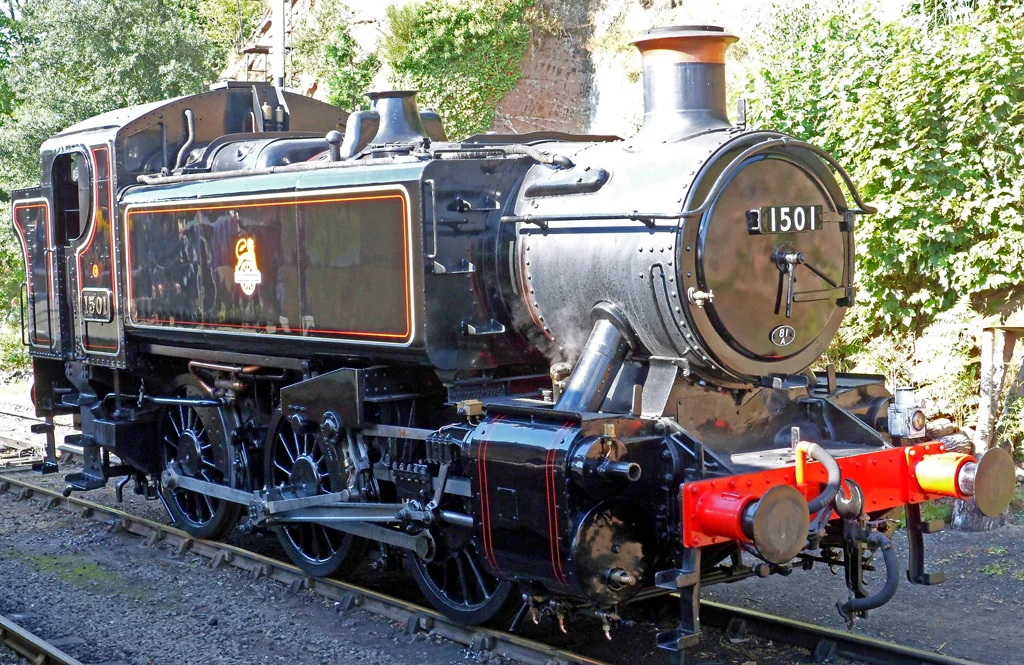
Wyken Collieries Ltd had been pulling coal from the Warwickshire Coalfield since 1862, but the Coventry Colliery proper began operating in 1917 when the twin shafts at Keresley End were sunk to a depth of 720 yards. The First World War's iron-and-steel hunger drove the timing. In 1924, every share in the Warwickshire Coal Company was acquired by the Coltness Iron Company, and when the older Craven Colliery worked out its seams in 1927 its miners transferred here. The colliery sat in awkward geography between Bedworth and Coventry, and the spoil it produced was so voluminous that a two-mile private railway had to be laid to connect with the London & North Western's Coventry-to-Nuneaton line at Three Spires Junction near Foleshill. That railway gave the colliery its locomotive stable, including a former Great Western pannier tank, No. 1501, that today survives in preservation on the Severn Valley Railway, the only Coventry Colliery engine to escape the scrapper's torch.
The Men Underground
The locomotives are easy to inventory. The miners are harder. North Warwickshire was a coalfield community for over a century, and Keresley End grew up around the pit: terraced houses, a chapel, a co-op, and the Coventry and Keresley Colliery Sports and Social Club, where men coming off shift drank pints and played dominoes. Two world wars made the colliery essential and the work brutal. Coal dust ground itself into skin and lungs that no amount of bathing could wash clean. The miners' children went to schools built for miners' children. When the National Coal Board took over after nationalisation in 1947, the pit continued largely as before. Production rose, mechanisation crept in, and a community whose entire identity was wrapped around the cage descending and rising remained, for two more generations, a community of pitmen.
The Closure That Felt Like an Ending
Coventry Colliery closed in 1991, seven years after the bitter miners' strike of 1984 to 1985 had broken the back of the British coal industry. By the time the last shift ended, the wider Warwickshire coalfield was nearly empty. The site lay derelict until British Coal handed it to the local authority in 1996, and the social club hung on longer than the pit had, finally shutting in May 2012 after losses mounted to about £500 a day. The end of the club was reported almost as if it were the end of the colliery itself, because for those who remembered, it was. The men who had drunk there had spent their working lives a quarter of a mile below where they now drank, and when the pit shut, the slow draining away of the community had begun. The club outlasted the work, but only just.
What Replaced It
Today the 200-acre site is Prologis Park, Coventry. Tall steel sheds with loading docks and acres of HGV parking spread across the levelled ground where the spoil heaps once rose. The connection to the national rail network has survived the transformation, which is unusual for ex-colliery sites and useful for an operator moving large volumes of goods. From the air the geometry is suburban-industrial, regular and pale, but if you know what to look for, the older curves of the former railway alignment still show through the new estate roads. Winding House Lane is the giveaway. Beneath the tarmac, the shaft was capped with concrete decades ago, but the coal below remains where it lay when the last cage came up in 1991.
From the Air
Located at 52.457°N, 1.528°W, between Bedworth and the northern edge of Coventry. Best viewed from 1,500 to 2,500 feet above ground level. The site reads as a regular grid of large warehouses with parking arrays, distinct from the surrounding residential streets of Keresley End. Coventry Airport (EGBE) is 7 miles to the south; Birmingham Airport (EGBB) sits 11 miles to the west. The M6 runs to the north and the A444 to the east. Note the proximity of Birmingham CTR when transiting westward.
Nearby Stories
- Round Oak Steelworks 1.7 km away
- RAF Gaydon 6.6 km away
- Ashby-de-la-Zouch 7.3 km away
- Battle of Naseby 7.3 km away
- Stafford Castle 7.5 km away
- Siege of Worcester (1646) 7.8 km away
- Asfordby Colliery 9.7 km away
- Silverstone Circuit 15 km away