
Coventry Ordnance Works
The British government in 1905 had a problem common to powerful countries: too few suppliers for the things that mattered most. Two firms, Vickers and Armstrong Whitworth, between them sold the Royal Navy almost every heavy gun and turret it bought, and the prices reflected the absence of competition. The Admiralty's solution was to encourage a third giant into the trade, and on a 60-acre tract in Coventry's Stoney Stanton Road the Coventry Ordnance Works was born from a consortium of three shipbuilders: John Brown of Clydebank with a controlling half-share, Cammell Laird of Sheffield and Birkenhead with a quarter, and Govan's Fairfield with the rest. For the next two decades the factory machined the breeches and mountings of weapons that fired across the Skagerrak and the Somme.
An Arms Race in Three Shares
The ordnance business that the three shipbuilders amalgamated had originally been started in Birmingham in the late 1890s by H.H. Mulliner and F. Wigley, moved to Coventry in 1902, and bought outright by Charles Cammell the following year. By 1909 Coventry Ordnance had pushed beyond its Stoney Stanton site to additional works at Scotstoun on the Clyde, where a wet dock and special pits handled the heaviest turrets, plus a shell-loading and magazine plant at Cliffe in Kent and a 22,000-yard gun-proving range at Boston in Lincolnshire. The Coventry plant grew a complete factory dedicated to fuzes. Then came a clash that revealed how political the arms trade could be: managing director Herbert Hall Mulliner had quarrelled repeatedly with the Admiralty and was forced out in February 1910, replaced by Rear-Admiral R.H.S. Bacon, who until weeks before had been the Admiralty's Director of Naval Ordnance. Within days the orders for major battleship mountings arrived.
Guns for the Great War
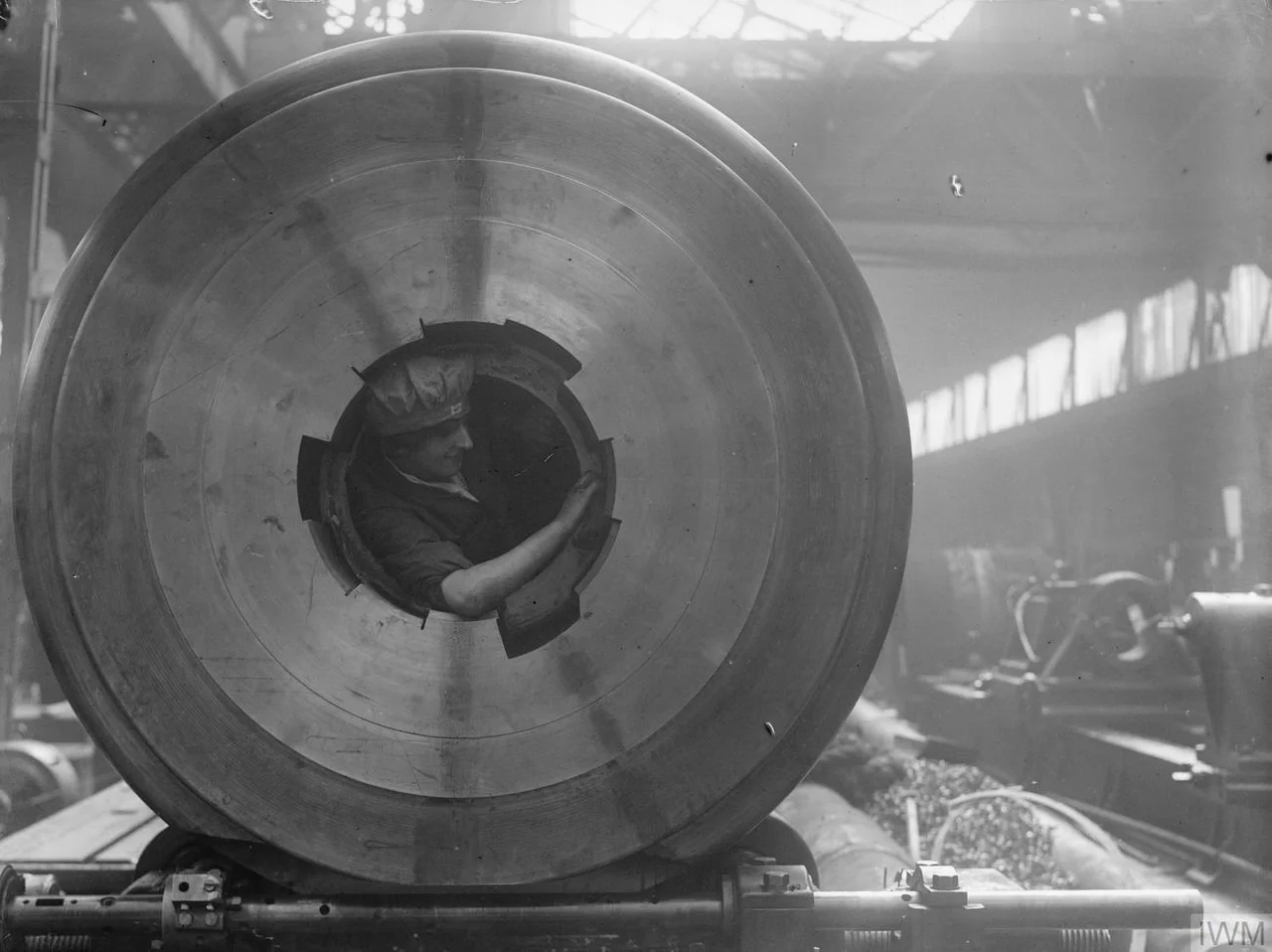
The works produced weapons that wrote their names into the catalogue of the First World War. The QF 4.5-inch howitzer, designed at Coventry and entering British Army service in 1910, became one of the most successful field pieces of the conflict. The BL 5.5-inch naval gun followed in 1913. In 1914 Coventry completed the BL 15-inch siege howitzer, a monster of a weapon hauled to the Western Front for breaking concrete and morale alike. The 1917 C.O.W. 37mm gun was the world's first modern autocannon. In a photograph from the period a woman in a long apron leans into the breech of a 15-inch howitzer, cleaning its rifling. Tens of thousands of women joined the British munitions workforce during the war, and the Coventry factory was one of the places where they worked, machining and gauging the very largest pieces in ways the pre-war industry had not imagined possible.
Peace and a New Name
Four days after the armistice of November 1918, Dick, Kerr & Co Limited announced that it intended to merge with Coventry Ordnance. Within weeks the combine had a new identity. English Electric Company Limited was formed at the end of 1918 to own Coventry Ordnance, the Phoenix Dynamo Manufacturing Company, Dick Kerr, the United Electric Car Company and Willans & Robinson. Its founders intended it to be one of Britain's three principal electrical manufacturers, doing the work of railway electrification, big central power stations, and hydro-electric installations. The Coventry plant tried to find a peacetime footing in the slump that followed the war and failed. It closed in 1925. Harland & Wolff took over the Scotstoun works in 1920 and slid it into care and maintenance by 1927.
Rearmament, Recovery, Reuse
The 1936 rearmament programme woke the Coventry works back up to make gun mountings, and the Second World War kept it running flat out. Afterwards the standard 4.5-inch turrets for County-class destroyers were assembled here into the late 1960s. Then the plant pivoted again, to turbines for the Cruachan pumped-storage power station and for Australia's Snowy Mountains scheme, and to Danly steel presses for the British motor industry at Linwood, Longbridge, Dagenham and Liverpool. One vertical boring mill on site had a 36-foot diameter turntable, originally cut for machining gun-turret gear rings, and now perfect for turbine castings. Three tiers of overhead cranes could together lift several hundred tons. In 1969 the site was sold to Albion Motors. The buildings still stand on Stoney Stanton Road, still in industrial use, still owned by Albion, now a subsidiary of the American firm American Axle, making automotive parts where naval guns once swung on chain.
From the Air
Located at 52.4189°N, 1.4930°W, on Stoney Stanton Road in the north-east of Coventry city centre. Best viewed from 1,500 to 2,500 feet above ground level. The site reads as a long industrial parcel parallel to the road, with multi-tier roof structures distinctive against the surrounding terraced housing. Coventry Airport (EGBE) lies 4 miles to the south-east; Birmingham Airport (EGBB) is 13 miles to the west. Look for the Coventry Canal running north-west from the city centre, which passes within a quarter mile of the works.
Nearby Stories
- Round Oak Steelworks 1.7 km away
- RAF Gaydon 6.6 km away
- Ashby-de-la-Zouch 7.3 km away
- Battle of Naseby 7.3 km away
- Stafford Castle 7.5 km away
- Siege of Worcester (1646) 7.8 km away
- Asfordby Colliery 9.7 km away
- Silverstone Circuit 15 km away