
Cregneash
In the summer of 1947 the Irish Taoiseach, Éamon de Valera, walked up the hill to Harry Kelly's cottage in this tiny village above the Calf of Man and asked to meet Ned Maddrell. De Valera spoke Irish. Maddrell spoke Manx. The two languages, cousins on the Goidelic branch of Gaelic, were close enough that an elderly Manx fisherman and the head of the Irish government could carry on a conversation across them. Cregneash had become the last place on earth where that conversation was still possible. "I am a Manx nationalist," Maddrell told de Valera that day. "I don't mean that we should cut adrift from the Empire, but I think we should preserve what is our own."
A Village Above the Calf
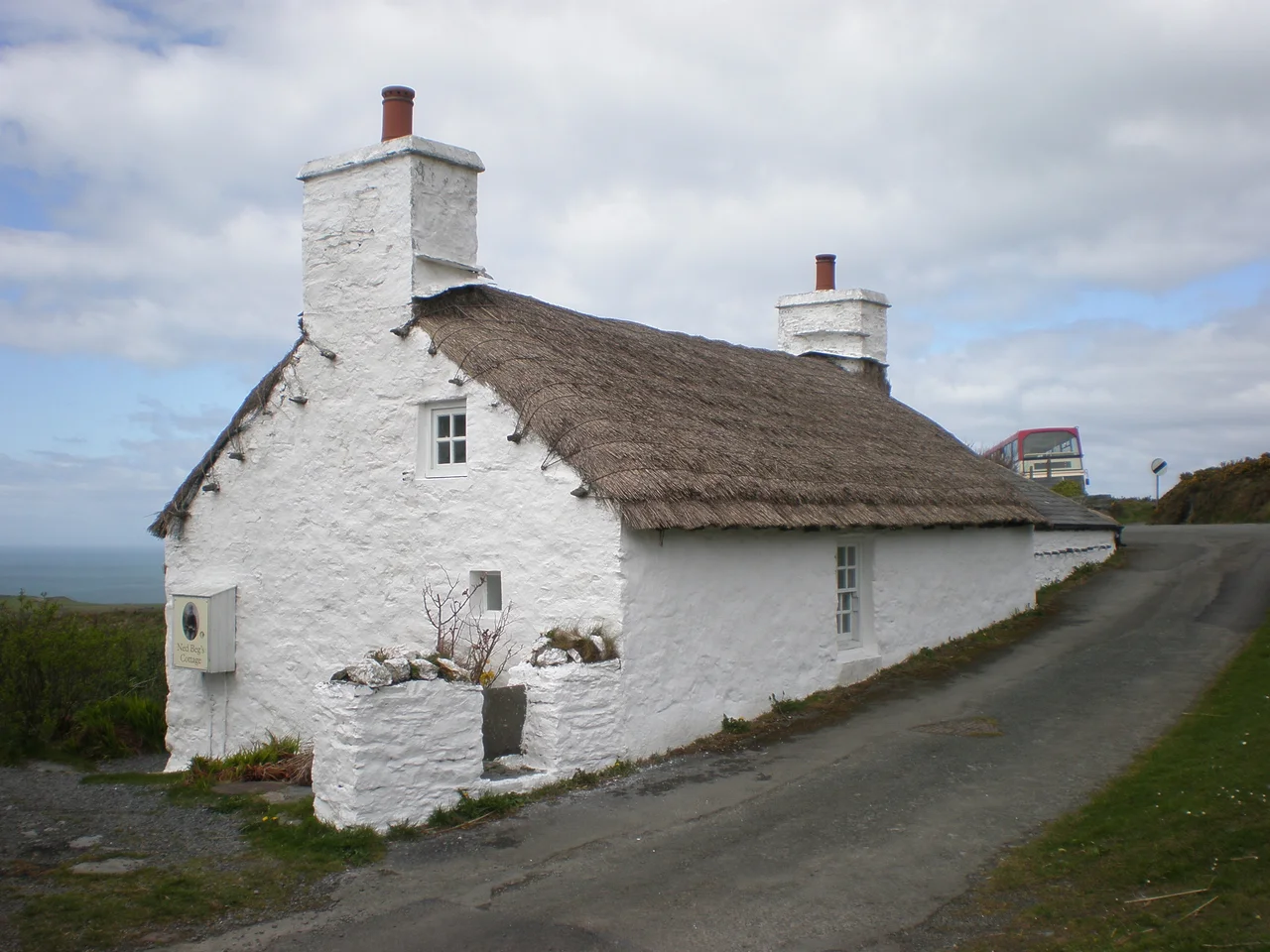
Cregneash sits on a windswept brow of land above Spanish Head and the Calf of Man, the small tidal island off the south-western tip of the Isle of Man. The houses are low, white-walled, and many still wear their original thatch — held down against the Atlantic by ropes and stones, in the old island fashion. St Peter's Church, built in 1878, stands in the middle of the village and still holds Sunday services. Loaghtan sheep — the four-horned native Manx breed, the colour of milky tea — graze the surrounding fields. Because the village is far from any town, it is one of the twenty-six Dark Sky Discovery Sites on the island; on a clear winter night the Milky Way is a roof over the cottages.
Where the Language Lingered
Manx Gaelic disappeared as a community language across most of the Isle of Man in the late nineteenth century, as English schooling and migration to the towns hollowed it out generation by generation. But in remote places it held on, and Cregneash held on longest. Many of the last native speakers recorded by linguists in the mid-twentieth century had grown up in or around the village. Ned Maddrell, born in 1877 a few miles away and raised here, is often called the last native speaker; he died in 1974. The break in transmission was not the death of the language, though, only of its unbroken line. Revived Manx has since climbed back: it is taught in schools, has its own primary school at the Bunscoill Ghaelgagh, and is once again being passed from parent to child. The community that produced Ned Maddrell would recognise the sound of it, if not always the situations it now meets.
Inside the Cottages
Officially opened in 1938 and now run by Manx National Heritage, the Cregneash Folk Village preserves the rhythm of a small Manx settlement in the nineteenth century. Visitors walk among working buildings: a joiner's workshop, a turner's shed, cottages furnished as they were. Harry Kelly's cottage in the centre of the village is the one most visitors remember — Kelly was a Manx-speaker whose home was gifted to the museum after his death in 1935, and inside its small front room you can stand more or less where he stood at his loom, where de Valera sat with Maddrell. Ned Beg's house — Ned Beg Hom Ruy, the writer Edward Faragher, who tried late in life to set down what he could of the old Manx tales — is a few doors away. In summer, museum workers in traditional dress demonstrate weaving, spinning and Manx farming routines that the people who actually lived here would have recognised.
On Screen and on the Air
The village's untouched look has made it a regular film location. Waking Ned Devine was shot here in 1998, with Cregneash standing in for the fictional Irish village of Tullymore. Stormbreaker, Treasure Island, Keeping Mum and Mindhorn have all used its lanes and cottages. The 2012 Manx short Solace in Wicca, filmed largely on Manx National Heritage sites including Cregneash, was the first production ever made entirely in Manx Gaelic — a quiet, telling milestone for a language pronounced dead within living memory. There is a recording online, held by Manx National Heritage, of Ned Maddrell reciting the Lord's Prayer in Manx. He speaks slowly. The vowels are wide. The words sit easily in his mouth, the way a language does when it has been there for a lifetime.
From the Air
Cregneash is at 54.069N, 4.769W, on the high ground above the Calf of Man and Spanish Head, at the south-western tip of the Isle of Man. Best viewed at 1,500 to 2,500 feet — the white-walled thatched cottages and St Peter's Church stand out against the green pasture, with the Calf of Man and Chicken Rock lighthouse offshore to the south-west. Approach traffic for Ronaldsway (EGNS), 7 NM east, often routes along this coast in fair weather, giving a clear look at the village, the Mull Hills behind it, and Port Erin tucked into its bay to the north.
Nearby Stories
- RAF Jurby Head 14 km away
- German submarine U-246 16 km away
- German submarine U-1051 17 km away
- Kilclief Castle 18 km away
- Ardglass 31 km away
- St Bees Lighthouse 44 km away
- Trwyn Du Lighthouse 54 km away
- Seascale Lifeboat Station 61 km away