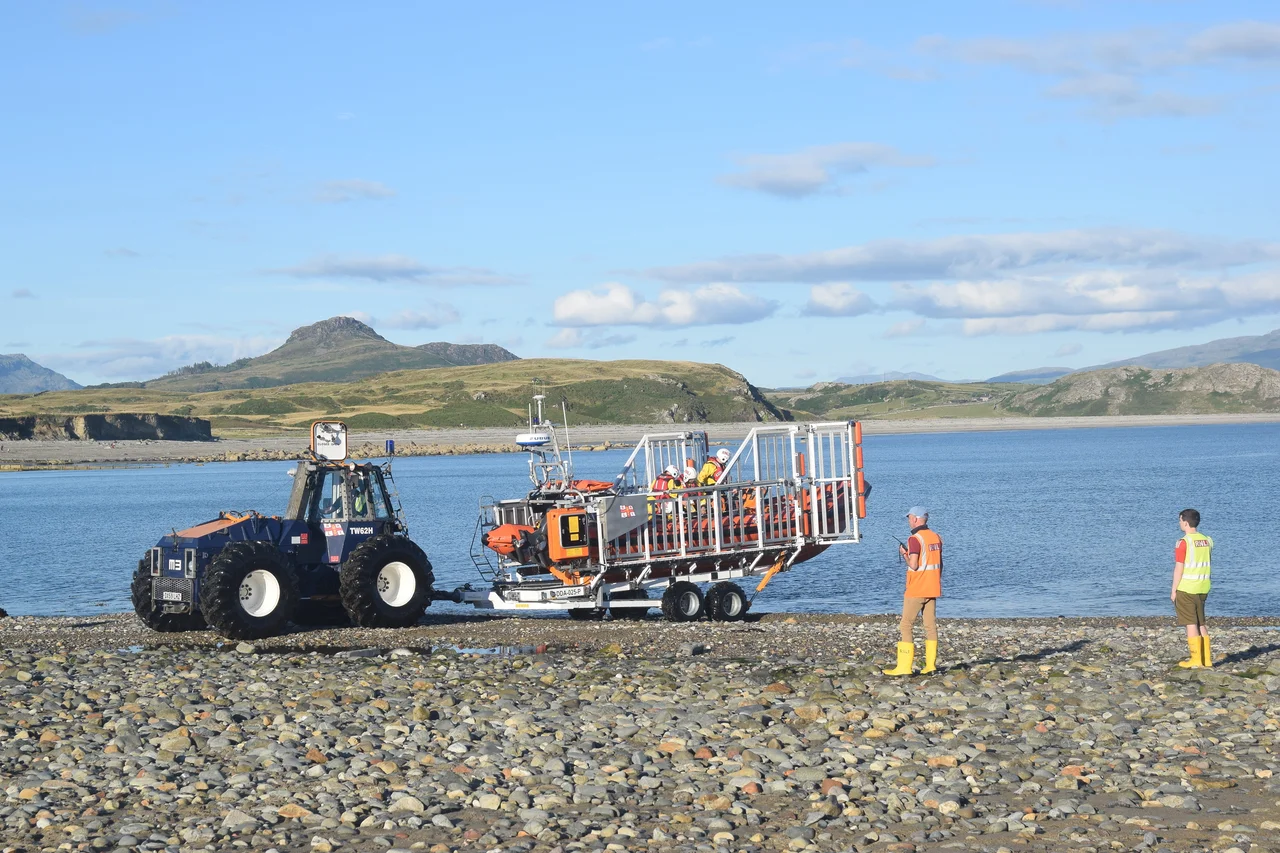

Criccieth Lifeboat Station
On 3 September 1951, a school master and four boys watched the Pwllheli lifeboat sit at its mooring while their dinghy capsized half a mile offshore. The lifeboat could not leave. Silt had closed the harbour entrance at dead low water, and by the time the tide rose the men in the dinghy - the Dorothy - were dead. Five people drowned within a few minutes' run of a rescue craft that was physically trapped. The RNLI's response was to reopen Criccieth, a small carriage-launched boat that could be pushed straight off the beach without a harbour at all. The station had been closed for twenty-two years. The five deaths brought it back.
Portmadoc, 1853
The station had a strange beginning. It opened in 1853 as Portmadoc Lifeboat Station, set up by the Shipwrecked Fishermen and Mariners' Royal Benevolent Society - a separate charity that handed over its lifeboats to the RNLI a year later. The original boathouse stood on Lôn Felin in Criccieth, not in Portmadoc at all, and the name discrepancy lasted nearly forty years before the station was rebranded Criccieth in 1892. The Victorian boathouse, rebuilt several times across the next century-and-a-half, is still in use - most recently refurbished in 2018. Built to last, it has launched lifeboats for the same stretch of Cardigan Bay coast through five reigns and two world wars.
Pulling and Sailing
The early Criccieth boats were 'pulling and sailing' - rowed when calm, sailed when wind allowed - and they took a brutal beating. The Phillip Woolley was wrecked on service in October 1910. The Reserve Fleet replacement was damaged on another call within a month, and a second reserve had to be sent. A new boat, the James and Caroline, finally arrived in September 1911 and stayed at the station for two decades. The names follow a pattern familiar to any RNLI station: each boat carried the name of the donor who paid for it, and each donor's gift bought another decade or two of rescues for a coastline that swallowed working boats with depressing regularity.
Closed, 1931
By 1931 the RNLI's strategic logic argued that motor lifeboats based at Pwllheli could cover the whole bay including Criccieth. The station closed, the boathouse was repurposed, and for two decades there was no dedicated rescue craft at Criccieth. The 1951 Dorothy disaster proved the logic catastrophically wrong. Modern boats need deeper water than rowing boats. The silting at Pwllheli, which had not been a problem in 1853, was a fatal problem in 1951. The RNLI rethought everything. A smaller carriage-launched motor lifeboat was put back into the 1891 Criccieth boathouse in 1953, and a separate boat at Pwllheli took over the deep-water work that could only be done at higher tides.
Inshore Lifeboats
In the 1960s the RNLI began rolling out a new kind of craft: fast inshore lifeboats - rigid-hulled inflatables built for the close-in work where most coastal casualties actually happened. Criccieth got an evaluation boat in 1967 and the experiment was successful enough that the old all-weather lifeboat was withdrawn permanently the next year. ILBs have served Criccieth ever since, and the station is now an inshore-only operation. The change reflects the broader pattern of British coastal rescue: more leisure casualties, fewer sinking ships, and a need for boats that can be on the water within five minutes of the pager going off.
Vellum for John Owen
On 1 September 1977 the Criccieth ILB went out into rough seas and a strong wind to a yacht aground on Portmadoc Bar. Helmsman John Owen and crew Robert Williams and Kenneth Roberts brought all four people off the yacht alive. The RNLI's response was to present each of them with 'The Institution's Thanks Inscribed on Vellum' - a citation that recognises a high standard of seamanship in dangerous conditions. The vellum is one step below a formal medal. Owen's name joins a long list at Criccieth - generations of fishermen and lifeboatmen who have launched the same boats from the same beach because, since 1853, the choice has always been to go out or to watch.
From the Air
52.92°N, 4.23°W on Lôn Felin in Criccieth, on the south coast of the Llŷn Peninsula. Best viewed at 1,500-2,500 ft alongside the dark rock of Criccieth Castle to the east. The boathouse sits on the shoreline; the station serves Cardigan Bay from Pwllheli to Porthmadog. EGCK (Caernarfon) is the nearest active airport, 12 nm north-west.
Nearby Stories
- GeoMôn 1.9 km away
- Battle of the Conwy 3.2 km away
- Irish Sea Bridge 5.2 km away
- Ysbyty Ifan 10 km away
- Machynlleth 16 km away
- Barmouth Lifeboat Station 23 km away
- Irish Sea 27 km away
- HMS Tyler 32 km away