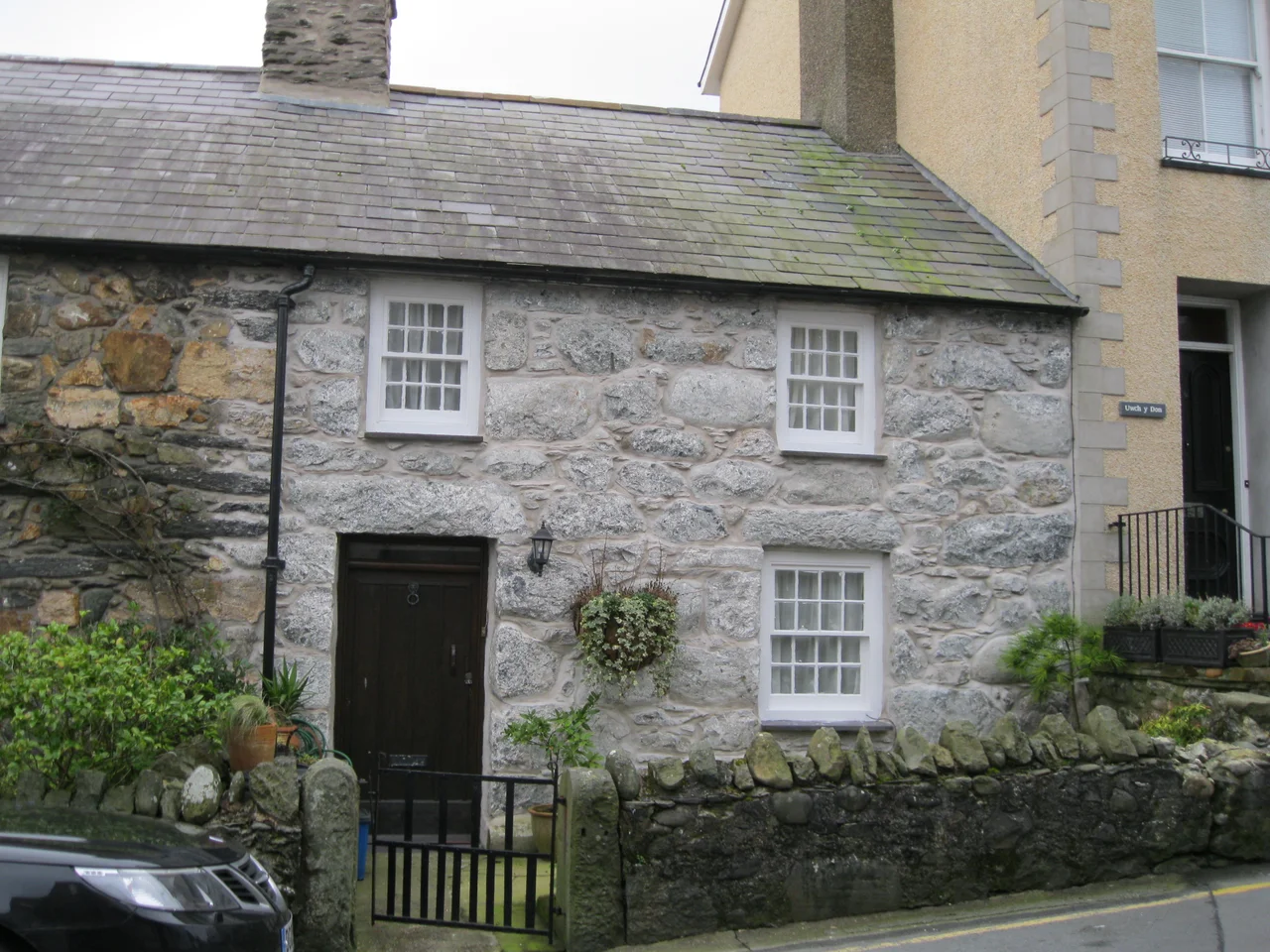

Criccieth
Three British prime ministers played the Criccieth golf course on the same day. Bonar Law, David Lloyd George, and Winston Churchill stood on the same nine-hole course on Caerdyni Hill, with the green of the penultimate hole seventy-five feet above its tee and the final hole only a hundred yards long with the green a hundred feet below it. It is the kind of small absurd detail that pins down everything about Criccieth - a Welsh seaside town of fewer than two thousand people that produced one of the twentieth century's most consequential statesmen and that, for one strange afternoon, gathered three of his peers on the same coastal hill.
The Two Castles
The headland that defines Criccieth carries the ruins of one of the most extraordinary castles in Wales - a fortress that began as a Welsh princely stronghold of the early thirteenth century, was captured by Edward I in 1283 during his conquest of Gwynedd, then burnt by Owain Glyndwr's rising in 1404 and never rebuilt. What survives is a twin gate-tower and inner walls perched on a black rock that breaks straight up out of Cardigan Bay. The dark stone gives the headland its Welsh name, Craig-y-Castell. Turner painted it in the 1830s, slightly inaccurately - he sketched it from life but in the finished oil reversed the building, turning it into a mirror image of itself. The ruins still dominate every approach to the town.
Three Prime Ministers, One Golf Course
The Criccieth Golf Club opened in 1906, a nine-hole course on the upland behind the town with views all the way to Snowdonia. By the 1920s it had become one of Lloyd George's regular haunts - he had grown up two miles away in Llanystumdwy, returned to Criccieth as a young solicitor, and represented Caernarfon Boroughs as MP for fifty-five years. Bonar Law, who succeeded him as Prime Minister in 1922, played the course as Lloyd George's guest. Churchill, who admired Lloyd George politically though he eventually replaced him as the senior Liberal-then-Conservative voice in British politics, played here too. The story that all three were on the course on the same day is one of those small historical curiosities that captures how concentrated British political life of that era was around a handful of country houses and country clubs. The course closed on New Year's Eve 2017.
The Lloyd George Constellation
Lloyd George was born in Manchester in 1863 but his family moved to Llanystumdwy when he was an infant, and he spent his school years walking the lanes around Criccieth. He married Margaret Owen of Mynydd Ednyfed, a farm overlooking the town, in 1888. Their daughter Megan, born in 1902, became the first female MP in Wales. Their nephew William George, born in 1912, became a poet of some note. The Memorial Hall on Y Maes was completed in 1925 to a design by Morris Roberts of Porthmadog that fuses art deco and arts and crafts, with the foundation stone laid by Lloyd George himself three years earlier. The whole town quietly orbits the Lloyd George constellation, even now, eighty years after his death.
The Welsh Town
Criccieth is one of the strongest Welsh-language towns on the coast, with 64% of residents speaking Welsh at the 2011 census and 94% of pupils at Ysgol Treferthyr, the local primary, fluent in it. The National Eisteddfod was held here in 1975 - a marker of cultural prestige in modern Welsh life - and the new housing estate of Gorseddfa now stands where the Gorsedd stones were raised that year. The Memorial Hall still hosts the annual Criccieth Festival. Sunday evening hymn singing on the small green at Abermarchnad - the site of the medieval market - has continued for more than a century. JB Priestley sang here. So did Megan Lloyd George. The Welsh tradition of communal hymn singing, cymanfa ganu, is not a museum piece in Criccieth.
Cardigan Bay Holidays
What pulls visitors now is the same combination that pulled the Victorian holidaymakers: a south-facing beach safe enough for children, fish enough in the bay to keep sea anglers happy, ice cream from the original Cadwalader's parlour that opened on Castle Street in 1927, the castle ruins for the hour after lunch. Trains run on the Cambrian Coast Line through Pwllheli to Machynlleth, and through onward to Birmingham and Wolverhampton. The TrawsCymru T2 bus stops in Y Maes. Robert Graves once wrote a comic poem about Criccieth - 'Welsh Incident', about mysterious creatures that came out of the sea caves one Tuesday afternoon - and the town is mostly content to be the kind of place where things like that almost seem plausible.
From the Air
52.92°N, 4.24°W on the south coast of the Llŷn Peninsula, with the dark rock of Criccieth Castle marking the headland. Best viewed at 1,500-2,500 ft to take in the twin beaches either side of the castle, the curve of Cardigan Bay east to Porthmadog, and the Snowdonia massif behind. EGCK (Caernarfon) is 14 nm north-west.
Nearby Stories
- GeoMôn 1.9 km away
- Battle of the Conwy 3.2 km away
- Irish Sea Bridge 5.2 km away
- Ysbyty Ifan 10 km away
- Machynlleth 16 km away
- Barmouth Lifeboat Station 23 km away
- Irish Sea 27 km away
- HMS Tyler 32 km away