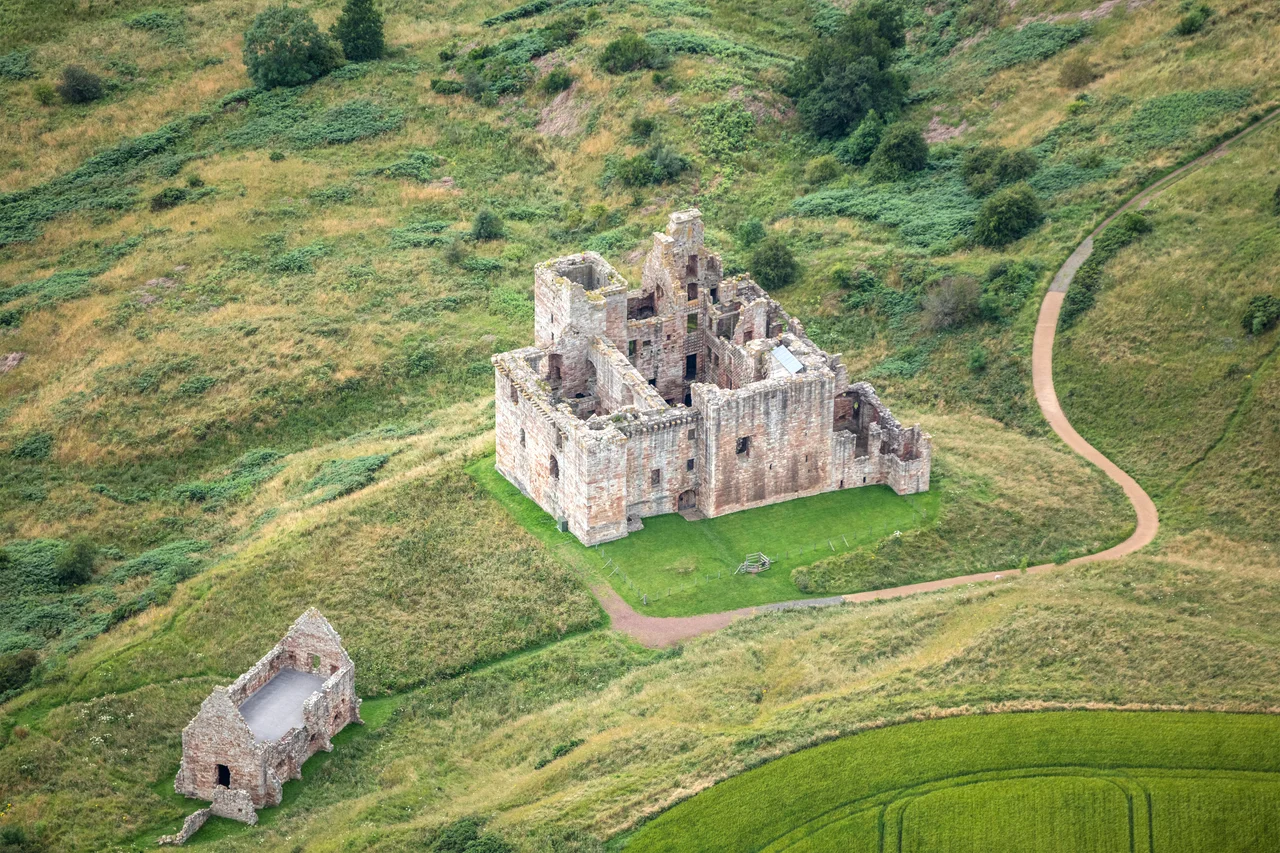

Crichton Castle
On the inner courtyard wall of Crichton Castle, the stones form diamonds. Eight rows of them, each block faceted like a cut gem, throwing pyramids of shadow across the courtyard whenever the sun hits the wall. There is nothing else like it in Scotland. The pattern was copied from the Palazzo dei Diamanti in Ferrara, built in the 1490s, and the man who copied it was Francis Stewart, 5th Earl of Bothwell - a Scottish noble who had travelled in Italy, married a Douglas, and decided to bring a piece of Italian Renaissance architecture back to a fortress on the head of the River Tyne in Midlothian. Ten years later, Bothwell was accused of witchcraft, forfeited his lands, and fled to Naples to die. The diamond wall has outlived him by more than four centuries.
The Tower and the Black Dinner
In the late 14th century John de Crichton built a tower house here as his family seat - a stone keep on a rise above the head of the River Tyne, two miles south of the modern village of Pathhead. His son William served as Lord Chancellor of Scotland and was made Lord Crichton around 1443. Three years earlier, in 1440, William had been one of the organisers of the Black Dinner: the young William Douglas, 6th Earl of Douglas, was invited as a guest to Edinburgh Castle and murdered with his brother in front of the 10-year-old King James II. The killing broke the power of the House of Douglas. As a reward, Crichton obtained the Douglas property of Bothwell Castle in Lanarkshire for himself. John of Corstorphine, chief of Clan Forrester and a Douglas adherent, stormed Crichton in 1445 in retaliation and slighted - partly destroyed - the castle. William rebuilt it on a grander scale, adding a second tower to form an L-plan, and also built the nearby Crichton collegiate church.
The Hepburns Take It
In 1483 the 3rd Lord Crichton lost the castle when his patron Alexander Stewart, Duke of Albany, was sentenced for treason. Five years later King James IV granted it to Patrick Hepburn, Lord Hailes - the man who would soon be made the 1st Earl of Bothwell. The Hepburns of Bothwell were one of the most powerful families in Scotland, and Crichton became their seat. Patrick's son Adam, the 2nd Earl, died at the Battle of Flodden in 1513 alongside the king and most of the Scottish nobility. The castle passed to Adam's widow, Lady Agnes Stewart, who promptly married Alexander Home, 3rd Lord Home, in 1514. Their son Patrick Hepburn, 3rd Earl of Bothwell, inherited Crichton in time to participate in the destabilisation of Scotland during the minority of Mary, Queen of Scots - intriguing with the English, then making peace with the Regent Mary of Guise.
Mary's Wedding Party and Bothwell's Fall
On 4 January 1562, Crichton hosted the wedding of Patrick Hepburn's daughter Jean to John Stewart, Prior of Coldingham and illegitimate son of King James V. The bride's new sister-in-law - John Stewart's half-sister Mary, Queen of Scots herself - attended the wedding and spent several nights at the castle. Five years later, in 1567, James Hepburn, 4th Earl of Bothwell - Jean's brother and Mary's bridegroom-to-be - was implicated in the February murder of Mary's husband Lord Darnley. In May, Mary married Bothwell. By December all Bothwell's titles and estates were forfeited. Crichton passed to Francis Stewart, the bastard grandson of James V through John Stewart and Jean Hepburn's marriage. Francis was created Earl of Bothwell in 1581. He travelled extensively in Europe, and in the 1580s he came home with a head full of Renaissance ideas.
The Diamond Wall
Francis Stewart designed the Italianate north range himself. The courtyard façade was modelled on the Palazzo dei Diamanti, the Diamond Palace built in Ferrara in the 1490s - one of the most distinctive buildings of Italian Renaissance architecture, faced with thousands of pointed diamond-cut stones. Francis brought the technique back to Midlothian and applied it to a small section of Crichton's courtyard. Inside the range he installed innovations: Scotland's first 'scale-and-platt' staircase, a modern stair with broad landings between flights, and a proper drawing room - rooms specifically for sitting and talking, not just for sleeping or eating. His initials and his wife Margaret Douglas's appear on the walls, together with a carved anchor representing his position as Lord High Admiral of Scotland. King James VI visited him here on 17 March 1587 to plan an embassy to Denmark.
Witchcraft, Naples, Ruin
Francis Stewart lost the king's favour in the early 1590s. He was accused of witchcraft - the North Berwick trials of 1590-92 had created an atmosphere in which any nobleman the king distrusted could be linked to occult conspiracy - and forfeited his estates in 1592. He fled Scotland and eventually reached Naples, where he died. The castle passed to his son Francis Stewart, who tried to recover the family fortunes but failed under his father's debts and sold Crichton to the Hepburns of Humbie. The castle slowly decayed. J. M. W. Turner painted it in the early 19th century as a romantic ruin. Walter Scott included it in his 1808 poem Marmion. In 1956 it was given into state care by Major Henry Callander of Preston Hall, and has been scheduled as a national monument since 1921. It featured in the 1995 film Rob Roy and the 2011 film The Wicker Tree. The diamond wall is still there, still standing, still throwing its pyramid shadows across the courtyard, still the only one of its kind in Scotland.
From the Air
Located at 55.8396 N, 2.9914 W, near Crichton village in Midlothian, 2 miles south of Pathhead and the same distance east of Gorebridge. Sits at the head of the River Tyne (the Scottish one, not the English). Visible reference points: the castle ruin is prominent on rising ground; nearby is the Crichton collegiate church built by William Crichton. Borthwick Castle is about 1 mile to the southwest - the two castles together make a striking pair from the air. Nearest airport: Edinburgh (EGPH), about 11 nautical miles northwest. Recommended viewing altitude 2,000-3,500 ft AGL for clear views of the ruins, courtyard, and stable block.
Nearby Stories
- Burngrange Mining Disaster 5.9 km away
- Battle of Philiphaugh 6.5 km away
- Ravenscraig Castle 11 km away
- Crawford Castle 12 km away
- Battle of Nesbit Moor (1402) 12 km away
- Battle of Dollar 14 km away
- College Valley 18 km away
- HMS Pathfinder (1904) 19 km away