
Cromwell's Castle
When Admiral Robert Blake's Parliamentary forces captured Tresco in June 1651, the Royalist garrison of King Charles's Castle blew up their own fort and fled. The stone they left behind did not stay where they dropped it. The following year Blake's masons hauled it down the hillside and built a new fort on the rocks at the water's edge - a three-storey round tower with walls almost thirteen feet thick. They called it Cromwell's Castle, after the Parliamentary leader, and unlike the failed castle uphill its guns could actually fire at ships entering New Grimsby harbour. English Heritage now describes it as 'one of only a few stone fortifications that survive from the Interregnum' - the brief eleven years between 1649 and 1660 when England was a republic. The interior wooden floors are gone, but the spiral staircase still climbs to a vaulted stone roof, and the six gun-ports on the parapet still look out across the channel to Bryher.
The Stone from King Charles's Castle
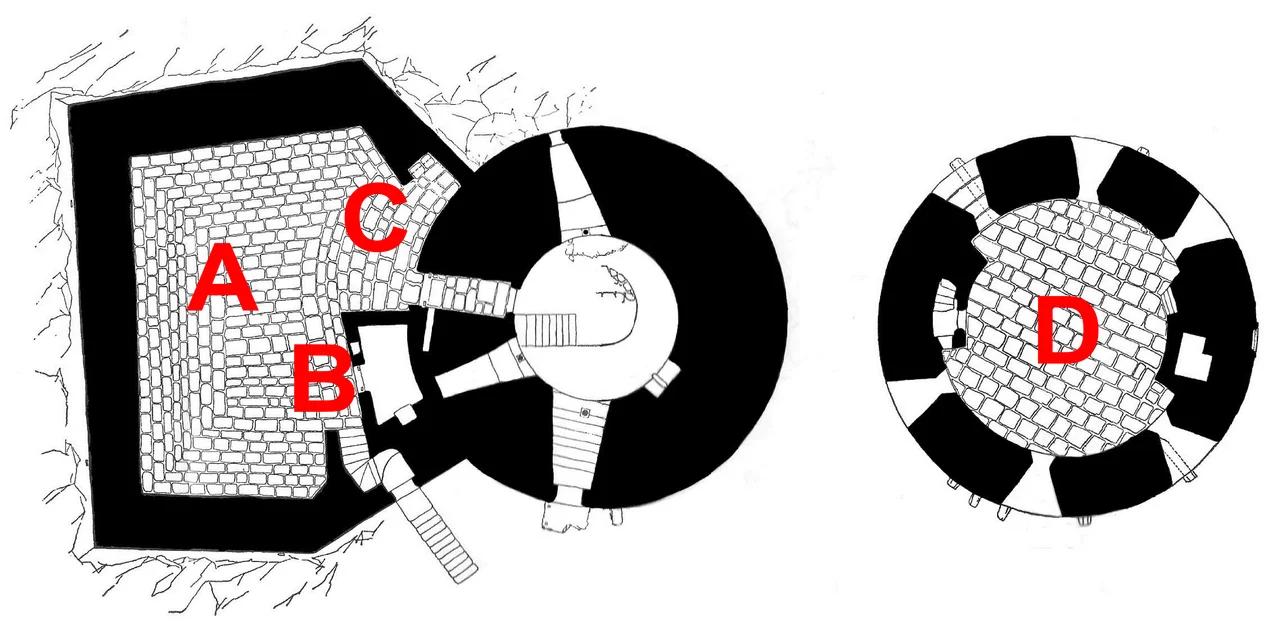
The site already had a small sixteenth-century blockhouse on it - a low fortification at the water's edge beneath the failed King Charles's Castle uphill. Between 1651 and 1652 Sir Robert Blake had a three-storey circular tower built on top of this blockhouse, 13.45 metres across and 15.1 metres high, with walls nearly thirteen feet thick made of massive rubble. A later eighteenth-century survey would describe the tower as 'a Huge Mass of Masonry,' which is what you build when you have a lot of stone, no shortage of labour, and an Atlantic gale rattling your scaffolding. Some of the stone came directly from the ruins of King Charles's Castle - the Royalists' own building material recycled into Parliament's reply. Six gun-ports with broad external splays on the roof allowed cannon to cover the channel between Bryher and Tresco, and there may have been an additional gun platform just below the tower.
The Dutch Threat
Why build a new fort at all? The Parliamentary forces who took the Scillies in 1651 were not primarily worried about a Royalist counter-attack. They were worried about the Dutch. England and the Netherlands were drifting toward what would become the First Anglo-Dutch War of 1652-1654, and Royalist privateers based on Tresco had been preying on Dutch shipping in the western approaches for years. The Dutch had threatened to intervene directly to suppress the privateers, and Parliament feared that any Dutch foothold in the Scillies could become a permanent foreign base just thirty miles off Cornwall. Cromwell's Castle was built specifically to guard the deep-water entrance to New Grimsby harbour - a channel that allowed vessels to slip through to the inner anchorages of the archipelago. With the new tower commanding that approach at sea level, no fleet could simply sail past it the way Blake himself had sailed past King Charles's Castle from below.
Abraham Tovey's Gun Platform
After the Restoration of Charles II in 1660 the castle was surveyed and patched up. By the 1730s it had ten artillery positions on paper but not nearly enough working guns to fill them. Then in 1739 the War of Jenkins' Ear broke out between Britain and Spain - a conflict named after an English captain who claimed Spanish coastguards had sliced off his ear and pickled it. The Master Gunner at the Garrison on St Mary's, Abraham Tovey, was sent over to upgrade the defences. Tovey built a large gun platform for six guns on the southwest side of the tower, possibly on top of any pre-existing sixteenth-century platform. A parapet protected the gunners, a new entrance was cut into the main tower, and other adjustments followed. When the antiquary William Borlase visited in 1752, the platform carried 9-pounder cannon and the tower roof carried 4-pounders - but the place was already unmanned and decaying.
The Surviving Interior
By 1922 the lease had passed to Arthur Dorrien-Smith, the Tresco landowner, who handed several Tresco properties - including the castle - into the guardianship of the Ministry of Works. English Heritage took over in due course, and today Cromwell's Castle is open to visitors. The interior wooden floors are long gone, but the spiral staircase still climbs through the thickness of the wall to the vaulted stone roof, and from the parapet you can still look out through the gun-ports across the channel to Bryher. The castle is a Grade II* listed building - the second-highest level of protection English law offers - and protected as a scheduled monument. It is also, importantly, one of the relatively few surviving structures built during the eleven years when England was a republic. The Restoration restored Charles II but left this round granite drum standing as a quiet reminder of the other path the country might have taken.
From the Air
Cromwell's Castle stands at 49.9622 N, 6.34947 W, on the rocky shore of Tresco at the entrance to New Grimsby harbour, immediately below the ruined King Charles's Castle on the cliff above. From the air the round granite tower is unmistakable - a stubby cylinder at the waterline with the larger ruins of King Charles's Castle behind and uphill. The two castles together make one of the most distinctive aerial landmarks in the whole Scilly archipelago. Nearest airport is St Mary's (EGHE) about 3 nautical miles south. Tresco Heliport sometimes operates seasonal services. New Grimsby anchorage to the east is heavily used by yachts and inter-island launches. Watch for boat traffic in the Tresco Channel between Tresco and Bryher. Best viewing altitude 1,500 to 2,500 ft AGL for a clear read of both castles.
Nearby Stories
- SS Vigrid 6.2 km away
- SS Georgia (1890) 32 km away
- SS Irma (1905) 35 km away
- 1979 Fastnet Race 45 km away
- Great Wheal Charlotte 53 km away
- SM U-27 55 km away
- Wolfpack Prien 151 km away
- Tower of Hercules 715 km away