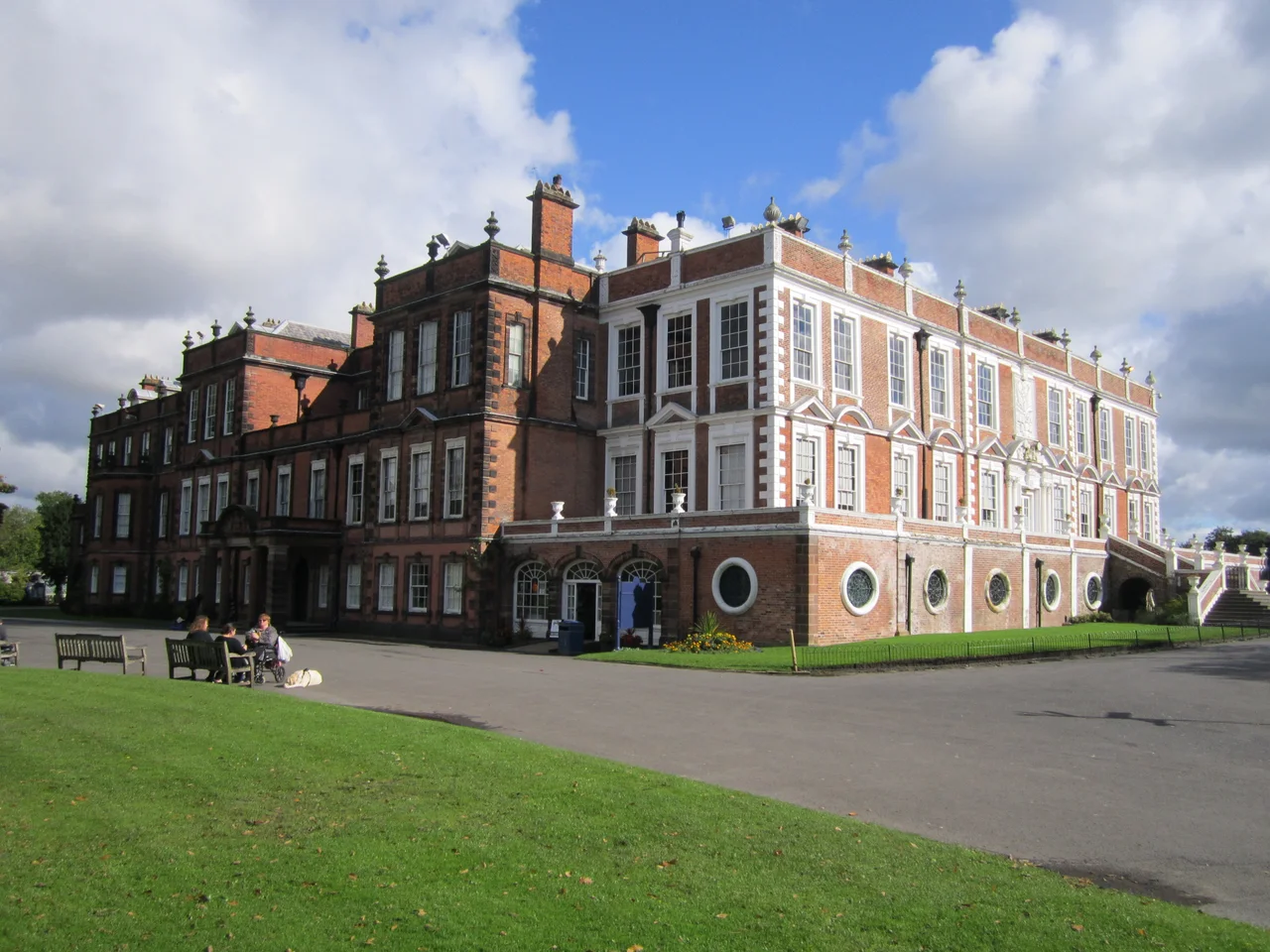

Croxteth Hall
When the seventh Earl of Sefton died in 1972, his lawyers launched a worldwide search for an heir. They found none. The Molyneux line - which had held Croxteth Hall since the sixteenth century, entertained Queen Victoria here in 1851, and ridden hounds through their private chase for generations - simply ran out. The estate passed instead to Liverpool City Council. Today, schoolchildren run the same lawns where 700 members of the local gentry once gathered to greet a royal carriage, and the kennels designed for the fourth Earl's hounds are tended by a volunteer group founded in 2017.
A House That Outlasted Its Family
Croxteth Hall sits in the West Derby suburb of Liverpool, surrounded by what remains of a 500-acre hunting chase that once stretched far beyond the present park's boundaries. The Molyneux family moved in during the sixteenth century and never left, accumulating four-storey wings, Queen Anne brickwork, a chapel, and seventeen separate Grade II and Grade II* listed buildings around the main house. Foxy - Josephine, the American-born Countess of Sefton, nicknamed for her auburn hair - was the last family member to live here, a friend of the Duchess of Windsor who held on at the hall until her death in 1980. After her, the council took over a house that was already wearing its age, and has been managing the inheritance ever since.
Victoria's Wet October
On 9 October 1851, Queen Victoria, Prince Albert, and their children arrived at Croxteth Hall to spend the night before a state visit to Liverpool. The day began well: 700 of the local gentry assembled on the lawns in the autumn sunshine. By morning, torrential rain had set in, and the royal party processed into the city under the kind of weather Liverpool specialises in. The visit was widely reported and remains one of the better-documented chapters in the hall's social calendar - the moment when a private country estate caught a few hours of the national gaze before vanishing back into its own routines of hunting, gardening, and the long management of land.
The Liverpool Botanics
Inside the Victorian walled garden lives the last of the Liverpool Botanics - one of Britain's oldest horticultural collections, founded in 1802 by William Roscoe, the Liverpool banker, abolitionist, and amateur botanist. Liverpool was once a world centre for orchids, and the collection here is composed mainly of wild-collected species rather than the garden hybrids favoured elsewhere. Three National Collections sit under the glass: Dracaena (the dragon trees), Codiaeum (croton), and Solenostemon (coleus, the pelargonium's flamboyant cousin), alongside a deep collection of bromeliads. It is a botanic afterlife: a city's vanished horticultural empire preserved in a single walled garden behind a stately home it no longer owns.
The Kennels and the Wood
The kennels along Croxteth Hall Lane were built in the 1870s for the fourth Earl of Sefton by the Chester architect John Douglas - red brick, a patterned roof of blue and green slates, a tall chimney stack that still rises above the trees. Hounds no longer live here; the Croxteth Park Volunteer Group, founded in 2017, maintains them instead. Beyond the gardens lies Mull Wood, part of the 85-hectare Croxteth Local Nature Reserve, doubled in size in partnership with the Lancashire Wildlife Trust. A wildflower meadow has been sown near the Old Kennels. Each Saturday at 9 a.m. the park hosts a free 5km parkrun, starting and finishing at the hall - the same gravelled forecourt where royal carriages once drew up.
Flight Context
Croxteth Hall stands at 53.442 degrees north, 2.891 degrees west, in the northeast quadrant of Liverpool, roughly four miles from the city centre. Liverpool John Lennon Airport (EGGP) is approximately 7 nautical miles south-southwest; the hall's wooded park is a clear green island in the otherwise dense suburban grid of West Derby. Look for the rectangular block of Croxteth Park immediately east of the M57 motorway, with Knowsley Safari Park's larger estate further east. Visible from 2,000 feet AGL upward in good visibility.
From the Air
Located at 53.442N, 2.891W in West Derby, northeast Liverpool. Nearest major airport: Liverpool John Lennon (EGGP), approximately 7nm south-southwest. The park forms a distinct rectangular wooded island in the suburban grid, east of the M57. Best identified from 2,000-3,000 feet AGL by the contrast between dense terracing and the wooded estate.
Nearby Stories
- Blackpool Pleasure Beach 4.4 km away
- Whalley Abbey 4.8 km away
- Worsley 5.4 km away
- Second Battle of Middlewich 7.7 km away
- Chester Zoo 7.9 km away
- Llanrwst 23 km away
- Abergele Rail Disaster 27 km away
- Sea Lion Rocks railway station 73 km away