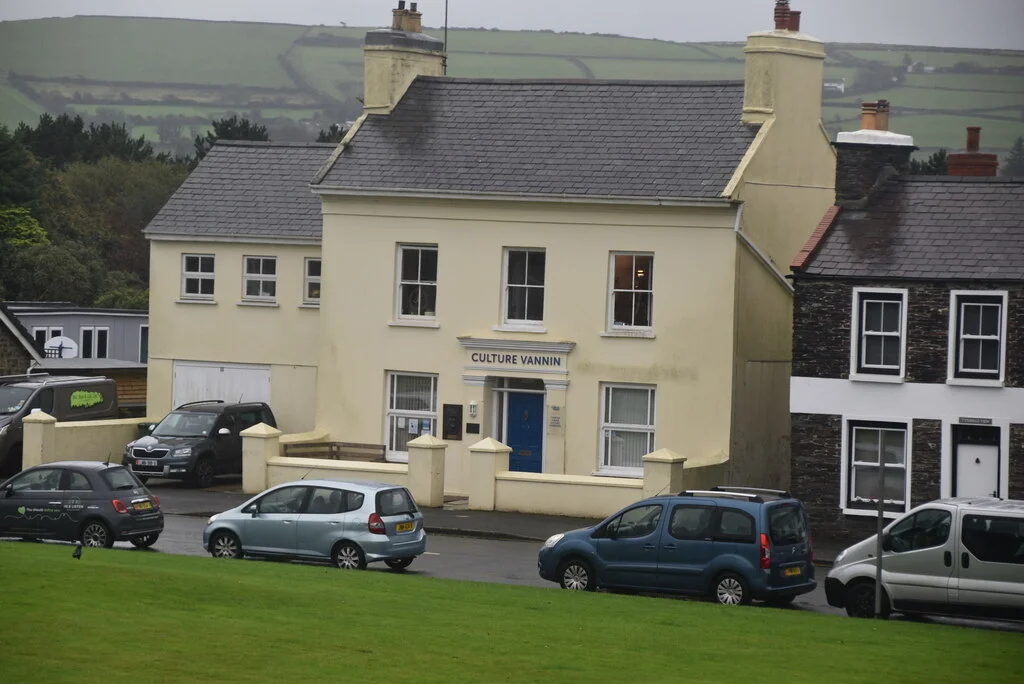

Culture Vannin
Across the road from Tynwald Hill - the ancient open-air parliament where Manx laws have been proclaimed for over a millennium - and next door to Bunscoill Ghaelgagh, the Manx-language primary school, sits a house called Fairfield. From the outside, it looks like any other handsome stone residence in St John's. Inside is the operational heart of Culture Vannin, the foundation tasked, in its own succinct motto, with taking Manx culture forward. The placement is not accidental. Tynwald Hill is the past - the symbolic centre of Manx self-government since the Norse era. The primary school is the future - the children writing letters to UNESCO in a language declared extinct. Culture Vannin sits between them and tries, with a staff of four, to make sure one becomes the other.
From Heritage Foundation to Culture Vannin
The organisation was established in 1982 by the Isle of Man Government as the Manx Heritage Foundation. The name held it back. As the chair explained at the time of the 2014 rebrand, the former title held connotations more towards the cultural history of the island - past tense, heritage as something inherited rather than something made. The Foundation's actual work had grown progressively more present-tense over three decades: supporting living musicians, funding contemporary publishing, commissioning new oral histories, helping schools build Manx-language curriculum, sponsoring festivals where the dance and the music were practised, not just remembered. So in February 2014 the body rebranded as Culture Vannin - 'Vannin' being the Manx genitive of 'Mannin,' the island's Manx name. The new name carries the present and the future. The work is the same, but the framing finally fits what the work has become.
A Small Office, Wide Mandate
The Foundation's stated mandate is unusually broad. Culture Vannin defines Manx culture as crafts, language, history, natural history, music, literature, folk-lore, art, folk dance, architecture, archaeology, industrial development, law and ecology. The point of the list is the breadth: this is not a music foundation, or a language foundation, or a heritage trust. It is all of them at once. The full-time staff is just four people - a director, Dr Breesha Maddrell; a Manx Language Development Officer, Ruth Keggin Gell, who is also one of the island's best-known Manx singers in her own right; a Manx Music Development Officer, Dr Chloe Woolley; and a small administrative team. Above them sits a management board: two MHKs appointed by Tynwald, three members of the public nominated by the Council of Ministers and approved by Tynwald, and representatives from the Isle of Man Arts Council and Manx National Heritage. The structure is deliberately bipartisan and deliberately small, designed to move money and expertise without bureaucracy.
Reih Bleeaney Vanannan
Every year since 1987, the Foundation awards the Reih Bleeaney Vanannan - 'Manannan's Choice of the Year,' named for Manannan mac Lir, the sea-god of Manx and Irish mythology who is said to wrap the island in mist when invaders approach. The prize honours an outstanding contribution to Manx culture. The list of past winners reads like an index of Manx cultural life - language teachers, musicians, dance leaders, broadcasters, the people who quietly hold up communities of practice for decades and rarely get any other recognition. In 2006 the award went to Bunscoill Ghaelgagh itself, the primary school next door. The juxtaposition is poetic and accurate: the foundation handing its highest honour to the school whose children would, three years later, embarrass UNESCO into reclassifying the language they were learning.
Tynwald Hill, Next Door
Fairfield House opened to the public as the new Culture Vannin office on Tynwald Day 2016 - the annual ceremony, held every 5 July at Tynwald Hill across the road, where new laws are read aloud in both English and Manx and the entire institutional history of Manx self-government is renewed for another year. The Foundation's other festivals - Shennaghys Jiu, Yn Chruinnaght, Cooish and Bree - dot the year with music, language and dance gatherings. Yn Chruinnaght is the older inter-Celtic festival, drawing performers from Scotland, Ireland, Wales, Cornwall and Brittany. Cooish is the language-immersion week. Bree is the youth music programme. Underneath the festivals and the awards and the publishing grants is a quietly serious project: keeping a small island's culture vital in a world that finds it economically rational to homogenise. For the moment, on the Isle of Man, that project is working.
From the Air
Culture Vannin's offices sit at 54.203 deg N, 4.642 deg W in St John's, in the centre of the Isle of Man. The village is set inland between the western coast and the central uplands. Ronaldsway (EGNS) is the nearest airport, roughly 12 nm south-east. Visual landmarks include the conical white-and-grass mound of Tynwald Hill at the centre of the village - directly across the road from the Foundation - and the bulk of Snaefell rising to the north-east at 2,037 ft. Bunscoill Ghaelgagh, the Manx-language primary school, sits next door.
Nearby Stories
- Ballywalter 14 km away
- Pasages (steam trawler) 15 km away
- SS Georgetown Victory 19 km away
- Celtic Array 31 km away
- Raeberry Castle 34 km away
- German submarine U-1051 36 km away
- St Bees Lifeboat Station 49 km away
- PS Rothsay Castle 73 km away