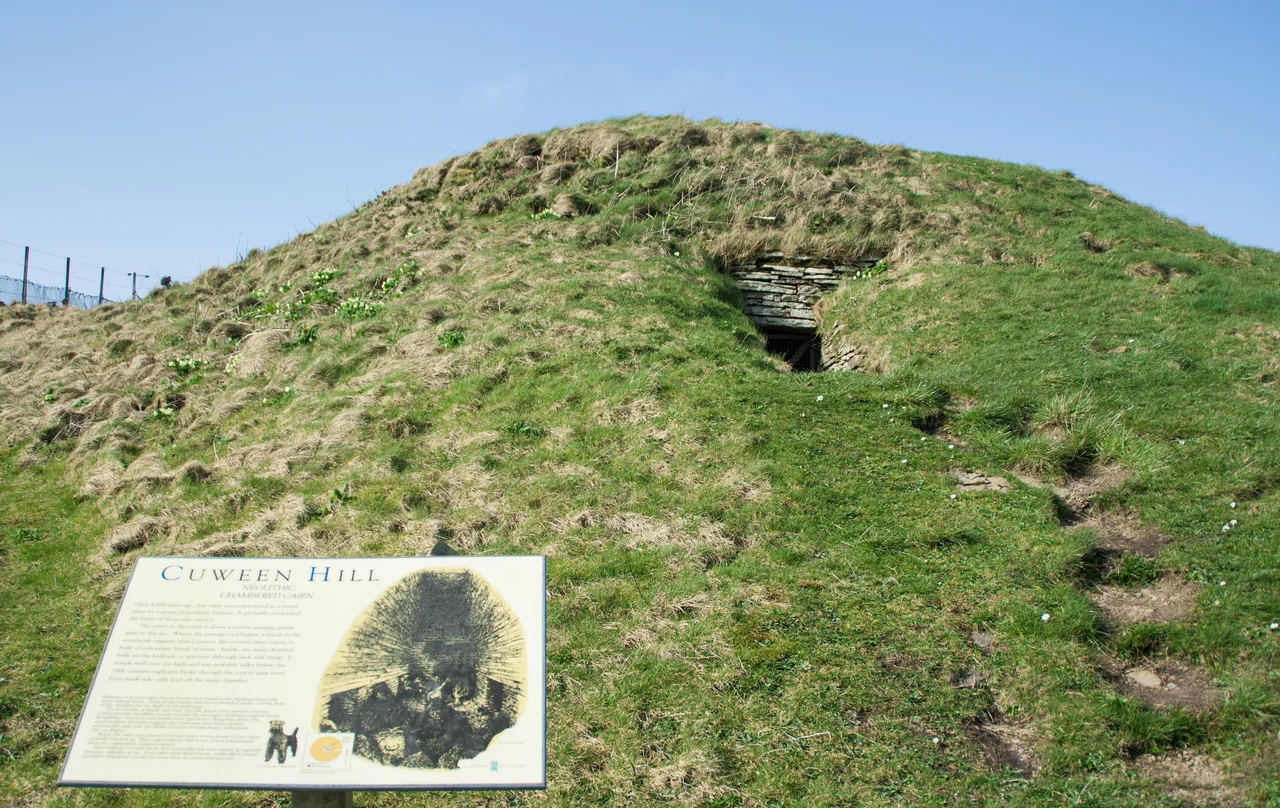

Cuween Hill Chambered Cairn
When the Edinburgh forensic artist Amy Thornton finished reconstructing the head of a dog that had died around 3000 BC, the result was not what anyone expected. The animal looked at her from her workbench with the size and bearing of a large collie and the pricked ears and pale fur of a European grey wolf. Its skull had been buried with humans in a stone chamber dug into a hill above Orkney's main island. There were twenty-three other dog skulls in the same tomb. Nobody knows quite what to make of that.
A Tomb Like Maeshowe, Only Smaller
Cuween Hill sits six miles west of Kirkwall, a low green swell rising from farmland north of the road to Finstown. Step off the track and the entrance to the cairn appears as a slot in the turf, no taller than a doorway laid sideways. The passage is partly open to the sky now, but originally it ran through the body of the mound to a central chamber more than two metres high, built on bare bedrock. Three small side cells open off the main space. The construction is the same family as Maeshowe, the great chambered tomb a few miles south, but on a smaller and more intimate scale. The Neolithic farmers who raised it around 3000 BC knew what they were doing; their drystone walls have held the hill on their shoulders for fifty centuries.
The 1901 Excavation
Antiquarians broke into the cairn in 1901, hauling out the bones of several humans and at least two dozen dogs. The dog skulls were the surprise. Cuween was not unique in this; Neolithic Orcadians seem to have buried dogs in or near their tombs across a number of sites, but at Cuween the canine remains were unusually concentrated. Whether the dogs were totems of a clan, working animals laid to rest with their owners, or sacrificial offerings to the ancestors, the bones do not say. In the 1990s, further digging at the foot of the hill uncovered the remains of a Neolithic settlement at Stonehall, suggesting that whoever built and used Cuween lived close enough to walk uphill with their dead on their backs.
The Face That Was Not a Person
In 2019 the National Museums Scotland team approached the Royal Dick School of Veterinary Studies in Edinburgh with one of the Cuween dog skulls. CT scanning produced a high-resolution 3D model, and Amy Thornton built up muscle and skin in the same way she would have for a Neolithic human. Coat colour was advised by experts on early dog populations and by analogy with the European grey wolf. Dr Alison Sheridan of National Museums Scotland called it the first known forensic reconstruction of an animal from the Neolithic era. The face that emerged was not pet, not wolf, but something in between, the size of a large collie with features pulled toward its wild ancestors. It is the closest anyone has come to looking a five-thousand-year-old Orcadian dog in the eye.
What the Chamber Holds Now
The roof of the cairn is modern; nineteenth-century explorers broke through the original top to get in, and Historic Environment Scotland later capped it. A flashlight is essential. The walls inside still bear the marks of careful corbelling, each stone slightly oversetting the one beneath until the whole chamber narrows to its closed top. Stand inside and the silence is total. The wind that scours the hill above does not reach down here. The Neolithic farmers who carried their dead and their dogs into this small dark space were not building a tomb so much as a doorway, somewhere the living could visit the bones of the dead and walk back out into the light. Five thousand years later, that is still what visitors do.
What You See From the Hill
Climb the rest of the way up Cuween Hill above the cairn and the view explains why the builders chose this spot. The whole of central Mainland spreads out below: the lochs of Stenness and Harray, the green farmland running down to Kirkwall in the east, the broad sweep of Wide Firth and the North Isles beyond. Two carved standing stones, known locally as the Stone Men, mark the upper slope. From here the dead could keep watch over the living, and the living could climb up to remember them. The Neolithic mind was not nostalgic in the modern sense; ancestors were a continuing presence, consulted and fed. The Cuween dogs may have been part of that long conversation, and now they are still part of it, watching from a museum case in Edinburgh and from inside the hill itself.
From the Air
Located at 58.9975 degrees north, 3.108 degrees west, on the north side of a low hill above the A965 between Kirkwall and Finstown. Best viewed at 1,500 to 3,000 feet AGL; the cairn appears as a faint grass-covered swelling on the southern flank of Cuween Hill, with the lochs of Harray and Stenness clearly visible to the southwest. Nearest airport is Kirkwall (EGPA), about six miles east. Wick (EGPC) lies across the Pentland Firth to the south. Weather over Orkney is volatile year-round; expect strong westerlies and rapidly changing cloud.
Nearby Stories
- Pentland Skerries 5.4 km away
- Thurso 13 km away
- HMS Daring (H16) 42 km away
- Wolfburn Distillery 42 km away
- Orcadian Basin 55 km away
- Fair Isle 57 km away
- Jarlshof 119 km away
- The Laki Eruption: The Volcano That Changed World History 941 km away