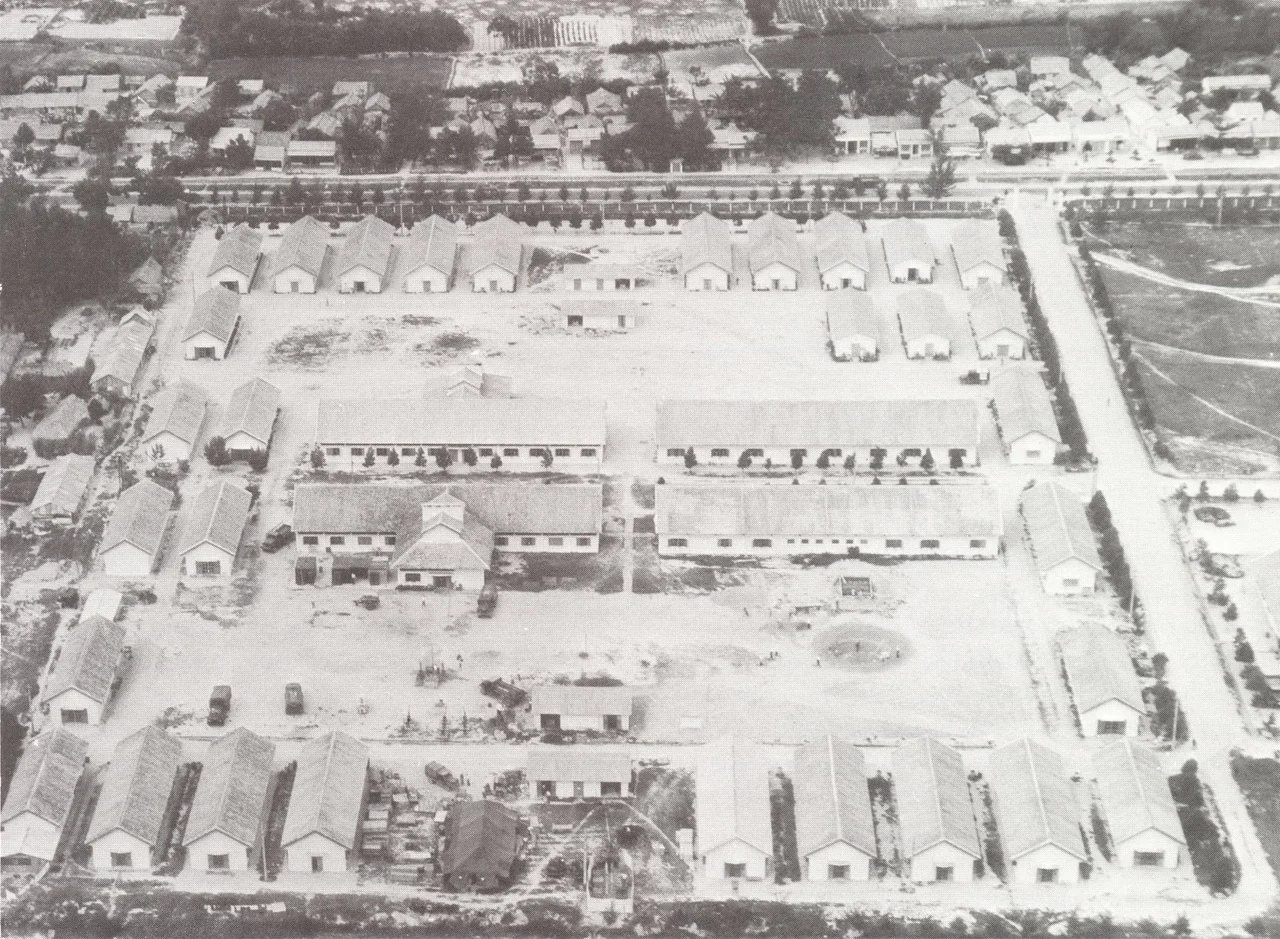

Da Nang Air Base
On 8 March 1965, the 1st Battalion, 3rd Marines waded ashore at Da Nang beach — the first American combat troops deployed to South Vietnam. They were greeted by South Vietnamese officials offering garlands of flowers. Within hours, they were at the airfield, where the machinery of a major war was already spinning up. The base they entered had already lived several lives: Japanese-occupied Tourane Airfield, then a French colonial facility where American C-119s flew covert supply missions, then a South Vietnamese air force base hosting the opening strikes of Operation Rolling Thunder. It would live several more before it was over.
From Tourane to the Jet Age
The airfield's modern history begins under occupation. On 14 July 1941, the Japanese government issued an ultimatum to Vichy France demanding use of bases throughout Indochina. The French acquiesced, and by late July the Japanese were operating at what they called Tourane Airfield, alongside Cam Ranh Bay and Bien Hoa. After the war, the French rebuilt the facility. In 1953 and 1954, as the First Indochina War reached its catastrophic conclusion at Dien Bien Phu, the US Eighteenth Air Force deployed C-119 Flying Boxcars to Tourane to support French forces. Some of those aircraft were crewed by American civilians — an early, quiet form of US involvement in a conflict that would eventually consume a generation. The French also laid a NATO-standard 7,800-foot asphalt runway at the base during this period, the same runway American jets would use a decade later. After Dien Bien Phu fell and the Geneva Accords divided Vietnam at the 17th parallel, the base passed to the Republic of Vietnam Air Force.
The War Comes to the Base
By the early 1960s, Da Nang Air Base had become a hub for the expanding American advisory effort. US Army helicopter companies arrived in January 1962, flying Piasecki CH-21 Shawnees on transport missions into I Corps — the northernmost military region of South Vietnam. The USAF's 5th Tactical Control Group arrived the same month to coordinate air support. On 2 March 1965, twenty A-1 Skyraiders launched from Da Nang on the first strikes of Operation Rolling Thunder, hitting a North Vietnamese naval facility at Quảng Khê. It was the beginning of a sustained air campaign against the North that would last three years. The base grew rapidly: troop carrier squadrons, tactical fighter wings, rescue units, and Marine aviation groups all rotated through. At its peak the airfield was one of the busiest military airports in the world, handling combat sorties, resupply flights, medevac missions, and — until 1975 — civilian Air Vietnam domestic flights.
Under Fire
The base was never safe. Enemy forces probed and struck it repeatedly throughout the war, demonstrating that no amount of perimeter security could fully protect a fixed installation in a guerrilla conflict. The vulnerabilities were sometimes startling: on one occasion, People's Army of Vietnam (PAVN) fighters killed an undetected guard and then used his unsecured telephone to divert American troops to the far side of the base. In July, PAVN forces fired more than 50 122mm rockets in a single attack, destroying 10 aircraft, damaging 40 more, killing 8 Americans and wounding 176. In April 1970 another rocket attack killed one airman and one Marine. On 8 January 1973 — just weeks before the Paris Peace Accords — five US jets accidentally bombed the base itself, destroying three fuel tanks and damaging seven aircraft. The war's capacity for self-inflicted damage was not limited to enemy action.
The Fall
By late March 1975, the strategic situation in I Corps had collapsed. Panicked civilians and deserting soldiers converged on Da Nang from across the region, flooding the city and the airfield. On 27 March, refugees surged onto the runways and taxiways trying to board World Airways evacuation flights, overwhelming ground crews and blocking aircraft. The PAVN assault on the city began on the morning of 28 March with an artillery barrage; by nightfall, Lieutenant General Ngô Quang Trưởng had ordered the remaining ARVN forces to abandon Da Nang and move to the beaches for evacuation by sea. The airfield fell the following day. On 7 April, North Vietnamese transport aircraft began landing at the base to support operations further south. What had been the forward edge of American power in Southeast Asia was now a PAVN logistics hub. The runway built by the French in 1953 was still in use — under its fourth owner in thirty years.
From the Air
Da Nang International Airport (VVDN) — formerly Da Nang Air Base — is located at 16.04°N, 108.20°E, on the northwest edge of Da Nang city. The single main runway runs roughly north–south. The airfield is easily identified from altitude by its position between the Han River to the east and the Marble Mountains (Ngũ Hành Sơn) to the southeast. Recommended viewing altitude for the full airfield layout is 3,000–5,000 feet. The Tiên Sa peninsula and Da Nang Bay are visible to the northeast. VVDN handles commercial traffic; pilots should check current NOTAMs and ATC procedures. The nearby Marble Mountain Air Facility site, used by US Marines during the war, lies approximately 5 km to the southeast.
Nearby Stories
- Mỹ Sơn 6.7 km away
- Tomb of Tự Đức 9.5 km away
- Chàm Islands 16 km away
- Thiên Mụ Temple 41 km away
- Chu Lai Air Base 47 km away
- Tomb of Gia Long 54 km away
- Dong Ampham National Biodiversity Conservation Area 81 km away
- Battle of the Paracel Islands 321 km away