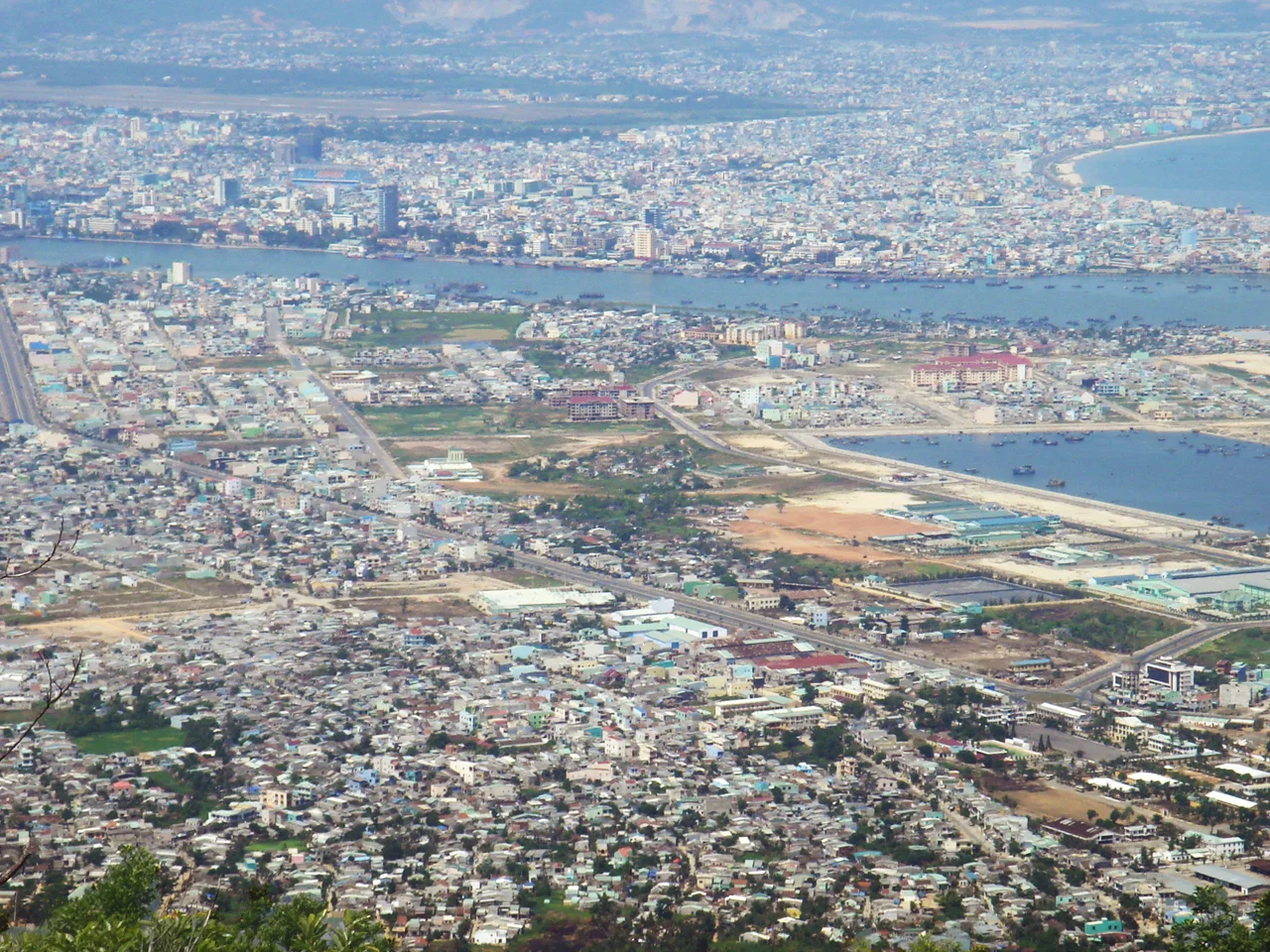

Da Nang
On the morning of March 8, 1965, the first U.S. combat troops to set foot in Vietnam waded ashore at Da Nang. They were greeted by South Vietnamese officials and young women offering garlands of flowers. Sixty years later, the beach those Marines crossed — My Khe, known to Americans as 'China Beach' — is lined with glittering high-rise hotels, and Da Nang has become one of Southeast Asia's fastest-growing resort cities. The transformation is so complete, and so deliberate, that the city reads less like a place haunted by its past and more like one that has simply decided to build something new on top of it.
Three Thousand Years of Borrowed Ground
Long before the Americans, long before the French, this coastline belonged to the Cham. The Hindu Champa Kingdom established itself here perhaps 3,000 years ago, building temples and trading ports along the same stretch of sand where beach umbrellas now sprout in neat rows. The Museum of Cham Sculpture in the city center holds one of the world's finest collections of Cham art — intricate stone carvings of deities, dancers, and mythological scenes recovered from sites across central Vietnam. Vietnamese expansion pushed south in the 17th century, absorbing the Cham heartland, and Da Nang became a gateway city of the new territory. The French recognized its strategic value immediately: a deep natural harbor, proximity to the imperial capital at Hue, and a position midway along the coast. Colonial architecture appeared alongside older temples. Each layer of history sits beneath the next, and the Cham remains are always there for those who look.
The Dragon Breathes Fire on Weekends
The Han River splits Da Nang in two, and the city has invested in making its bridges worth crossing. The Dragon Bridge is the most theatrical — a 666-meter span in the form of a yellow dragon whose scales shimmer in thousands of LED lights, and whose head, at the eastern end, breathes actual fire on Friday, Saturday and Sunday nights. Crowds gather on the riverbanks to watch. It is exactly the kind of spectacle that would seem absurd in most cities, but Da Nang carries it off with a cheerful confidence that feels entirely its own. Across the river sits the commercial center and the airport; on the eastern bank, My Khe Beach stretches nearly 40 kilometers south toward Hoi An in an almost unbroken line of pale sand, gentle waves, and — now — a solidifying wall of hotel towers. The city is building fast, and building big.
Monkey Mountain and Its Guardians
At the northern tip of the city, the Son Tra Peninsula rises steeply from the sea. Locals call it Monkey Mountain, and the name is literal: the peninsula is home to roughly 60 percent of Vietnam's entire population of red-shanked douc monkeys, a critically endangered primate with a coat that looks like it was assembled from different species — chestnut chest, white forearms, black shoulders, orange face. Much of Son Tra is a protected nature reserve, and the road that winds through it — steep, sharp-cornered, with views down to the turquoise water on both sides — ranks among the great motorcycle rides of Southeast Asia. Go just before sunrise and keep to the north side quietly, and you may spot the doucs before they disappear into the canopy. The peninsula's military past lingers in the form of restricted zones and warning signs; the Cold War infrastructure that once made Son Tra a signals intelligence hub has been absorbed back into the jungle.
A City That Eats Well and Drinks Slowly
Central Vietnamese food is its own tradition, distinct from both Hanoi's lighter northern flavors and Saigon's richer southern cooking. Mi Quang — Quang Nam-style noodles with chicken, shrimp, quail eggs, peanuts, and rice crackers in a turmeric-tinted broth — is the regional signature, and Da Nang's version is considered the authentic standard. At the seafood restaurants along the My Khe waterfront, the formula is ancient and efficient: choose your fish or shellfish from the tanks, name your preferred cooking method, and within minutes the table fills. The coffee culture runs equally deep. Da Nang's style of iced coffee — ca phe sua da — comes in a short glass over a single large block of ice, which melts slowly as conversation stretches across the afternoon. Frog coffee, ca phe coc, is what you get at the low plastic stools on the sidewalk, sipping alongside men playing Chinese chess as the motorbikes stream past.
The City Between Two Worlds
Da Nang has always been a threshold. Hoi An, the perfectly preserved ancient trading port, lies 28 kilometers south along the coast. Hue, the old imperial capital with its vast citadel and royal tombs, is 2 hours north by road over the Hai Van Pass — a mountain route so spectacular that the tunnel option seems like a genuine sacrifice. My Son, where Cham tower-sanctuaries stand in a jungle valley, is a short drive inland. For visitors working through central Vietnam's dense layering of history, Da Nang is the natural base: well-connected, increasingly sophisticated in its hotels and restaurants, and possessed of its own considerable pleasures. It is not the most immediately charming Vietnamese city — Hoi An takes that title without contest — but it has a directness and energy that the more curated destinations can't quite match. It is a city in the middle of becoming something, and watching the process is half the interest.
From the Air
Da Nang lies at 16.07°N, 108.21°E on the central Vietnamese coast. From altitude, the city is immediately identifiable by the long curve of My Khe Beach running south from the urban core, the Han River bisecting the city east-west, and the dark-forested Son Tra Peninsula jutting north into the sea. The Hai Van Pass — a dramatic ridge dropping steeply to the coast — marks the northern boundary of the city's territory. Recommended viewing altitude 3,000–5,000 feet for coastal definition. Da Nang International Airport (VVDN) sits just west of the river in the city center. Nearby airports include Phu Bai International (VVPB) at Hue, approximately 70 km north.
Nearby Stories
- Mỹ Sơn 6.7 km away
- Tomb of Tự Đức 9.5 km away
- Chàm Islands 16 km away
- Thiên Mụ Temple 41 km away
- Chu Lai Air Base 47 km away
- Tomb of Gia Long 54 km away
- Dong Ampham National Biodiversity Conservation Area 81 km away
- Battle of the Paracel Islands 321 km away