.png)
Dance of Zalongo
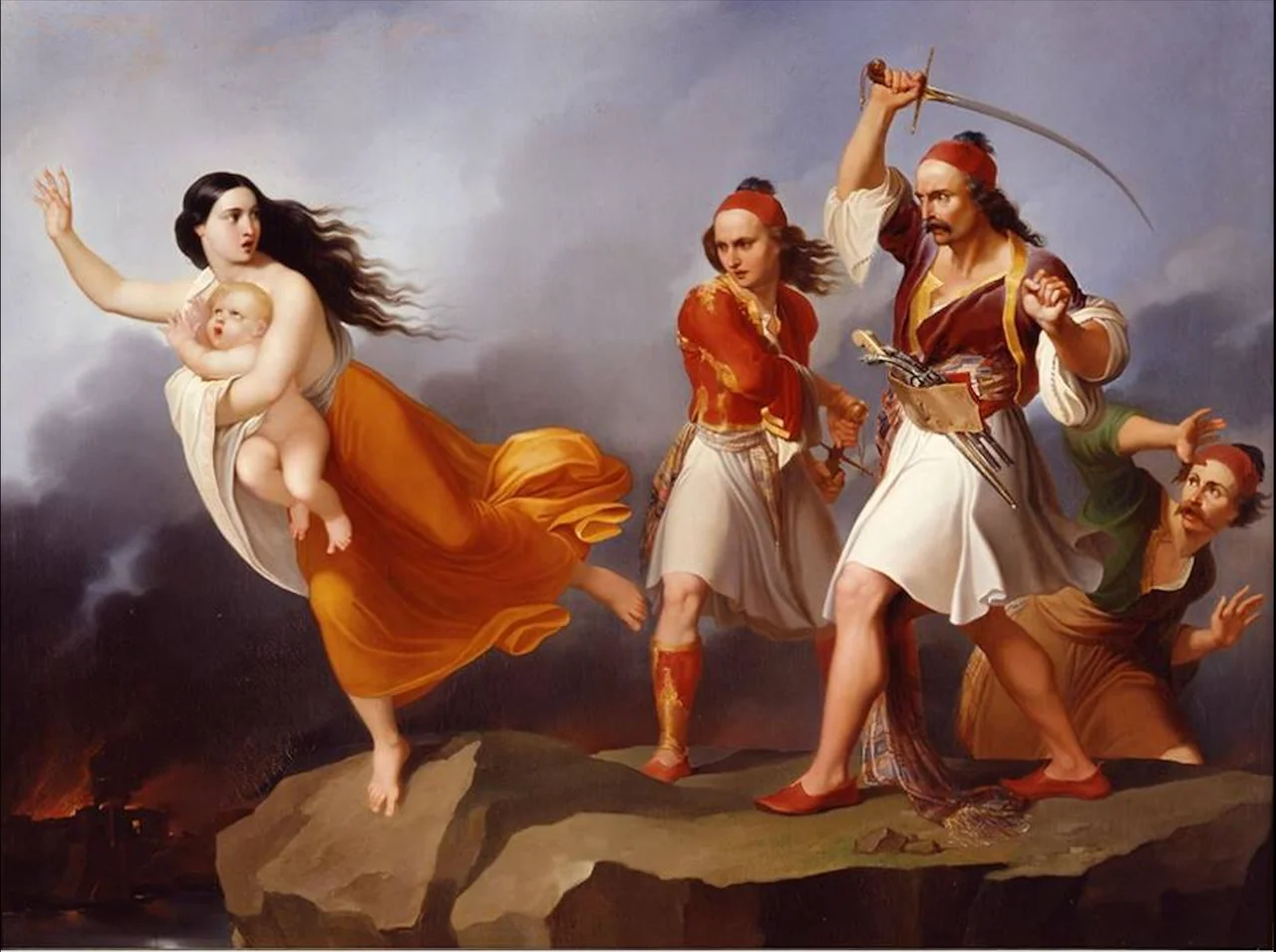
On December 16, 1803, a group of Souliote women — roughly sixty of them, many holding infants and young children — found themselves trapped at the top of Mount Zalongo in Epirus. Ali Pasha's soldiers were closing in. There was no way out. What happened next on that cliff edge is certain in its brutal outcome: the women died. Whether they went over singing and dancing, as the legend insists, or in silence and terror, as the sparse contemporary evidence suggests, is a question history has never fully resolved. What is not in question is that these were real women, with names and families and everything to lose, who faced an impossible choice and made it.
The Souliotes and Their World
The Souliotes were an Orthodox Christian community whose roots lay in Albanian clans that had settled in the mountains of Epirus during the Late Middle Ages. Albanian was their native tongue, though they were bilingual in Greek, and they worshipped alongside Greeks in the same Orthodox faith that would eventually draw them into the orbit of Greek national identity. They lived in the rugged highlands of Souli, where the terrain itself was a fortress — steep ridges and narrow passes that allowed a relatively small community to resist much larger forces for decades. That resistance made them legendary. It also made them targets. Ali Pasha of Ioannina, the Ottoman-Albanian ruler who dominated northwestern Greece in the early 19th century, had been pressing to absorb Souli for years. By December 1803, after a prolonged war, he had succeeded. The Souliotes agreed to terms, packed what they could carry, and began the long march toward the coast and safety.
What Happened on the Mountain
The accounts diverge almost immediately after the fall of Souli. Some versions, drawing on later Greek historiography, portray Ali Pasha as a treacherous tyrant who reneged on promises of safe passage and sent soldiers after the refugees. Others note the complicated reality: that Ali did provide safe conduct to some Souliote leaders, including the chief Fotos Tzavelas, whose captive wife he released. What seems clear is that not all the refugees made it safely to Parga. A group of women, separated from the men and cut off from escape, took shelter at the convent of Zalongo. When Ali Pasha's soldiers stormed the convent and killed its defenders, those who could escape climbed to the summit of the mountain. There, on the edge of the cliff, they ran out of mountain. The first Greek account of the event, written by Christoforos Perraivos in 1815, described the women dying at Zalongo. Perraivos himself revised and republished his history multiple times, and by his third and final edition in 1857, the specific detail of dancing and singing had been quietly removed. The heroic dance narrative was elaborated by later writers, embedded in schoolbooks, and eventually crystallized in a folk song composed in the early 20th century. Scholars today consider the dancing and singing an invented tradition — a later embellishment added to what was, at its core, an act of impossible desperation.
How the Story Crossed Europe
Whatever the precise details, the story traveled fast. By the 1820s it had reached England and America, where it was taken up by supporters of Greek independence and circulated in newspapers and pamphlets. The numbers grew in the retelling — some accounts spoke of a hundred women, not sixty. European painters seized on the theme. At the Paris Salon of 1827, the French Romantic artist Ary Scheffer exhibited his painting of the Souliot women, depicting them as noble and defiant figures. French painter Constance Blanchard showed them running toward their death in 1838, also at the Salon. The story became useful — as proof of Ottoman cruelty, as evidence of Greek courage — and that usefulness shaped how it was told. The actual women, the specific weight of what they chose on that mountain, tended to disappear into the symbol they were made to represent.
What Memory Owes Them
The story of Zalongo inspired other women facing similar circumstances. During the Greek War of Independence, after the Ottoman siege of Naoussa, thirteen women and their children threw themselves into the Arapitsa River rather than be taken captive. The pattern of desperate resistance became part of the emerging Greek national identity, and the women of Zalongo became its defining emblem. A folk song in their name is still danced throughout Greece today. A popular drama written by Spyridon Peresiadis in 1903 carried their story to stage audiences. The fact that the dancing narrative is largely a later construction does not diminish the reality of what those women faced. It only means that what they actually did — climbing a mountain with their children, standing at its edge, and choosing — was harrowing enough without embellishment. The monument on the summit, unveiled in 1961, stands above the place where they died. It is worth going there, and thinking about what you would do.
From the Air
Mount Zalongo sits at approximately 39.15°N, 20.68°E in the Preveza regional unit of Epirus, northwestern Greece. The mountain rises to around 700 meters and overlooks the Ionian coast. From the air, the white concrete monument is visible on the clifftop, especially in clear conditions. The nearest airport is LGPZ (Aktion National Airport, Preveza), approximately 25 kilometers to the south. Flying along the coast at 3,000–5,000 feet, the cliff face where the events occurred is visible on the western side of the mountain above the village of Kamarina. The Ionian Sea lies just to the west; the Ambracian Gulf opens to the southeast. Morning light from the east illuminates the white monument clearly.
Nearby Stories
- Castle of Santa Maura 13 km away
- Battle of Olpae 19 km away
- Achilleion (Corfu) 24 km away
- Dodona 27 km away
- Stratos 28 km away
- Corfu 56 km away
- Meteora: The Monasteries Built on Impossible Pillars 60 km away
- Hellenic Trench 117 km away