
David Crockett Birthplace State Park
The cabin is not on a mountaintop. Visitors arrive expecting one — the 1955 Walt Disney ballad insists Davy Crockett was born on a mountaintop in Tennessee — and instead find a small replica log cabin sitting on a flat river terrace where Big Limestone Creek joins the Nolichucky. The cabin is a reconstruction. The footstone in front of it, inscribed in the 1880s, marks where the original birth cabin is believed to have stood. The location, however, is precise: this is where David Crockett was born on August 17, 1786, in the brief extralegal state of Franklin, on land that had been Cherokee hunting territory for centuries and then Jacob Brown's Nolichucky Settlement for fifteen years. Crockett spent his life trading on the frontier and died at the Alamo at forty-nine. The state park along the river preserves a more honest version of who he actually was.
The River Bend Where He Was Born
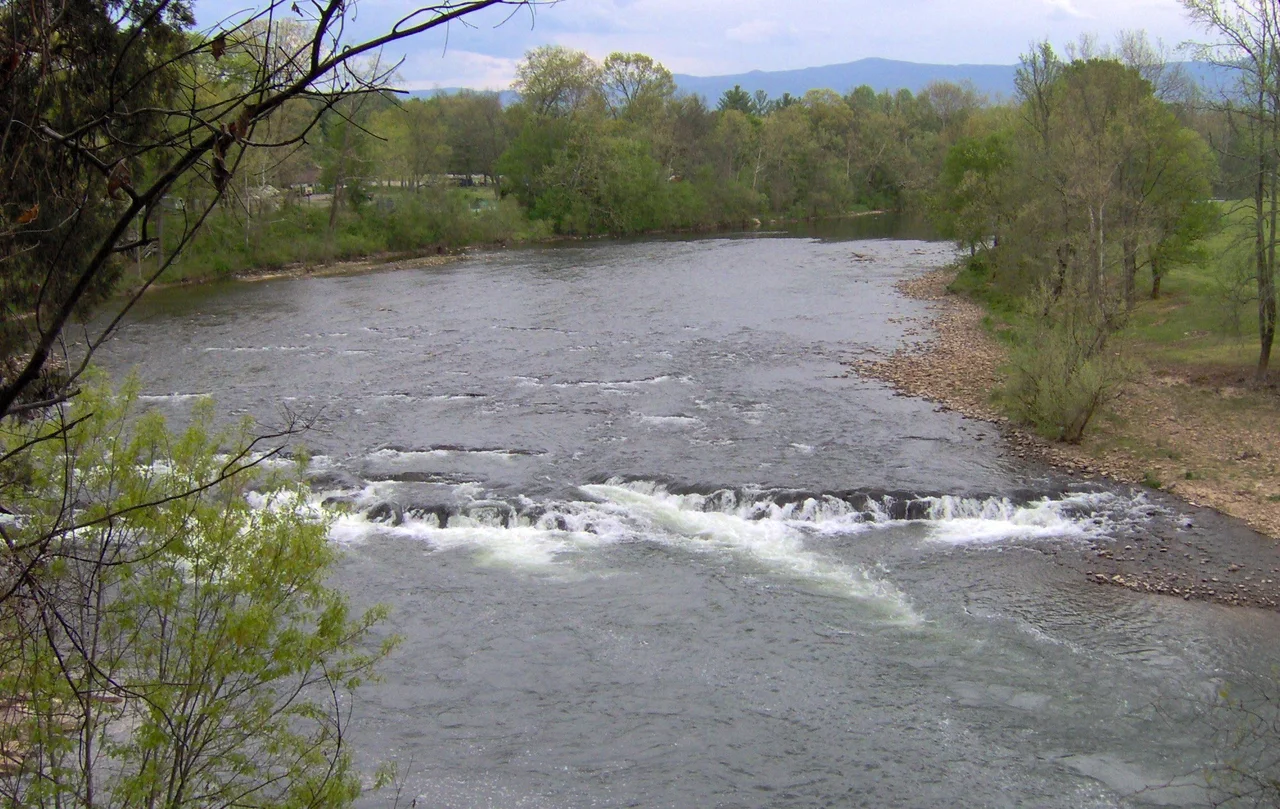
The Nolichucky flows westward out of the Unaka Mountains, slicing a scenic valley through Washington, Greene, and Jefferson counties before emptying into the French Broad. The park sits at the confluence with Big Limestone Creek, about 68 miles above the river's mouth. Just downstream, the Nolichucky enters a stretch of rocky shoals — the same shoals Crockett described decades later in his autobiography when he recalled his brothers nearly drowning trying to paddle over a fall in the river, which went slap-right straight down. The park covers 105 acres of bottomland between the river and the bluffs. Across the river to the west sits the Earnest Farms Historic District. Native American settlements existed at this confluence as early as the Woodland period, from 1000 BC to 1000 AD, and continued sporadically for centuries afterward. The 1977 Tennessee Division of Archaeology dig at the birthplace site found no cabin remains — the land had been plowed too thoroughly for two centuries — but turned up projectile points, eighteenth-century artifacts, and other signs of long human use.
Whose Land This Was
The Cherokee leased the Nolichucky valley to Jacob Brown in the early 1770s, then sold it to him in 1775. Brown's Nolichucky Settlement aligned itself with the Watauga Association during the Revolution and became part of Washington County, North Carolina, in 1777. By 1783, it had been carved into the new Greene County. John Crockett — David's father — appears in Washington County court records as early as 1778 and shows up in Greene County records through the 1780s. By the time David was born in 1786, the land that had been Cherokee hunting territory for generations had been transferred through leases, treaties, and outright dispossession into Euro-American ownership. The frontier David Crockett grew up on was a frontier created by removing the people who had been there first. Some of that removal he would later try to oppose in Congress. Most of it had already happened by the time he could walk.
Congressman Who Said No to Andrew Jackson
Crockett grew up hunting and storytelling in East Tennessee, rose to colonel of the Lawrence County militia, won a seat in the Tennessee state legislature in 1821, and was elected to the U.S. House of Representatives in 1827. In Washington he opposed many of President Andrew Jackson's policies — most consequentially the Indian Removal Act of 1830, which authorized the forced expulsion of the Cherokee and other southeastern nations that became known as the Trail of Tears. Crockett's vote against the Removal Act, given his Tennessee constituency, was politically suicidal. It helped cost him his seat in the 1835 election. The honest version of Crockett that survives in his own writing is more complicated than the buckskin folk hero of later legend: a frontiersman who participated in the violence of his era and also drew a real line against Jackson's removal program when most of his colleagues did not. He left for Texas after losing the 1835 race, joined the Texas Revolution, and died at the Alamo in early March 1836.
What Got Rebuilt, and What the Flood Took
Samuel Stonecypher bought the property in 1824 and reportedly dismantled the original Crockett cabin to build a smaller house nearby. The footstone of the original cabin stayed put. In the 1880s someone inscribed it: On this spot Davy Crockett was born Aug 17 1786. The Davy Crockett Birthplace Association — which was using the Disney-era spelling — bought the land in the 1950s, used the logs from the old Stonecypher cabin to build the replica that stands today, and modeled the design on a late-eighteenth-century cabin elsewhere in Greene County since nobody knew what the original had looked like. The DCBA transferred the park to the state in 1973. In 1967, the Limestone Ruritan Club placed a round monument near the cabin with the names of all fifty states engraved into stone native to each one. In September 2024, Hurricane Helene drove catastrophic flooding through the Nolichucky valley. The park had been evacuated, so there were no injuries, but the damage was extensive. Most of the park has been closed to the public since the storm. Tennessee State Parks officials are hopeful about rebuilding, but as of 2026 no reopening date has been set.
From the Air
David Crockett Birthplace State Park sits at roughly 36.204 N, 82.656 W along the Nolichucky River, near the community of Limestone, about 10 nm east of Greeneville, Tennessee. Elevation is approximately 1,300 feet. Best viewed at low altitude on clear days — the river bend at the Big Limestone Creek confluence and the bluffs above are the key landmarks. Greeneville Municipal (0A9) lies about 8 nm west; Tri-Cities Airport (KTRI) is roughly 18 nm north-northeast; McGhee Tyson (KTYS) about 65 nm west-southwest. The park is in the Ridge-and-Valley province with the Unaka Mountains rising to the southeast. Note: most of the park has been closed since Hurricane Helene's September 2024 flooding — overflights show extensive river-channel changes through this reach of the Nolichucky.
Nearby Stories
- Black Mountains (North Carolina) 11 km away
- Holston Mountain 13 km away
- Amis House (Rogersville, Tennessee) 15 km away
- Mitchell County, North Carolina 16 km away
- The Titanic Museum: The Ship That Docked in Tennessee 24 km away
- Richmond Hill Inn 34 km away
- Cumberland Gap 39 km away
- 2016 Great Smoky Mountains Wildfires 57 km away