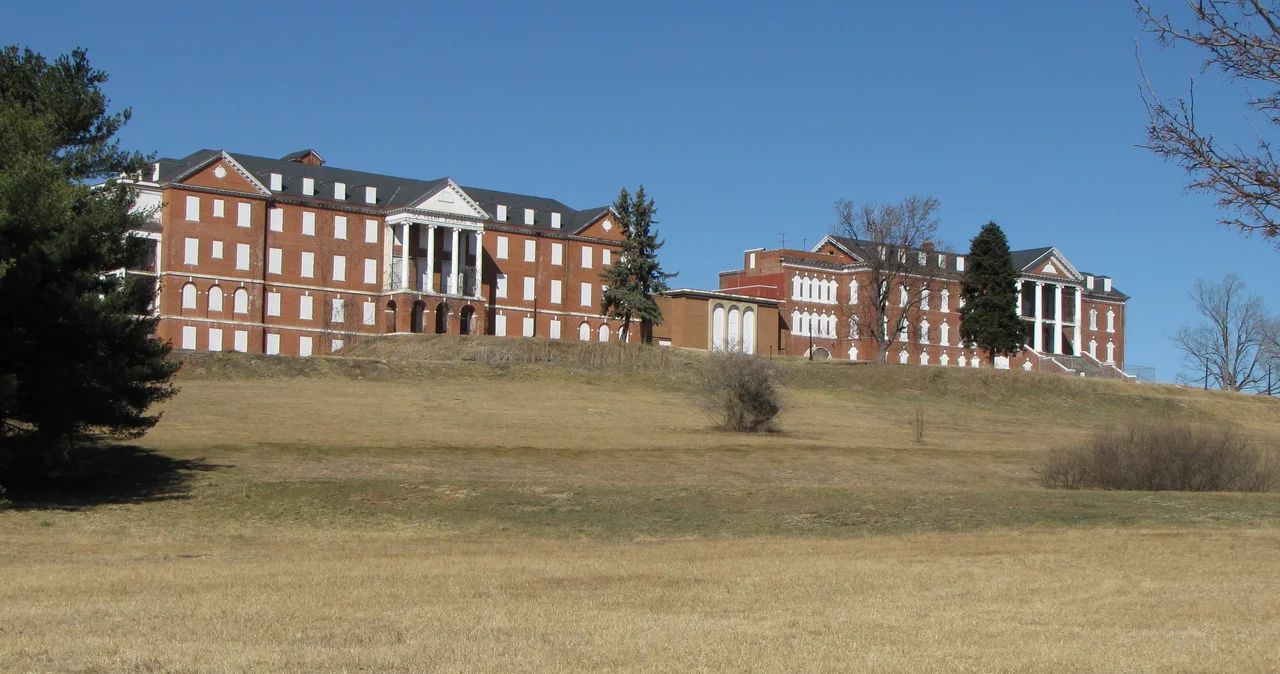

DeJarnette Sanitarium
Joseph DeJarnette envied the Nazis. In a letter to the government of Virginia in the 1930s, the superintendent of the psychiatric hospital that bore his name complained that Germany's program of forced sterilization was outpacing America's own - that the Germans were "beating us at our own game." He had spent three decades arguing that Virginians he diagnosed as defective should not be allowed to reproduce. The Georgian-Revival building he founded in 1932, on a hill outside Staunton, still stands. It is abandoned, fenced off, and one of the most haunted-feeling structures in the Shenandoah Valley. The history it holds is darker than any ghost story.
A Hospital with a Mission
DeJarnette had been superintendent of the publicly-funded Western State Hospital since 1906. By the early 1930s, he wanted a parallel institution for middle-income patients - people who could pay modest fees and whose families could afford a building that looked less like an asylum and more like a country estate. The Commonwealth obliged. The DeJarnette Sanitarium opened in 1932 on land adjacent to Western State, all red brick and white columns, with classical porticos and landscaped lawns. The Virginia General Assembly formally renamed it the DeJarnette State Sanatorium in 1934. The architecture reflected an early-twentieth-century theory called moral treatment, the idea that orderly buildings and quiet grounds could calm troubled minds. Behind the symmetry, the institution carried out the prevailing practices of its era: occupational therapy, custodial confinement, and - critically - sterilization.
Buck v. Bell and the Virginia Law
DeJarnette participated in Buck v. Bell, the 1927 Supreme Court case that upheld the Virginia Sterilization Act of 1924. Justice Oliver Wendell Holmes Jr., writing for the majority, declared that "three generations of imbeciles are enough" - one of the most notorious sentences ever written by an American court. The Virginia law authorized the involuntary sterilization of patients institutions deemed unfit. Carrie Buck, the young woman at the center of the case, had been committed to a Virginia institution after she gave birth as the result of a rape. The court ruled that she, her mother, and her infant daughter were all feebleminded; doctors sterilized her without meaningful consent. Patients at Western State and the DeJarnette Sanitarium were subjected to sterilization under this law until the early 1970s. The Virginia General Assembly did not formally express "profound regret" for the program until 2001.
The People Who Lived Here
It is easy to write about a building. Harder to remember that for sixty-four years, real people lived inside it - patients, often poor, often without anyone to advocate for them, whose presence in the wards was someone else's decision. Among them were children and adolescents; after 1975, when the facility was renamed the DeJarnette Center for Human Development, the institution specialized in adolescent psychiatric care. Some came willingly seeking help. Others were committed against their will. The records that survive are often clinical rather than personal, but every case file represents a person whose body and reproductive future were treated as state property. To walk past the abandoned building today is to walk past a memorial that has not yet been named one.
Empty Halls
By the 1990s, deinstitutionalization had reshaped American psychiatry. Community-based care replaced the warehouse model, and aging asylums across the country fell empty. In 1996, the DeJarnette Center's operations moved to a modern complex nearby - now the Commonwealth Center for Children and Adolescents - and the original 1932 building was abandoned. It has stood derelict ever since. Urban explorers and ghost-hunters cycle through, drawn by broken windows and graffiti-covered wards. Local authorities post no-trespassing signs. Plans for redevelopment have come and gone. The building is too historic to demolish casually and too freighted with meaning to repurpose easily. For now, it waits - a Georgian-Revival reminder that some of the cruelest ideas in American history wore the dignified architecture of medicine.
From the Air
Located at 38.1314N, 79.0450W on a hill outside Staunton, Virginia, adjacent to the former Western State Hospital campus. Recommended viewing altitude is 4,500 to 6,500 feet for a clear overhead of the Shenandoah Valley and the rooflines of the abandoned campus. The Blue Ridge rises to the east, the Allegheny ridges to the west. Nearest airport is Shenandoah Valley Regional (KSHD) about 4 nm north; Charlottesville-Albemarle (KCHO) is roughly 30 nm east across the Blue Ridge. Watch for valley haze in summer and orographic clouds against the surrounding ridges.
Nearby Stories
- United States National Radio Quiet Zone 7.3 km away
- Bridgewater College 7.6 km away
- Fork Union Military Academy 13 km away
- Shenandoah: The Skyline Drive Through America's Oldest Mountains 24 km away
- Bath County, Virginia 25 km away
- Amherst, Virginia 26 km away
- Dolley Madison 27 km away
- Peaks of Otter 40 km away