
Delphi Archaeological Museum
Room 13 stops most visitors cold. The bronze Charioteer of Delphi stands there, cast in 475 BCE, still holding the reins of a chariot that no longer exists, his eyes — made of onyx and white enamel — fixed on some point in the middle distance with an expression of complete, composed attention. The rest of the chariot group — the horses, the chariot itself, a groom — was found in fragments; an earthquake had buried the whole ensemble in antiquity. The figure survived. His pleated robe falls in still, vertical folds around his feet. His eyelashes, individually inlaid, are still there. After 2,500 years, he looks ready to race.
A Museum Born from Excavation
The Delphi Archaeological Museum opened on 2 May 1903, built to house the finds from the great French excavation campaign that had spent years digging out the sanctuary buried beneath the village of Kastri. The building was designed by the French architect Albert Tournaire and paid for by a trust established by the Greek banker and philanthropist Andreas Syngros. The first exhibition was arranged by Théophile Homolle, director of the archaeological expedition, on the principle that architectural elements and sculptures should be shown 'in context,' with major monuments partially reconstructed in plaster. By the 1930s it was already too small. The current building, reorganised across fourteen rooms on two levels with more than 2,270 square metres of exhibition space, is the result of successive expansions — the museum growing steadily to match the extraordinary richness of what the site kept yielding.
The Sphinx, the Treasury, and the Navel of the World
The Sphinx of Naxos presents a problem of scale. It sat atop an Ionic column 10 metres tall, near the Halos — an open area of the sanctuary — and was dedicated by the island of Naxos between 575 and 560 BCE. Up close, in the museum, it is enormous: the haunches of a lion, the wings of an eagle, the head of a woman, all compressed into a single watchful presence. Nearby stands the omphalos — the navel-stone — the marker with which the ancient world located the exact centre of the earth. Delphi earned the label not merely through religious authority but through geography: Apollo's oracle sat at the place where, according to the myth, Zeus had released two eagles from opposite ends of the earth and they had met in flight above this spot. The stone in the museum is carved with a net pattern, perhaps representing the wool wrapping described in ancient sources. It sits quietly on a plinth, the axis of an ancient cosmology.
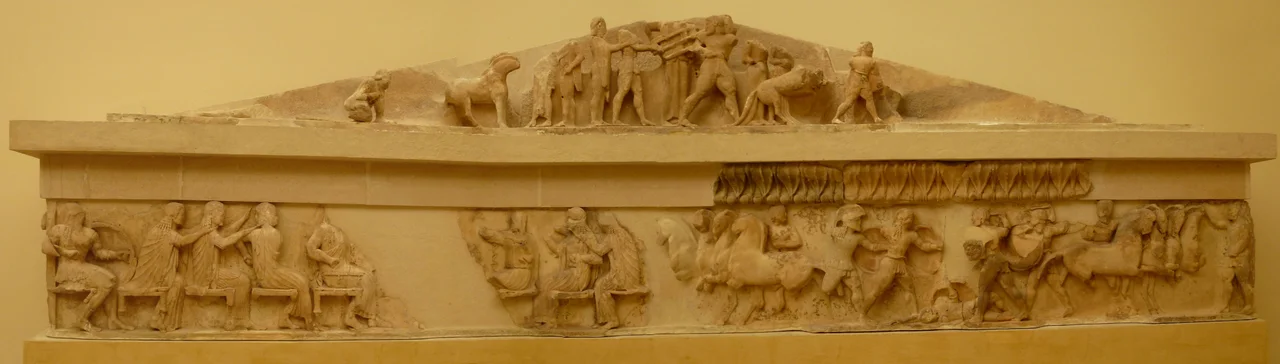
The Siphnian Treasury frieze, displayed across multiple rooms, is one of the great narrative sequences in early Greek sculpture. Carved in island marble around 525 BCE, the eastern frieze shows the gods assembled; the northern frieze depicts a battle of gods and giants — a Gigantomachy — in which the figures surge and press against each other with a dynamism the archaic style rarely achieves. The western frieze shows the Judgement of Paris. Accompanying all of this is one of the two surviving caryatids from the treasury's porch — an elegant female figure who stood as a structural column.
Athletes, Donors, and the Dead
Room 11 contains the dedication of Daochos II, tetrarch of Thessaly between 336 and 332 BCE. The base — eleven metres long — once supported nine statues, eight identified by inscription. They portray Daochos's family across generations, including three sons who were victors in athletic competitions: Agias, Telemachus, and Agelaus. Some of the figures are attributed to Lysippus, the most celebrated sculptor of the age. The Dancers of Delphi stand nearby: a column topped by three marble women with raised hands, springing from an acanthus crown — they probably held a tripod, now lost, which would have been crowned by the omphalos in the same room. The ground-floor gallery holds a different and quieter world: finds from the Delphi necropolis, from domestic houses, from the Corycian cave high on Parnassus. Mycenaean stirrup jars, clay figurines of Aphrodite, a doll with movable limbs from a fourth-century BCE grave. The objects of everyday life and death, pulled from the same soil as the bronzes upstairs.
What the Rooms Hold Together
The museum's chronological sweep is genuinely remarkable. The earliest objects — Neolithic vessels from the Corycian cave, obsidian blades — predate the sanctuary by thousands of years. The latest, displayed in room 14, include a head of a philosopher dated to the fourth century CE, by which time the oracle had been silenced by the emperor Theodosius and the sanctuary was sliding toward abandonment. Between those endpoints: the kouroi of Argos in room 1, the largest surviving pair of archaic male statues; the pediment sculptures of two successive temples of Apollo; the statue of Antinous, favourite of the emperor Hadrian, carved in Parian marble and erected after his death with the particular grief of an empire that wanted to make him a god. A room of Delphic hymns preserves fragments of actual ancient musical notation, carved on stone slabs in the second century BCE — some of the oldest surviving written music anywhere. Taken together, the rooms tell not just the story of a sanctuary but the story of a world.
From the Air
The Delphi Archaeological Museum sits at approximately 38.48°N, 22.50°E, immediately adjacent to the archaeological site on the slopes of Mount Parnassus, above the modern town of Delphi. From the air the museum is visible as a long low structure beside the terraced ruins of the sanctuary. The nearest major airport is LGRX (Araxos), approximately 100 km to the southwest by air; the standard visitor gateway is Athens Eleftherios Venizelos (LGAV), about 180 km to the east. A viewing altitude of 4,000–6,000 feet gives a clear picture of the sanctuary's dramatic siting: the cliffs of the Phaedriades above, the Pleistus valley below, and the Gulf of Corinth visible in the distance to the south.
Nearby Stories
- Battle of Leontion 2.8 km away
- Siege of Livadeia 3.1 km away
- Pyre of Heracles 8.2 km away
- Corinth Rail Disaster 8.8 km away
- Rio–Antirrio Bridge 9.9 km away
- Heraion of Perachora 13 km away
- Prousou Monastery 15 km away
- Free and Real 30 km away