
Delphi (Modern Town)
The last message delivered by the oracle of Delphi, according to an account from the fourth century CE, was addressed to the emperor Julian, who had sent his physician Oreibasius to ask about the fate of paganism. The answer came in verse: 'Tell the king that the flute has fallen to the ground. Phoebus does not have a home any more, neither an oracular laurel, nor a speaking fountain, because the talking water has dried out.' The oracle was shut down by Theodosius I in 381 CE. By 1410, the Ottomans controlled Phocis, and the site of ancient Delphi lay almost uninhabited, its columns and marble blocks slowly absorbed into the walls of a village the locals called Kastri.
The Village That Had to Move
In 1893, archaeologists from the École française d'Athènes identified the actual extent of ancient Delphi beneath Kastri — and reached an agreement with the Greek government to relocate the village entirely. The inhabitants were moved to a new site on the slopes immediately to the west of the sanctuary, and the modern town of Delphi was born. It is, in a strict sense, a town created for a purpose: to house people who had been living, quite literally, on top of one of the ancient world's most important religious sites, and to provide a base for the visitors who would come to see what lay beneath their former homes. The streets are narrow and often one-way, terraced into the hillside like the ancient sacred precinct below them. The town sits on Greek National Road 48, linking Amfissa to the north with the coast at Itea. From almost any street, Parnassus is the view.
What Delphi Was Before It Was Modern
Occupation at Delphi reaches back to the Neolithic period, with sustained settlement and religious activity beginning in the Mycenaean era, roughly 1600 to 1100 BCE. The site functioned as an oracle — associated first with the earth goddess Gaia, later with Apollo — from at least 1400 BCE, and it gained pan-Hellenic importance in the seventh century BCE. Every four years, starting in 586 BCE, athletes from across the Greek world gathered for the Pythian Games, one of the four great Panhellenic competitions and the one that uniquely also included musical contests. Victors received a laurel crown, ceremonially cut from a tree by a boy re-enacting the slaying of the Python. In the inner sanctuary of the Temple of Apollo, an eternal flame burned; after the battle of Plataea, Greek cities extinguished their fires and came to Delphi to renew them from what was called the hearth of Greece. The ancient world called Delphi the omphalos — the navel of the earth — and the label was not metaphorical. It described a precise cosmological claim: that this was the exact centre of the world.
Sacred Wars and the Long Arm of Macedonia
Delphi's history is inseparable from the series of conflicts known as the Sacred Wars, each fought over control of the sanctuary. The First Sacred War, in the late seventh and early sixth centuries BCE, ended with the destruction of Cirrha, the harbour-town on the plain below. The Second Sacred War, in the 440s BCE, saw the Phocians wrest control of the sanctuary from the Spartans. The Third Sacred War, beginning in 356 BCE, opened when the Phocians seized and plundered the sanctuary itself — a provocation that ultimately gave Philip II of Macedon the pretext he needed to intervene. His victory at the Battle of Chaeronea in 338 BCE established Macedonian dominance over Greece. Rome came next: the general Titus Quinctius Flamininus took Delphi in 198 BCE; Sulla sacked it in 86 BCE during the Mithridatic Wars; Nero pillaged it in 66 CE, reportedly carrying off 500 bronze statues. The sanctuary declined slowly, then abruptly. In the third century CE, mystery cults eclipsed the traditional pantheon. Christianity followed. The oracle fell silent.
The Town Today
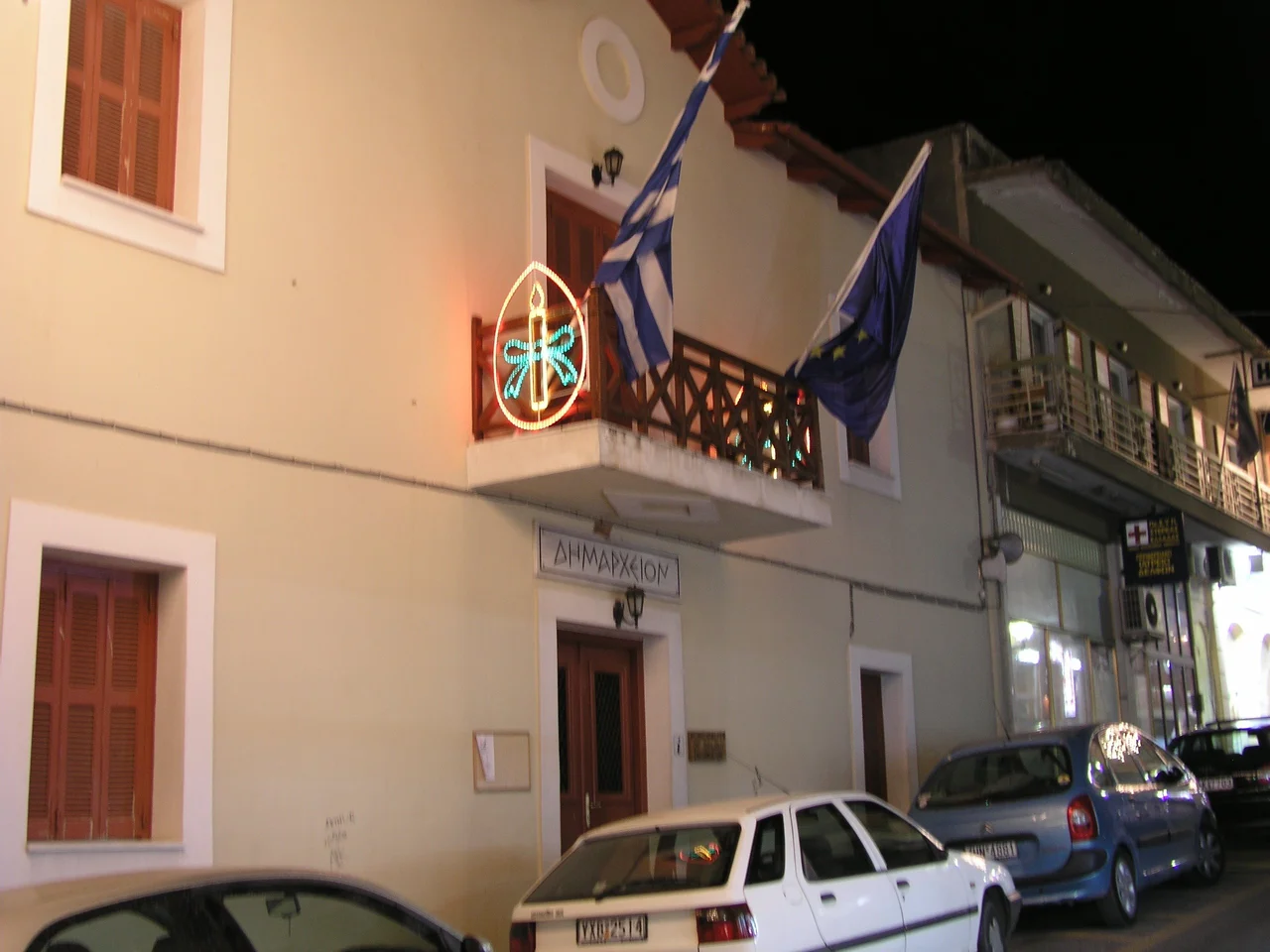
Modern Delphi has a population of about 2,373. It is a working tourism town — hotels, restaurants, and shops line the main street — but it is also a genuine place, with a church of Saint Nicholas, a town hall, and the house of the poet Angelos Sikelianos, who made Delphi his home and in 1927 staged an ambitious revival of the Delphic festivals in the ancient theatre. The European Cultural Centre of Delphi hosts the annual Delphi Economic Forum, an international conference on finance and politics that draws senior figures from around the world. Beyond the ancient ruins, the region offers the Parnassus Ski Center and the coastal towns of the gulf. The municipality of Delphi, formed in 2011, encompasses a vast area of central Greece including Amfissa, Galaxidi, Itea, and the villages of the Pleistos valley. The administrative seat is Amfissa. But the name that carries the weight is still Delphi, still attached to its mountain and its memory of being, once, the centre of the world.
From the Air
The modern town of Delphi lies at approximately 38.48°N, 22.49°E, on the southern slopes of Mount Parnassus in Phocis, central Greece. From the air the town is visible as a linear settlement terraced into the steep hillside immediately west of the sanctuary ruins; the Pleistus gorge falls away sharply to the south, opening onto the olive-covered plain that leads down to Itea and the Gulf of Corinth. The nearest major airport is LGRX (Araxos), approximately 100 km to the southwest; most visitors arrive via Athens Eleftherios Venizelos (LGAV), roughly 180 km to the east. A recommended viewing altitude of 5,000–8,000 feet makes the full geography legible: the mountain above, the gorge below, the gulf shining in the distance, and the sanctuary connecting them all.
Nearby Stories
- Battle of Leontion 2.8 km away
- Siege of Livadeia 3.1 km away
- Pyre of Heracles 8.2 km away
- Corinth Rail Disaster 8.8 km away
- Rio–Antirrio Bridge 9.9 km away
- Heraion of Perachora 13 km away
- Prousou Monastery 15 km away
- Free and Real 30 km away