
Department of La Libertad
The name is a promise kept. When Simón Bolívar signed the 1825 law changing this coastal department's name from Trujillo to La Libertad - Freedom - he was rewarding the place where Peruvian independence had been openly declared four years earlier, on December 29, 1820. Most Peruvian departments are named for rivers, mountains, or Quechua phrases. This one is named for an idea. The idea fits because the land itself has always produced civilizations that outlasted their conquerors: Moche potters whose work still turns up in desert sand, Chimú builders whose capital still stands in adobe, ancient irrigation engineers whose canals the Spanish destroyed and then wished they hadn't.
The Adobe Metropolis
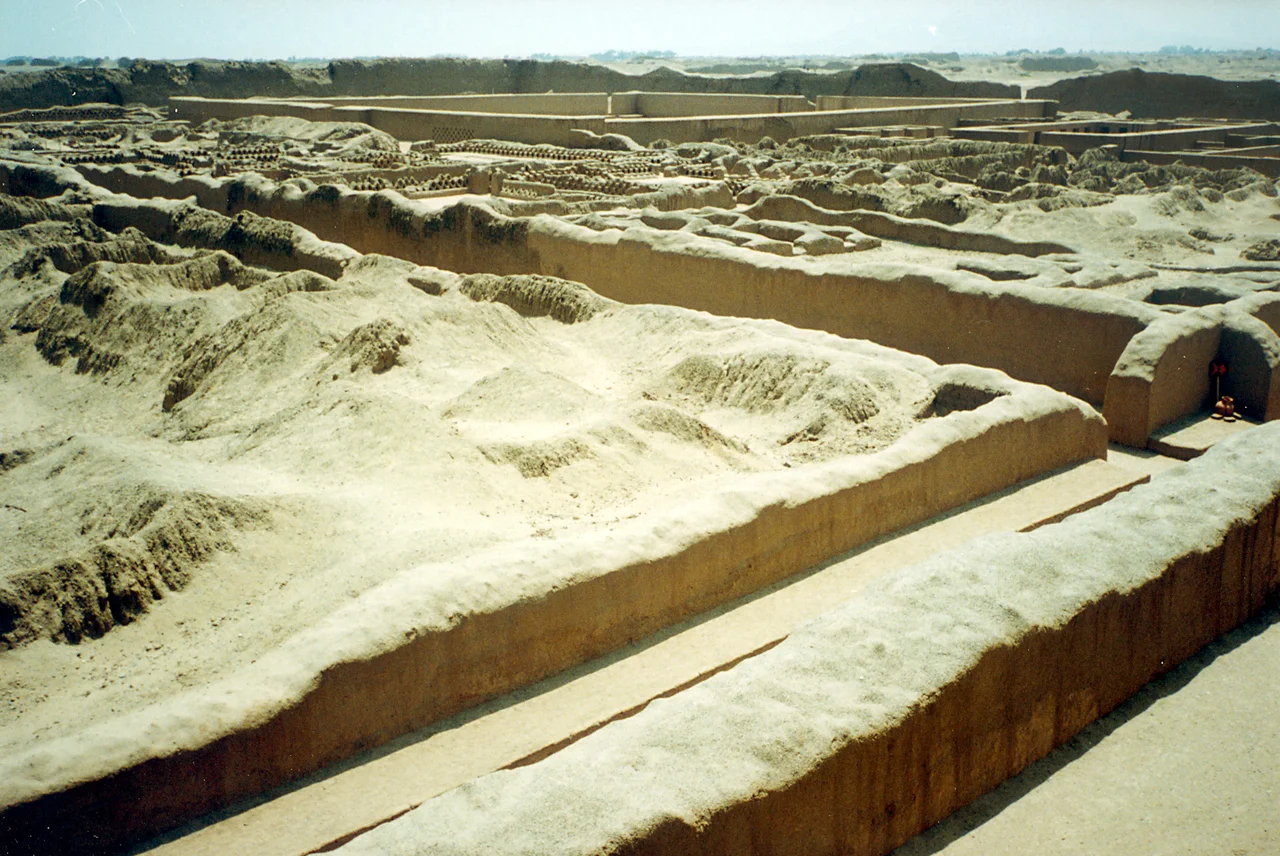
Five kilometers west of downtown Trujillo, a city made of mud spreads across the desert. Chan Chan was the capital of the Chimú Empire, and at its peak it held 60,000 people - the largest pre-Columbian city in South America. Walls rise in a honeycomb of ciudadelas, rectangular palace compounds decorated with friezes of fish, seabirds, and waves stamped into the clay. The buildings have survived five centuries partly because the northern Peruvian coast almost never rains - normal erosion barely touches adobe - and partly because mud bricks don't tempt scavengers the way cut stone does. UNESCO designated Chan Chan a World Heritage Site in 1986. When El Niño does bring rain, conservators race to cover the most delicate walls. The Chimú resisted the Inca Empire for as long as they could. Their engineers had built the most sophisticated irrigation networks in the ancient Americas.
Sun, Moon, and Blood
Before the Chimú, the Moche. From around 200 CE, this culture built temple mounds - huacas - out of millions of adobe bricks stamped with makers' marks like ancient signatures. The Huaca del Sol rises in stepped platforms, and the Huaca de la Luna across the valley holds painted murals where the fanged deity Ai Apaec glares from interior walls, his face repeated down corridor after corridor in vivid ochre and turquoise. Archaeologists have found evidence here of ritual combat and human sacrifice, captives killed during ceremonies timed to El Niño weather disruptions. The Moche were extraordinary potters; their portrait vessels depict specific individuals with such detail that researchers can distinguish identifiable faces across centuries. The people who filled Moche temples included farmers, soldiers, and the victims of religious violence - all now gathered under the desert dust, gradually emerging as excavation continues.
Independence Begins Here
In the summer of 1820, José de San Martín landed at Paracas Bay with an Argentine-Chilean army. He did not march on Lima first. Instead, the intendancy of Trujillo, through its intendant José Bernardo de Tagle y Portocarrero and the city mayor, organized its own rebellion. On December 29, 1820, Trujillo formally declared independence from Spain - months before the larger proclamation in Lima. On February 12, 1821, San Martín issued a Provisional Regulation that created the Department of Trujillo as one of the Protectorate of Peru's foundational units. Four years later, Bolívar renamed it La Libertad to honor what had happened there. The capital city itself was briefly renamed Ciudad Bolívar, though that change reverted in 1827. The department's name never did.
A Second UNESCO Site
La Libertad holds two UNESCO World Heritage Sites. Chan Chan is one. The other is Río Abiseo National Park, inscribed as a UNESCO Natural Heritage Site in 1990 and expanded to include Cultural Site status in 1992. Deep inside the cloud forest, where the eastern Andes fall toward the Amazon, stands Gran Pajatén - a complex of circular stone buildings decorated with slate mosaics showing condors and human figures. The terrain is so remote and the ruins so fragile that the park requires permits from Peru's Ministry of Agriculture and National Institute of Culture. Most Peruvians have never seen it. Tourism has been repeatedly debated and repeatedly deferred. The park also shelters yellow-tailed woolly monkeys, thought extinct until they were rediscovered in the 1970s. Two heritage sites, in one department, representing entirely different worlds - coastal adobe and mountain stone, desert and cloud forest.
Shoes, Pineapples, Faith
Modern La Libertad runs on agribusiness, cement from Pacasmayo, banking in Trujillo, and the sheer population density of Peru's second-most-populated department. Trujillo itself is the country's third-biggest city, famous for the Marinera - a courtship dance where a couple circles each other with white handkerchiefs - and for the annual Marinera Festival each January. El Porvenir, a district of Trujillo, hosts the International Calzaferia, a footwear fair; Peru's shoe industry has roots here. Inland at Otuzco, December 15 draws pilgrims to the Virgin of La Puerta, a tradition dating to 1664 when townsfolk placed the Virgin's image at the town's entrance to ward off pirates. The pirates never came. The Virgin stayed. The faithful return every year.
From the Air
Located at 8.00°S, 78.50°W on Peru's northwestern coast. Recommended viewing altitude 8,000-12,000 feet (2,400-3,600 m) for coastal approach, higher to include Andean backcountry. Primary airport is Capitán FAP Carlos Martínez de Pinillos International (SPRU) serving Trujillo; Chan Chan is visible from the air as a rectangular pattern of walls northeast of the city. The Pacific coast runs arrow-straight here; the port of Salaverry lies just south of Trujillo.
Nearby Stories
- Pallasca District 4.6 km away
- La Galgada 52 km away
- Battle of Cajamarca 65 km away
- Pirca Pirca 83 km away
- Rio Abiseo National Park 92 km away
- Piura 328 km away
- Easter Island: The Mystery of Rise and Collapse 3810 km away