_-_The_First_Interview_between_the_Spaniards_and_the_Peruvians_-_N00375_-_National_Gallery.jpg)
Battle of Cajamarca
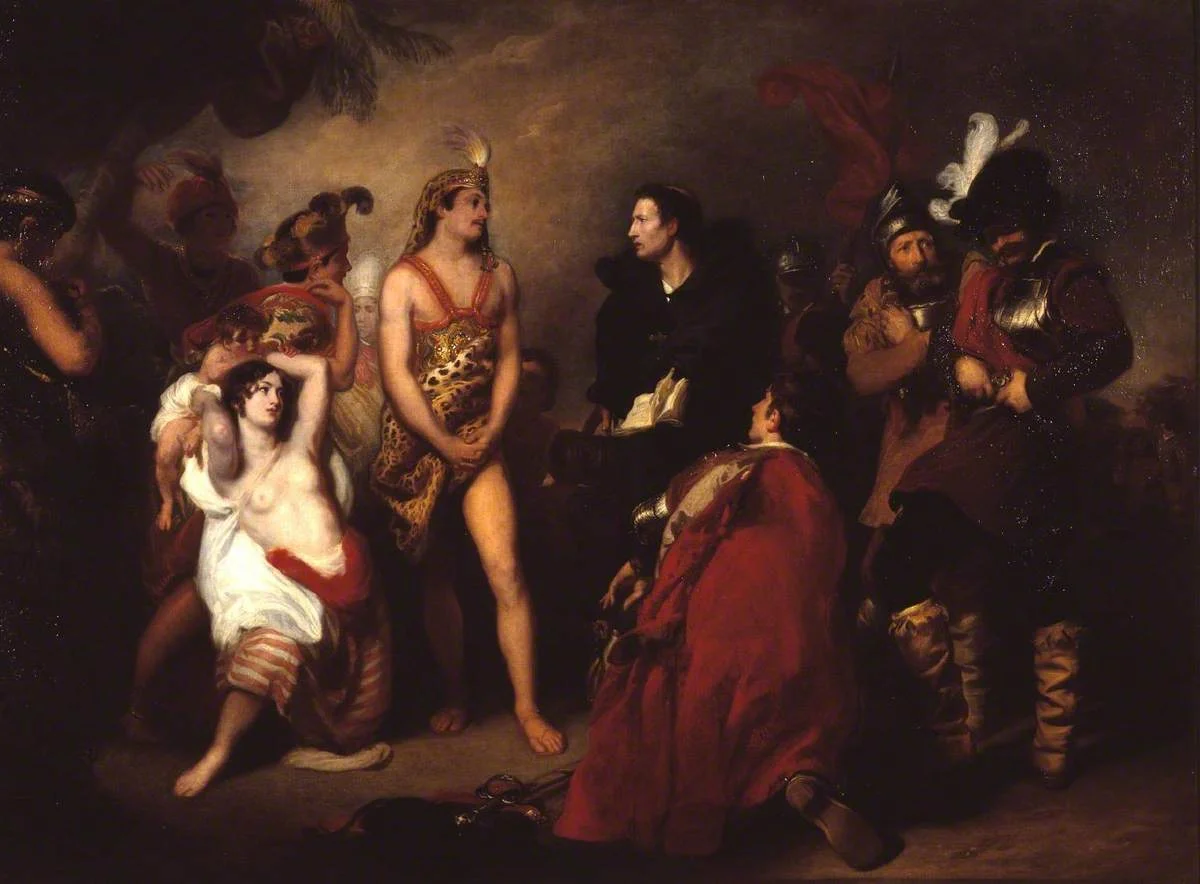
Atahualpa came down to the plaza unarmed. He had eighty thousand veteran soldiers in the hills above Cajamarca, fresh from beating his half-brother Huascar in a civil war that had just made him sole Sapa Inca - the supreme ruler of an empire stretching from Quito to central Chile. The 168 Spaniards who had walked into his mountain stronghold seemed strange and foreign and not particularly threatening. Atahualpa accepted their invitation to meet in the plaza on 16 November 1532 because he intended to overawe and capture them. He brought attendants, knives for hunting llamas, and a small honor guard of perhaps eight thousand men who were not carrying battle weapons. By sundown, his attendants and guard were dead. He himself was a prisoner. The empire he ruled would last another forty years, in fragmented form, before collapsing entirely.
The Sapa Inca and the Conquistador
Atahualpa was perhaps thirty-two years old, the son of the great expansionist emperor Huayna Capac, and had just won a brutal civil war against his half-brother Huascar. His commanders had captured Huascar near Cuzco only weeks before. The empire he now ruled was the largest in pre-Columbian America - somewhere between ten and sixteen million people across what are now Peru, Ecuador, Bolivia, and parts of Colombia, Chile, and Argentina. Francisco Pizarro was about fifty-four, illiterate, born poor in Spanish Extremadura, on his third expedition to Peru. He had 168 men, including 62 cavalry. He had four small cannons and a handful of arquebuses. He had Hernando de Soto, a brutal cavalry commander, as his second. He had his half-brothers Hernando, Juan, and Gonzalo Pizarro. He had the news from Cortes's Mexican conquest just over a decade before. He had no reasonable chance of conquering the Inca empire on military terms, and he knew it.
The Trap
Pizarro arrived in Cajamarca on Friday 15 November 1532. The town's two thousand inhabitants had largely cleared out. The Spaniards moved into the buildings around the empty central plaza, hiding cavalry in the alleyways, infantry behind the doorways, the cannons inside a stone building at the square's center. The plan was Cortes's plan from Mexico, scaled down: capture the emperor in the middle of his own army. Pedro Pizarro, who lived to write about it, recalled that during the long hours of waiting many of the Spanish urinated out of pure terror. They were 168 men in the middle of an empire of millions, with eighty thousand troops on the surrounding hills. If the trap failed, none of them would survive the day. Atahualpa kept them waiting. He bathed at hot springs nearby. He sent word he would arrive late. He came at dusk.
The Massacre
Friar Vicente de Valverde walked out into the plaza carrying a cross and a missal, with an interpreter, to demand that Atahualpa accept Catholicism and Charles V as his sovereign. Atahualpa was offended and confused. According to the chronicler Garcilaso de la Vega, he tried to make sense of the Spanish faith and king through poor translation, and the conversation broke down. According to the Inca account dictated decades later by Atahualpa's nephew Titu Cusi Yupanqui, Atahualpa had earlier offered the Spanish a ceremonial cup of chicha - the maize beer that consecrated formal meetings - and Pizarro had poured it on the ground. Atahualpa, insulted, threw the strange book the Spanish offered him to the ground in return. What happened next was minutes of organized killing. The cannons fired. The cavalry charged out of the alleyways. The Spanish swords cut down the unarmed attendants and the lightly armed guard. Pizarro himself reached Atahualpa's litter and pulled him from it. Outside the plaza, the eighty thousand-strong main Inca army, watching their emperor fall, scattered. The killing in the plaza ran for two hours. Estimates of Inca dead range from two thousand to seven thousand. No Spanish died.
The Ransom and the Garrote
Atahualpa, imprisoned, offered Pizarro the largest ransom in human history: a room filled once with gold and twice with silver. The Spanish accepted. For eight months Inca runners hauled treasure from temples and palaces across the empire to fill the room. While the gold piled up, the conquerors melted down sacred Inca metalwork - centuries of artistry reduced to ingots. With his commanders scattered and his half-brother Huascar dead by Atahualpa's order, the empire's machinery of governance had no center. When the ransom was paid, the Spanish convicted Atahualpa of crimes including ordering Huascar's death. They garroted him on 26 July 1533 in the plaza of Cajamarca, near where they had captured him. He was then about thirty-three. Pizarro went on to take Cuzco that November. The conquest was not over - Manco Inca's rebellion, the Vilcabamba state, the resistance lasted until 1572 - but the spine of the Inca state was broken in those eight months between November 1532 and July 1533.
What Was Lost, What Survived
Atahualpa's wife, Cuxirimay Ocllo, was ten years old when the Spanish captured her husband. She stayed with him in prison, was taken to Cuzco after his execution, became Pizarro's mistress at some point and bore him two sons. After Pizarro's assassination in 1541, she married the Spanish interpreter Juan de Betanzos, who later wrote one of the few accounts of the conquest told mostly from the Inca side - including interviews with Inca guards who had been near Atahualpa's litter when it fell. Most of his manuscript was lost for centuries until the complete text was found and published in 1987. The Inca civilization that Atahualpa ruled did not vanish. Quechua is still spoken by perhaps eight million people across the Andes. The descendants of his army still live on the same hillsides, plant the same potatoes, weave the same patterns. What ended at Cajamarca was sovereignty, not survival. The empire died. The people did not.
From the Air
Located at 7.16S, 78.52W in the northern Andes of Peru, in the Cajamarca region. The town sits at about 2,750m elevation on a plateau ringed by mountains. Visual landmarks: the colonial city center, the Cumbe Mayo pre-Inca aqueducts west of town, the Banos del Inca hot springs east of the city. Nearest airport: Cajamarca Mayor General FAP Armando Revoredo Iglesias (SPJR) on the western edge of the city. Mountain weather - frequent afternoon clouds and convective storms during November-April.
Nearby Stories
- Leimebamba District 31 km away
- Pirca Pirca 33 km away
- Otuzco 58 km away
- Revash 87 km away
- Rio Abiseo National Park 97 km away
- Santa Ana (La Florida) 246 km away
- Piura 272 km away
- Easter Island: The Mystery of Rise and Collapse 3870 km away