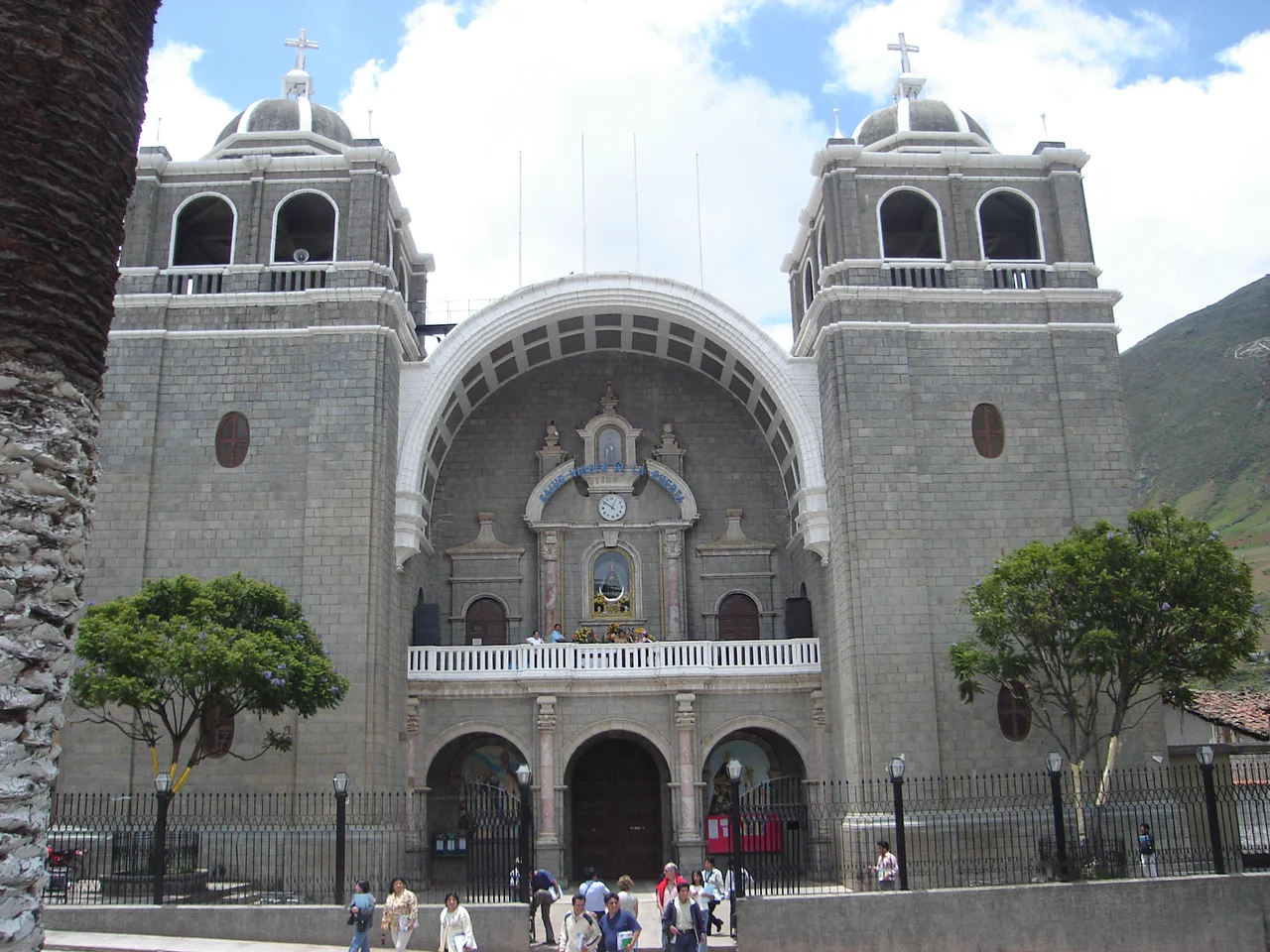

Otuzco
Every December, a river of people flows uphill. They leave Trujillo on the coast in the early morning - families with children on shoulders, grandmothers with walking sticks, teenagers in sneakers, priests in cassocks - and they start to climb. Seventy-three kilometers of mountain road, roughly three vertical kilometers of ascent. Some do it in a day. Most take longer. By the time they reach the altitude where the fog thins and the small city of Otuzco comes into view, they have been walking for days, and the point was never to get here fast. The point was to arrive having earned it. This is what they come for: the Virgin of the Gate, patron saint of Otuzco, whose feast is one of the most important religious holidays in South America.
Cut from Huamachuco
Otuzco exists as a province because two men decided it should. Don José Corcuera, deputy for the province of Huamachuco, and Don Enemecio Orbegozo, son of former Peruvian President Luis José de Orbegoso, put forward a law in 1856 to split Huamachuco Province and create a new one centered on Otuzco. That first attempt failed. The second, proposed later, was approved by the National Congress on April 17, 1861, and signed by President Ramón Castilla on April 25 of the same year. The new law carved Otuzco Province out of Huamachuco's territory and made the small town of Otuzco the provincial capital. Otuzco itself was only later elevated to the official status of city, by a law published on November 15, 1890.
Narrow Streets on a Steep Hill
The town sits in the La Libertad highlands at about 2,650 meters elevation, a walkable grid of narrow streets lined with low houses of tile roofs and wide doors. The Andean landscape crowds in from every direction - the Tupullo Gorge, the Pollo River, La Ermita mountain rising to the east. The architecture is simple and durable, shaped by centuries of repetition: stucco walls, wooden balconies, colored shutters, the kind of plaza with a fountain and a colonial church where people sit in the late afternoon. The Otuzcan area has been populated since the first human groups entered what is now La Libertad. Both Yunga-speaking peoples of the coast and Quechua-speaking highland groups left traces. Today the population is predominantly mestizo.
The Virgin of the Gate
The Virgin de la Puerta - Virgin of the Gate - has been venerated in Otuzco for centuries. The legend connects her image to protection against pirate raids and against epidemics. Whatever the precise origin, her cult outgrew the town long ago. The modern festival runs during the second week of December, drawing thousands of devotees to accompany her statue through the streets. Three nights of celebration unfold in sequence, each with fireworks, traditional hot air balloons lit from within, and more than twenty bands playing the haunting brass-and-percussion music of the northern highlands. Groups of dancers appear in costume - representing, in roles inherited from colonial religious pageantry, Romani figures, enslaved Africans, pallas, coyas, and devils. These are historical roles whose framing sits uneasily today. The week ends on December 15, when three-story-high bamboo castles of fireworks are lit and the night sky above the plaza becomes a continuous flash of color.
BurroCross
Among the festival events is one of the more unusual local traditions: BurroCross, the race of the donkeys. Riders - usually men of the surrounding villages - push their mounts through the streets and up into the surrounding mountain tracks, showing the control and partnership that come from riding these animals every day. Donkeys are not a symbolic flourish in Otuzco. They are still working transport. The mountainous terrain around the town is threaded with hundreds of dirt tracks that reach communities where vehicles cannot go. People load potatoes, wheat, firewood, and groceries onto the backs of donkeys and walk them along narrow cliff paths that thousands of hooves have worn into the rock. In the race, the everyday becomes the ceremony.
Wheat, Potatoes, and the Markets
Beyond the festival, Otuzco is a working highland agricultural economy. Wheat, potatoes, livestock, and traditional baked goods circulate through the weekly markets. Some of the production stays in town. The rest goes to Trujillo, three hours down the mountain, where it is sold at central markets in exchange for clothes, shoes, electrical goods, and produce from lower altitudes - which then come back up to be resold in Otuzco. Within a few kilometers of town, the cold dry highland terrain drops into warm fertile lower valleys famous for year-round pineapples and sugarcane. The climate compresses: a one-hour descent by colectivo takes you from sweater weather to sunscreen weather.
The Road the Other Way
The journey to Otuzco from Trujillo takes between one and two hours by paved highway - regular buses, small micros, or faster (and sometimes riskier) colectivos that leave from Avenida Union. Travelers arrive in a town that has, by design or by good fortune, stayed quieter than its more famous Andean cousins. Cuzco has turned much of its old center into a tourist stage. Otuzco has kept most of its streets for the people who actually live in them. Vendors sell in traditional clothing; donkeys still clop down the main street; most of the buildings are the same buildings they were a century ago. It is a place where the question of what to preserve has been answered differently - not by museum wall but by daily practice.
From the Air
Located at 7.90°S, 78.57°W in the La Libertad highlands of Peru, about 73 km northeast of Trujillo at roughly 2,650 meters elevation. Nearest commercial airport is Trujillo (TRU/SPRU) on the coast; paved mountain road connects the two. Recommended viewing altitude 11,000-14,000 feet AGL. Mornings are usually clearest; afternoon clouds often build over the cordillera. Surrounding terrain is steep - rugged valleys, narrow canyons, and hundreds of dirt tracks connecting mountain communities.
Nearby Stories
- Pallasca District 20 km away
- Battle of Cajamarca 45 km away
- La Galgada 63 km away
- Pirca Pirca 65 km away
- Rio Abiseo National Park 88 km away
- Piura 312 km away
- Easter Island: The Mystery of Rise and Collapse 3822 km away