
Revash
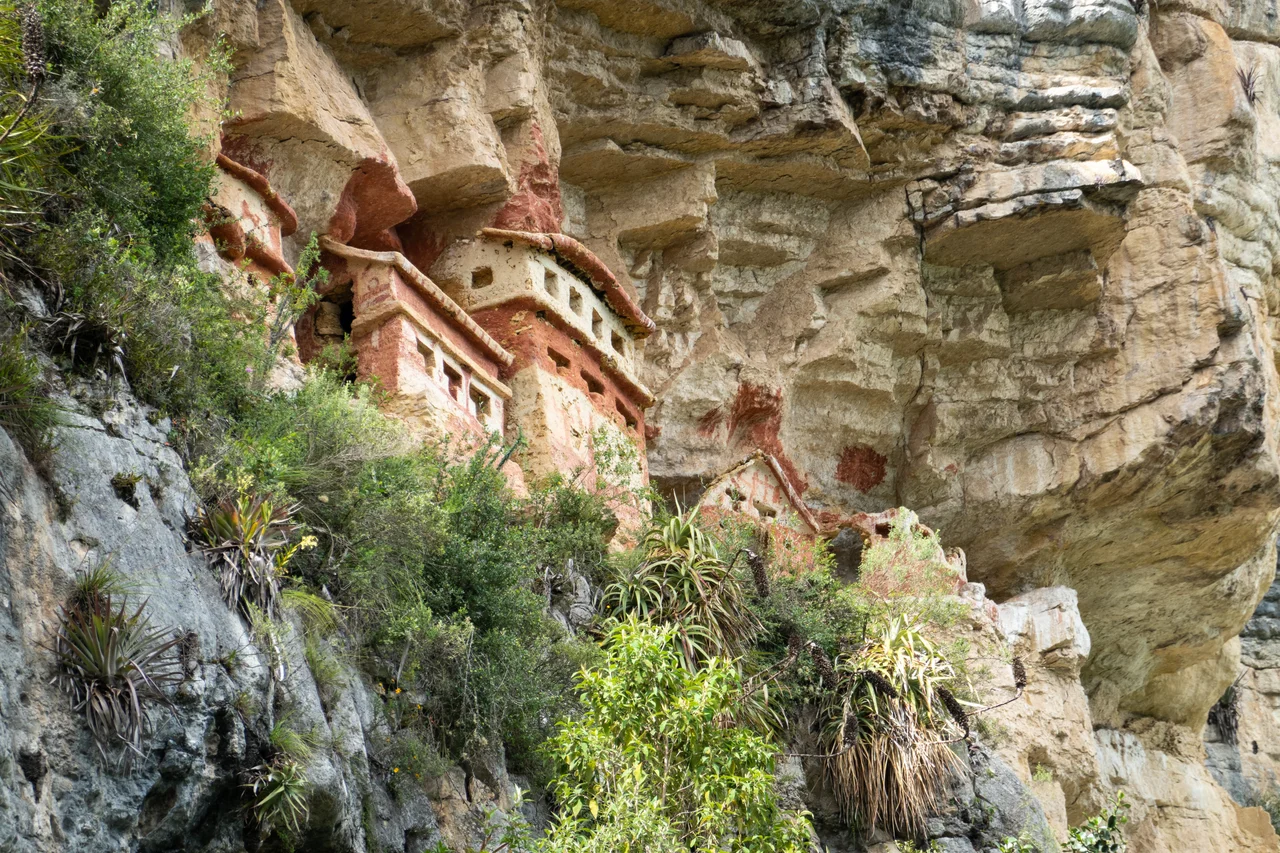
The paintings catch you first. Red ochre figures on whitewashed stone - small abstract people, suns, zigzags, feline shapes - pressed into the side of a cliff 2,800 meters above sea level in the Amazonas region of northern Peru. Revash is a cemetery in the shape of a miniature village, its funeral houses built tight against a limestone overhang in the Utcubamba valley. Walk along the base of the cliff and you can see where the Chachapoya - the cloud people - laid their dead in rooms that look, from across the canyon, exactly like the houses of a small town.
Cloud People
The Chachapoya were a civilization of the eastern cloud forests of Peru, inhabiting the high valleys between the Andes proper and the Amazon basin from roughly 800 CE until the Inca conquest in the 1470s. The Inca gave them the name - chacha pouya, often translated as cloud warriors or people of the cloud forest - and adopted some of their craftspeople but never fully controlled them. The Chachapoya built distinctive circular stone houses on ridgetops, massive fortress-towns like Kuelap, and funerary architecture unlike anything else in the Andes. Revash is one of their most striking surviving works. It sits in Santo Tomas district, part of Luya Province, about sixty kilometers south of the modern city of Chachapoyas, within the calcareous rock formation of Cerro Carbon along the left side of the upper Utcubamba valley.
Houses for the Powerful Dead
The funeral mansions of Revash run in a straight line along a narrow shelf carved by erosion into the cliff wall. The mausoleums are small rectangular stone buildings, one or two stories high, with sloped roofs and side doors rather than front doors. Because the cliff overhang above them keeps off rain and sun, the roofs are purely symbolic - mud cakes supported on sticks and reeds in the traditional quincha form. The walls were raised of stone set in mud mortar, and in the better-finished examples the inner surfaces were rubbed smooth and sometimes polished. The back of each tomb is the cliff itself. Judging from the bones still inside, the mausoleums were not individual burials but collective residences for prestige - community rooms for the powerful dead.
Red on White
What distinguishes Revash from other Chachapoya tombs is the decoration. The upper walls of each mausoleum are painted with moldings and figures: stylized feline forms, llamas or other South American camelids, human figures, two-color circles. Incised into the walls themselves are crosses, T-shapes, and rectangles. Their meaning is still argued over. The cross motifs resemble those used on the church at La Jalca downstream, which local tradition attributes to the mythical Juan Oso, 'little bear.' Whatever the Chachapoya artists meant them to signify, they clearly wanted the walls to be seen, not hidden. The position of Revash on its cliff and the brightness of the paintwork were a deliberate statement projected across the valley.
Mistaken for Something Else
Early observers compared Revash to the cliff dwellings of the Ancestral Puebloans in Colorado - Mesa Verde and similar sites. The resemblance is superficial but striking: small houses of stone stacked into conglomerates under rock overhangs, forming what look like miniature villages. But the Colorado cliff-dwellings were residences for the living, while Revash was built for the dead. The architectural similarity is coincidence, arising from two very different cultures deciding that the best place to build something important was up against a well-protected cliff. The Reichlens - Henry and Paule, French archaeologists who published on the site in 1950 - dated Revash to around the 14th century CE and linked its construction philosophically to chullpas, the collective burial towers common in the Tiwanaku-Huari period of ancient Peru.
Almost Intact
The mausoleums survived five centuries mostly intact, but the mummies they once held did not. Rodents destroyed some of the remains. Looters - local, regional, international - took most of the rest long before modern archaeologists arrived. Charles Wiener, the French explorer, was the first outsider to document the Chachapoya mausoleum tradition in the late 19th century. Systematic work came much later. Between 1983 and 1986, the Antisuyo expeditions of the Amazon Archaeology Institute identified and documented not just Revash but dozens of similar cliff cemeteries across the region - Ochin, La Petaca at Leimebamba, and others - each with its own version of the Chachapoya idea that the dead deserved houses. A different Chachapoya site, Pueblo de los Muertos, sits on a cliff just to the north. Revash is the most famous because the paint survived.
What Remains Worth Seeing
You can't get inside Revash without a guide and a serious hike from the village of San Bartolo or Cruzpata. The site is still essentially as the cloud forest left it - walls intact, paintings faded but legible, bone fragments scattered. It has not been turned into a controlled archaeological park, and for a place that has been vandalized this thoroughly, that is surprising. What makes Revash worth the effort is what it tells you about a civilization Spanish chroniclers mostly ignored: that the Chachapoya lived on ridge-tops, buried their dead on cliff-faces, and thought carefully about what their tombs would say from a kilometer away. The answer they wanted, it seems, was: we lived here, and we were good enough to be remembered.
From the Air
Located at 6.54 degrees south, 77.86 degrees west, in Peru's Amazonas region, about 60 km south of the city of Chachapoyas. The site is set in a limestone cliff at 2,800 meters elevation overlooking the Utcubamba valley. Terrain is rugged cloud forest - deep canyons, thick vegetation, frequent low clouds. Nearest paved airport is Chachapoyas (SPGB / CHH). The region suffers from rapid orographic buildup and low ceilings; IFR typically requires careful timing.
Nearby Stories
- Pirca Pirca 24 km away
- Pueblo de Los Muertos 25 km away
- Battle of Cajamarca 36 km away
- 1990-91 Alto Mayo Earthquakes 40 km away
- Marañón Dry Forests 53 km away
- Gran Pajatén 69 km away
- Moyobamba 75 km away
- Otuzco 147 km away