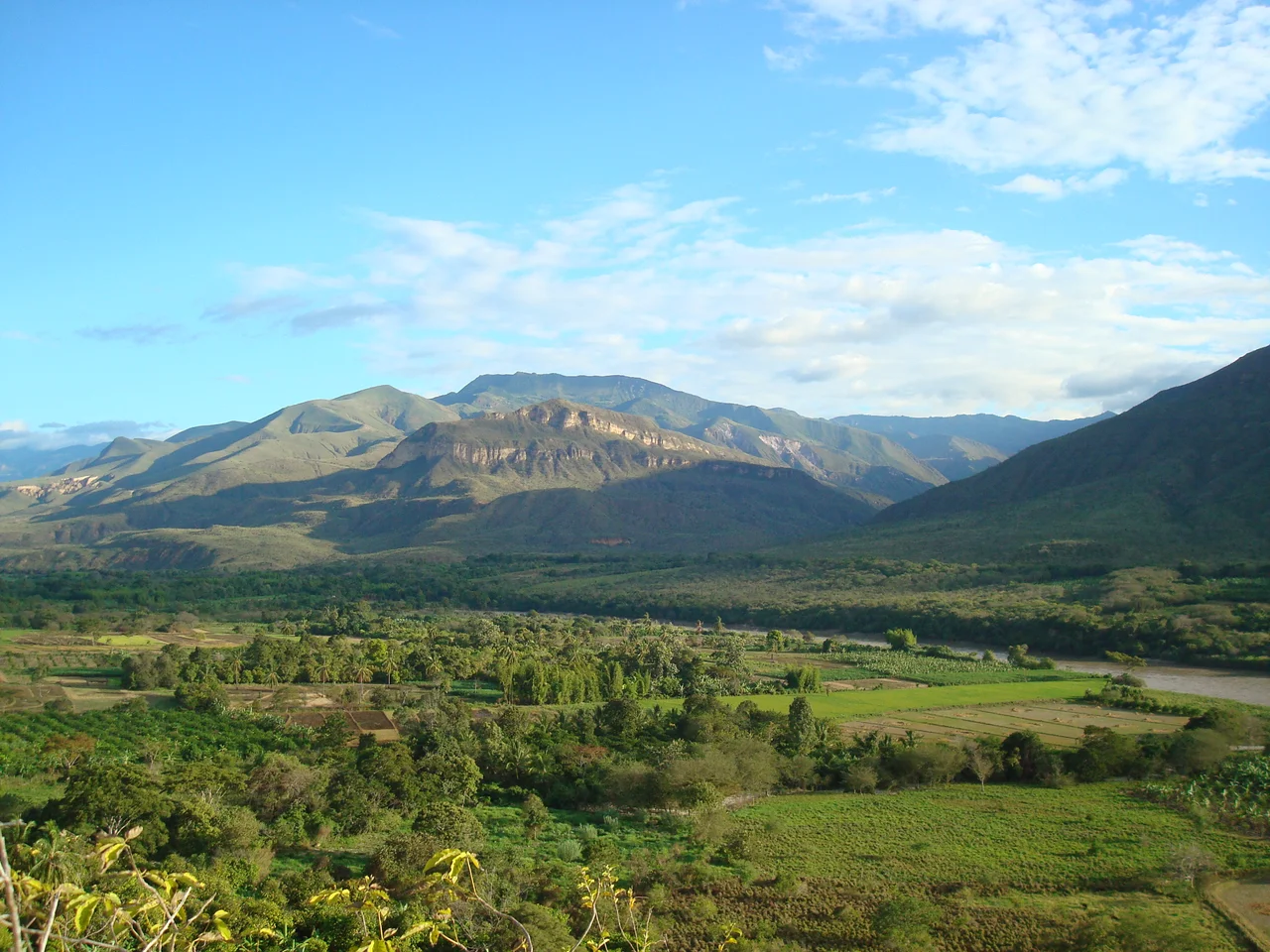

Marañón Dry Forests
Look at a satellite image of northern Peru and you will find a strange green fingerprint pressed into the Andes. East of it: the saturated emerald of the Amazon. West of it: the cold, pale tones of the western cordillera. Between them, running along the Marañón River and its tributaries, a narrower, drier ribbon - not desert, not jungle, but something biologically stranger than either. The Marañón Dry Forests cover more than a million hectares of inter-Andean valley, and they are, botanically, the richest of their kind anywhere in the Andes.
The Rainshadow
The forest exists because of what the Andes block. Moisture-laden clouds roll in from the Amazon basin to the east and run into the eastern cordillera. They rise, they cool, they dump their rain on the windward slope. By the time whatever is left crosses into the Marañón valley, most of the water is already gone. At elevations below 600 meters, the valley receives as little as 162 millimeters of rain per year - about the amount that falls on Phoenix, Arizona. Higher up, rainfall increases, but the pattern of dry warmth stays the same. It is a Cfb climate in the Köppen system: warm temperate, fully humid, warm summer. The land sweats rather than rains.
The River That Built It
The Marañón itself rises on the Nevado de Yapura glacier high in the western cordillera, then runs northwest between the two Andean chains, a river boxed in by mountains. It turns northeast, cuts through them at the Pongo de Manseriche gorge, and spills into the Amazon lowlands where it meets the Ucayali to form the Amazon proper. The dry forest ecoregion follows the river's upper valley from Tayabamba District near Rio Abiseo National Park in the south, downstream past Jaén where the Chamaya joins in, and onward along the valleys of the Utcubamba and Chiriaco rivers. The Cordillera de Colán National Sanctuary protects the eastern edge.
The Richest of the Dry Valleys
The Marañón Dry Forests hold 184 woody plant species, making them botanically the richest inter-Andean valley dry forest. Sixty-nine species are endemic to Peru, and many of those live in small, isolated pockets. The cast of characters includes drought specialists that look like they belong in Mexico: the spiny Acacia macracantha, the silky-trunked Ceiba insignis with its bottle-shaped form, the knife-armed Parkinsonia praecox, the cacti Praecereus euchlorus and Rauhocereus riosaniensis. Recently described species include Parkinsonia peruviana and Ruprechtia aperta, and botanists have even created a new plant genus, Maraniona, for a tree found nowhere else. Every survey turns up more.
Birds in the Gaps
The forest is a factory of endemism for birds as well. Twenty-two restricted-range species live here, and eleven are found nowhere else on Earth. The Marañón spinetail (Synallaxis maranonica), a little brown bird of the undergrowth, is endangered. So is the yellow-bellied seedeater. The painted frog (Atelopus pachydermus), one of the valley's amphibian endemics, is also endangered. These are not the charismatic animals that fill glossy wildlife magazines. They are the small, specialized lives that rainshadow valleys produce when they remain isolated long enough - each species a signature of ecological time.
Part of a Larger Family
The Marañón Dry Forests belong to a global ecoregion called the Tumbesian-Andean Valleys Dry Forests, which covers 103,000 square kilometers and includes six terrestrial ecoregions strung along western South America. The Tumbes-Piura dry forests of the Peruvian-Ecuadorian coast. The Ecuadorian dry forests. The Patía Valley, Magdalena Valley, and Cauca Valley dry forests of Colombia. And the Marañón. Each holds its own endemics, but they share a broad family resemblance - the climate of the rainshadow, the seasonal deciduous cycle, the high degree of local specialization. Together they are one of the most threatened biomes in the Americas.
The Dam Question
The Marañón Dry Forests have been modified for centuries by farming, cattle ranching, and logging. Patches of original forest remain in the steeper country, but most of the accessible valley is now a working agricultural landscape. The bigger threat is newer. In April 2011, Peruvian President Alan García announced plans for a series of 20 hydroelectric or irrigation dams on the Marañón, 18 of them in environmentally sensitive areas that include parts of the dry forest ecoregion. The projects would displace indigenous communities, farmers, and fishermen along the river, flood habitat that evolved in isolation over millions of years, and alter the river system that made the whole dry forest possible. Some projects have advanced; others have stalled under opposition. The forest's future is, in the most literal sense, still up in the air.
From the Air
Located at 5.94°S, 78.67°W in northern Peru, along the upper Marañón River valley. The ecoregion covers 1,139,594 hectares at elevations between roughly 400 and 2,500 meters, running northwest-southeast between the Andean cordilleras. Nearest commercial airports are Jaén (JAE/SPJE), Cajamarca (CJA/SPJR), and Chachapoyas (CHH/SPPY). Recommended viewing altitude 10,000-14,000 feet AGL. The dry, deciduous canopy contrasts sharply with the wet forests on surrounding slopes, making the valley easy to identify from the air.
Nearby Stories
- Gocta 23 km away
- Revash 48 km away
- Leimebamba District 105 km away
- Santa Ana (La Florida) 110 km away
- Borja, Peru 140 km away
- Ayabaca province 155 km away
- El Airo, Loja 156 km away
- Easter Island: The Mystery of Rise and Collapse 3956 km away