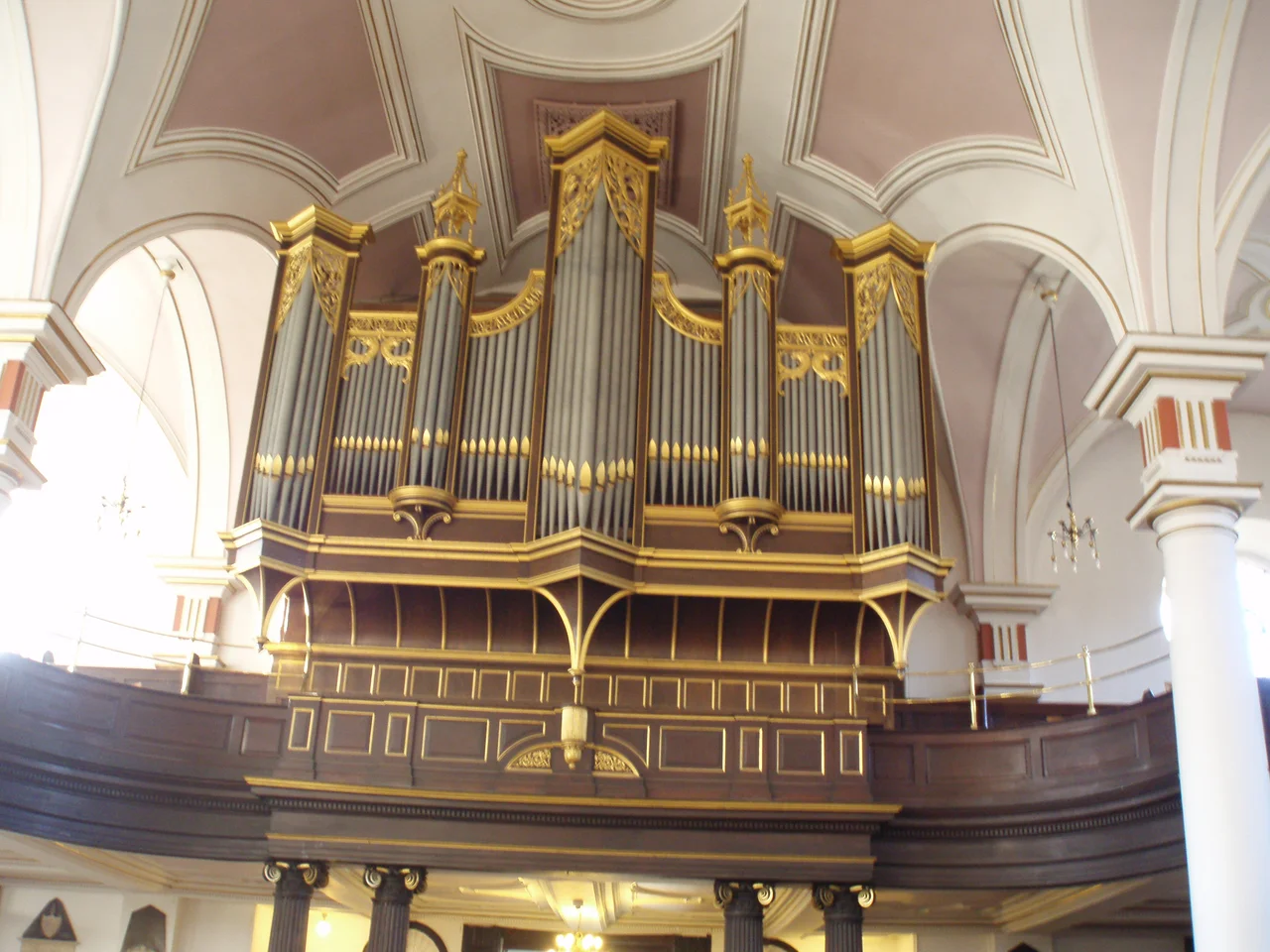

Derby Cathedral
On a February night in 1723 the vicar of All Saints, Derby, decided his church was too far gone to repair, so he hired a gang of workmen and had the building demolished before dawn. The Mayor and Corporation woke up to a fait accompli and a heap of rubble where their parish church had stood, and they did the only thing they could: they started fundraising. Two years later the great Georgian architect James Gibbs completed the elegant Neo-Classical hall that still forms the body of Derby Cathedral. Above it rises a Perpendicular Gothic tower from the 1530s, the only piece of the old church the midnight workmen spared. Today the tower is famous for the peregrine falcons that nest on a platform near its top and for the fact that its clock mechanism is driven by gun barrels.
From Edmund I to Bonnie Prince Charlie
The site has been a church for more than a thousand years. King Edmund I, an Anglo-Saxon monarch of the mid-tenth century, founded a royal collegiate church of All Saints here around 943, of which nothing physical survives. By the time of the Domesday Book in 1086 the church belonged to the king and was served by a college of seven priests. A second medieval church replaced the Saxon building in the fourteenth century, and the great tower, 212 feet tall, was added between 1510 and 1532, just before the Reformation closed off that style of building for good. The tower's twelve grotesque carved figures, three on each face, and the two stone Green Men flanking the West Door, are the surviving signatures of the Perpendicular Gothic stonemasons. By the time Bonnie Prince Charlie reached Derby in December 1745, the church was the most prominent building in town. He used the city as the southernmost point of his Jacobite march and then turned back. The cathedral now has a replica of the room where he held his fateful council of war.
Joan Waste and the Burning Road
Not every chapter of the church's history is comfortable. In 1556, during the reign of Mary I, a blind weaver named Joan Waste was tried for heresy inside All Saints. She had refused to abandon the Protestant translation of the New Testament she had paid to have read aloud to her, and the Marian authorities sentenced her to be burned alive. She was executed on the Burton Road in Derby that same year. She was 22 years old. The trial happened inside the building James Gibbs would later replace, but the floor she was condemned on lay under the same tower the cathedral keeps today. Joan Waste's name is now read at memorial services for the Marian martyrs, a small acknowledgement of a real woman whose blindness was apparently treated as evidence by the prosecution. The cathedral remembers her as a quiet undertow to its more triumphal history.
Bakewell's Iron, Gibbs's Restraint
When James Gibbs rebuilt the nave between 1723 and 1725 he did so on the cheap. "It is the more beautiful for having no galleries," he wrote in his Book of Architecture, "which, as well as pews, clog up and spoil the insides of churches." The Neo-Classical interior was deliberately austere. To save it from feeling cold, Gibbs commissioned a local ironsmith named Robert Bakewell to forge a wrought-iron chancel screen that stretches the full width of the church. Bakewell was paid 150 guineas, the equivalent of about a year's salary for a skilled tradesman, and the screen took him five years to finish, opening to the public in 1730. The entrance gates of the cathedral, moved here from St Mary's Gate in 1957, are also his work. Stand close to the screen and the iron looks almost cast, the leaves and curls have a softness no machine has matched.
Bess and the Cavendishes
The cathedral is also the burial place of the most powerful Englishwoman of the Tudor age. Bess of Hardwick, four times married, four times widowed, the builder of Hardwick Hall and grandmother to half the English nobility, lies in the south chancel under a stately alabaster effigy carved during her lifetime. Around her are monuments to the Cavendish family she founded, the Dukes of Devonshire of later centuries, including a memorial brass to the polymath Henry Cavendish and one to Georgiana Cavendish, Duchess of Devonshire, the 18th-century political celebrity whose 1806 funeral procession through Derby drew thousands. The cathedral also holds the tomb of John Lombe, the young industrial spy whose silk mill on the River Derwent, a few hundred yards from where his body rests, launched Britain's factory system in 1721.
Carbines and Falcons
Restorers in 1964 discovered something unexpected about the clock that drives the cathedral's two stone dials. The long metal tubes driven through the tower walls to connect the dial faces to the mechanism turned out to be cavalry carbine barrels, almost certainly looted or salvaged from the 1745 Jacobite rising. Whoever rebuilt the clockworks after Bonnie Prince Charlie's retreat had used the abandoned firearms as the cheapest available long tubes. The barrels are still there. So, more visibly, are the peregrine falcons. A pair settled on the tower in late 2005, a nesting platform was installed in 2006, and webcams in 2007 began letting Derbyshire follow their chicks. The breeding pair raised young successfully every year through 2016, when the old male was finally displaced by a younger rival. The female accepted the new arrival, and the lineage continued. Two hundred feet above the streets of Derby, urban falcons hunt pigeons from the gargoyles of a Tudor tower while choristers practice below. It is the kind of layered improbability that Gibbs would, presumably, have approved of.
From the Air
Derby Cathedral stands at 52.92°N, 1.48°W on Irongate in the medieval core of Derby, the principal city of Derbyshire. From the air the 212-foot tower is a clear vertical landmark above the surrounding low brick streets, with the River Derwent flowing past a few hundred yards to the east. East Midlands Airport (EGNX) lies 9 nautical miles to the southeast, the closest major field. Birmingham (EGBB) is roughly 32 nm to the southwest. Recommended viewing altitude is 1,500 to 3,000 feet to read the tower, the cathedral roof, and the nearby Derwent crossing.
Nearby Stories
- Prestbury, Cheshire 4.2 km away
- Stoke-on-Trent 5 km away
- Bingham, Nottinghamshire 8.6 km away
- Beauchief Abbey 9.6 km away
- Shot at Dawn Memorial 9.6 km away
- White Ladies Priory 13 km away
- Oakham 23 km away
- Battle of Gainsborough 24 km away