.jpg)
Derby Fort
St Michael's Isle is barely an island — a low green hump of grass and rock at the end of a causeway, with sea on every side and seabirds working the air above it. On its summit sit the ruins of an artillery battery that mattered, briefly, in a war eight hundred miles away. James Stanley, the 7th Earl of Derby and Lord of Mann, built Derby Fort here in 1645 while the English Civil War was eating his fortunes elsewhere. Within six years he would be captured and beheaded. Within twenty years his protégé Illiam Dhone, who had surrendered the island to Parliament, would be shot at Hango Hill up the bay. The fort itself outlasted them both, and is still here, more or less, with eight gun-ports facing a stretch of sea where the threats stopped arriving a long time ago.
Henry VIII's First Stone
The Stanleys were not the first to fortify this spot. Around 1540, on the orders of King Henry VIII, Edward Stanley — 3rd Earl of Derby, four generations earlier — had a defensive work built on St Michael's Isle to guard against a possible Scottish or French invasion. The 1540s were a paranoid decade in English coastal planning, and the small ports of the Irish Sea got their share of attention. That earlier fort is gone now beneath the later one. What you see today is the work of his great-great-grandson James, raised in the middle of the much more serious crisis of the Civil War, when the Stanleys backed the King against Parliament and needed every harbour on the island held.
Eight Gun-Ports Above the Bay
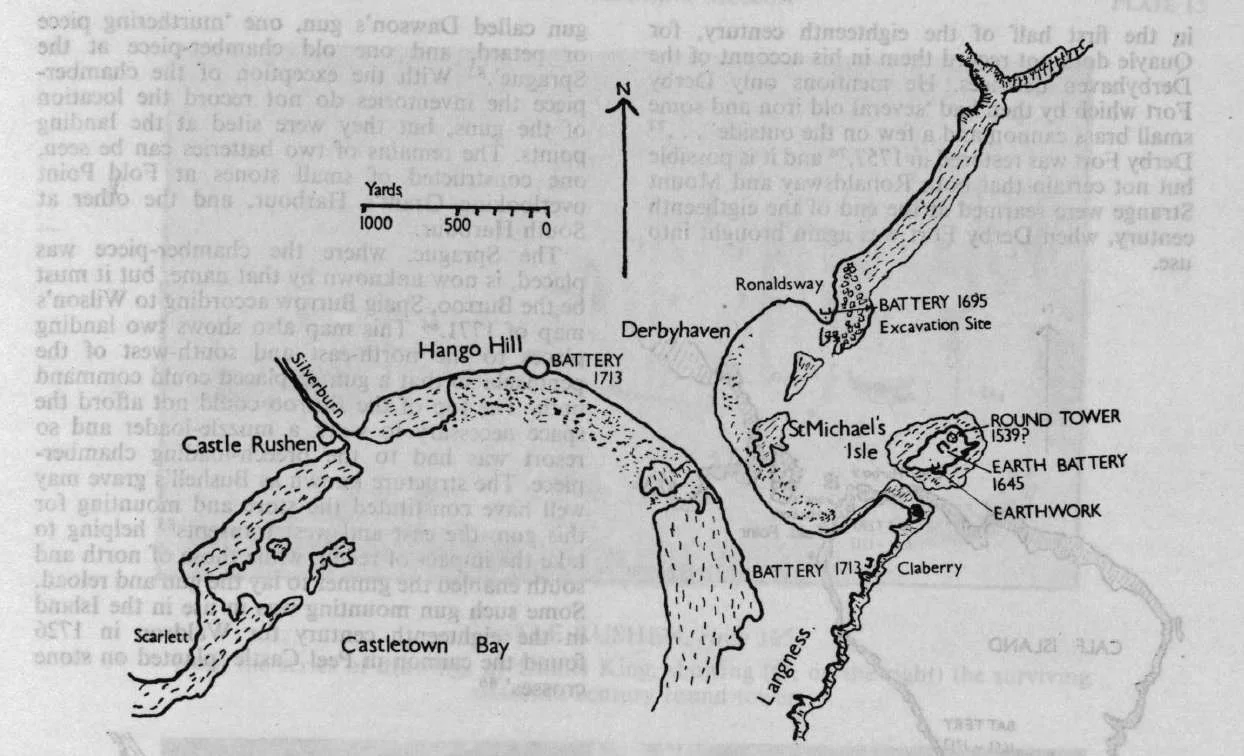
The battery James Stanley built is a round stone tower with walls eight feet thick and eight gun-ports cut around its circumference. A shallow ditch enclosed the site, with the earth from the ditch piled into a parapet on the seaward side rather than around the whole perimeter — economy of effort, in a war that did not allow many leisurely projects. By 1651 the fort's armament consisted of one demi-culverin, one saker, two demi-sakers and a sling-piece — the smooth-bore brass and cast-iron guns that were the standard of seventeenth-century coastal defence. In June 1645, only months after construction, the fort showed what it was for: a Royalist supply ship in Derbyhaven Bay was attacked by Captain Robert Page of the bark Plyodes, and the Plyodes came under fire from these guns before a party of soldiers boarded and took her. Whether this counts as a success or a failure for the fort depends, as so much in the Civil War did, on which side you were on.
The Defensive Problem
Derby Fort did not actually solve the defensive problem of Derbyhaven. From its position on St Michael's Isle to the far side of the bay is around 800 yards, and the seventeenth-century guns mounted here could not reach a ship anchored in the north-western part of the harbour. Nor could they bring fire to bear on a ship to the east. The point was finally acknowledged in 1695, when a new fort at Ronaldsway was added, and again in 1713, when a further battery — Mount Strange — went up on Hango Hill itself. By the time of the War of the Spanish Succession the defences of Derbyhaven had been thickened again with additional batteries. The fort here became part of a broader, redundant system, and after the Napoleonic Wars, when British naval supremacy made the whole question moot, the great guns of the Isle of Man fell silent. Derby Fort was effectively out of military use by the early 1820s.
What You Find Today
Today St Michael's Isle is a bird sanctuary, reachable by causeway from the Langness Peninsula east of Castletown Airport. The fort is roofless and weathered, its parapet still traceable on the northwest side facing across Derbyhaven Bay, and the shallow ditch still visible on the other three sides. The twelfth-century St Michael's Chapel sits a short walk away on the same small island — an even older fragment, from a time when this place was a halt for pilgrims rather than a gun-platform. Fulmars wheel. The wind drives spray over the causeway at high tide. A visitor with a map and an hour can stand in the round of the battery, look out through one of the eight gun-ports, and see exactly the stretch of bay that the cannon could not quite reach.
From the Air
Derby Fort is at 54.075N, 4.605W on St Michael's Isle, immediately east of the Ronaldsway runway threshold. Best viewed at 1,000 to 2,000 feet on departure or final approach to Ronaldsway (EGNS) — the small tidal island, the round battery on its summit, and the chapel a hundred yards away are all visible in clear weather. The causeway from Langness is the obvious link. Derbyhaven Bay opens to the north, with Castletown beyond and Hango Hill on the coast road between the two.
Nearby Stories
- RAF Jurby Head 14 km away
- German submarine U-246 16 km away
- German submarine U-1051 17 km away
- Kilclief Castle 18 km away
- Ardglass 31 km away
- St Bees Lighthouse 44 km away
- Trwyn Du Lighthouse 54 km away
- Seascale Lifeboat Station 61 km away