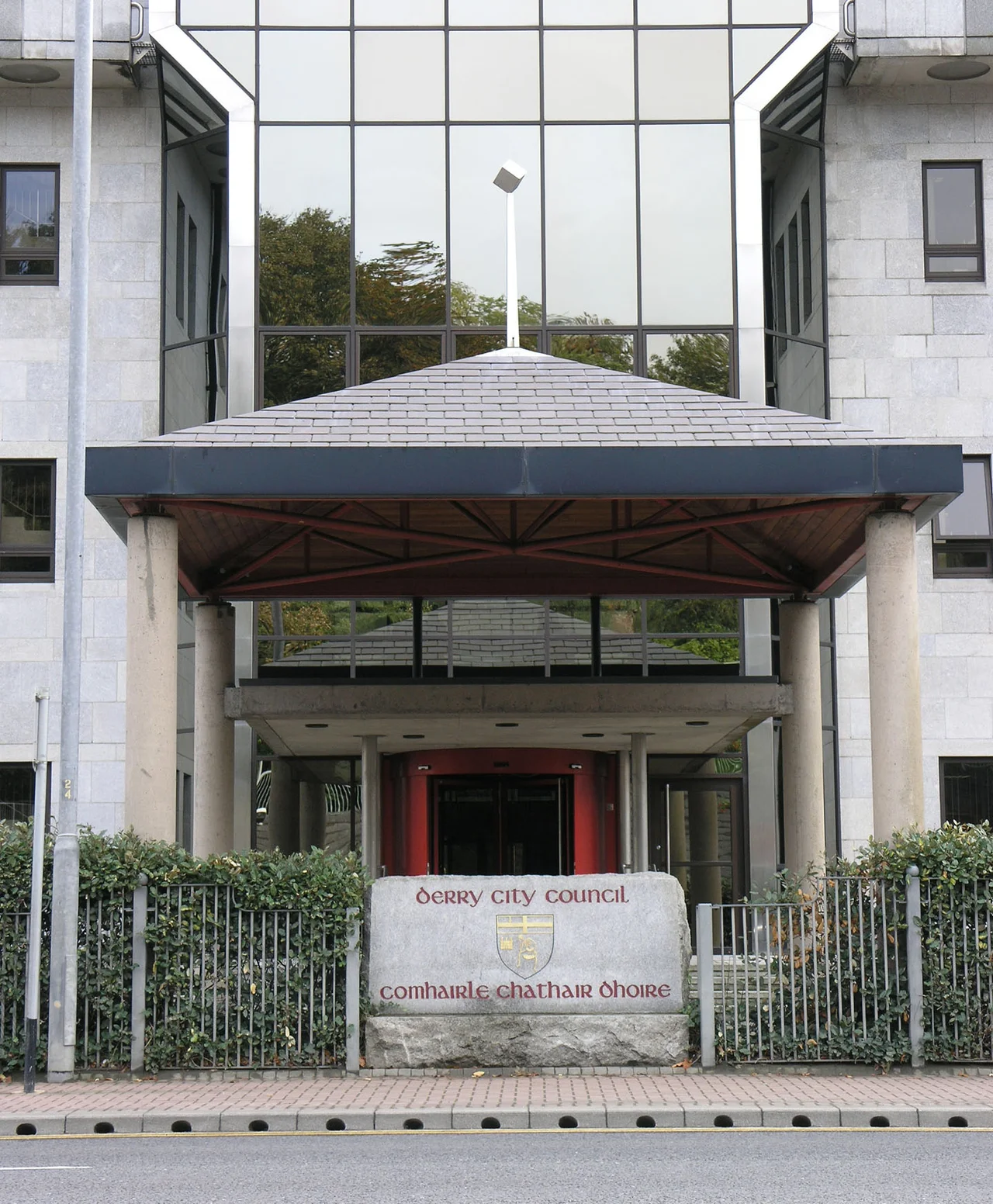

Derry City Council
The coat of arms granted to Derry's corporation in 1613 by Daniel Molyneux, Ulster King of Arms, includes a human skeleton sitting on a mossy stone, watched over by a triple-towered castle on a black field. The figure is reputed to be a Norman knight named De Burgh who was starved to death in a castle dungeon in 1332 on the orders of his cousin the Earl of Ulster. As civic symbols go, it is unusually candid about its origins. The local authority that inherited that bony heraldry, Derry City Council, ran the city through forty-two years that took it from gerrymandered unionist control to nationalist majority and on into reform. It was dissolved in April 2015 when it merged with Strabane District Council to form the present Derry and Strabane District Council. The skeleton survives. So does the harp.
From Corporation to Commission
From 1613 until 1969, Derry was run by Londonderry Corporation under a charter granted by James I. The city's medieval walls had been built only a few years earlier, by the same City of London livery companies, to garrison a Protestant settlement against the Catholic Gaelic hinterland. The Corporation was an instrument of that settlement and remained one for centuries. By the late 1960s its electoral wards had been drawn and redrawn to keep a unionist majority in a city with a Catholic majority population. In 1968 the Cameron Commission documented the gerrymander in detail. The British government's response was to abolish the elected Corporation entirely and replace it in 1969 with the unelected Londonderry Development Commission, charged with running the city as a new town until proper reform could be designed. The Commission was, in effect, an admission that the old system was unfixable.
The Single Transferable Vote
Reform arrived in 1973 with the Local Government (Boundaries) Act and the Local Government Act of 1972. The old county borough was merged with the surrounding rural district to form a single Londonderry district, and elections were conducted under the single transferable vote, the proportional system used elsewhere in Ireland. The first STV election that year produced what the gerrymander had been designed to prevent: a council that reflected the city's actual political opinion. The Social Democratic and Labour Party became the largest party and remained so at every subsequent election until the council's dissolution. Sinn Féin grew steadily in the 1980s and 1990s. The Ulster Unionists and the Democratic Unionists were elected from the Waterside, the east bank of the Foyle where most of the city's Protestants lived. In 2005 no unionist candidate stood for election at all in the west bank, an electoral fact that nobody much disputed.
The Argument About a Name
In 1984 the council voted to rename itself from Londonderry City Council to Derry City Council. This was, technically, only a name change applying to the council, not to the city itself, which legally remains Londonderry under its 1613 charter. The renamed council also rechristened the local airport from Londonderry Eglinton to City of Derry. Two Ulster Unionist councillors, Jim Guy and David Davis, broke ranks with a unionist boycott to vote for the change; they were expelled by their party and successfully re-elected as Independent Unionists. The name dispute has continued ever since. Locals call the city Derry, Londonderry, the Maiden City, or, with a kind of weary humour, Stroke City. The BBC tries to use both. The road signs sometimes hold both names. Some Derry-born unionists call it Londonderry as a deliberate small assertion. Some Derry-born nationalists call it Derry for the same reason in reverse.
The Guildhall
The council met in the Guildhall, the red sandstone hall on the riverside built in 1890, gutted by an IRA bomb in 1972, and restored. In the same building, between 2000 and 2004, the Saville Inquiry heard nine hundred witnesses give evidence about Bloody Sunday. The Inquiry's chairman, Lord Saville, sat where mayors had once chaired meetings about street lighting and refuse collection. The building thus carried, in the very same chamber, two different kinds of public business: the routine work of running a city and the slow, difficult work of telling the truth about what had happened in that city's streets. Outside the Guildhall the council kept its skeleton on the city seal. Inside, the harp was restored to the centre of the cross in 2003 after the College of Arms accepted that it had been there in the 1613 original.
What the Merger Changed
The 2015 reform of Northern Ireland's councils reduced the number of district councils from twenty-six to eleven. Derry City Council merged with Strabane District Council to form Derry and Strabane District Council, covering nearly the whole north-west corner of Northern Ireland. The merger ended forty-two years of a Derry-only local authority. The new council inherited the Guildhall, the City of Derry Airport, the city walls, and the Saville Inquiry's transcripts. It also inherited, by stages, a younger and slowly more reconciled population. Brenda Stevenson of the SDLP was the final mayor of Derry City Council in 2014-15; her deputy was Gary Middleton of the DUP. They had to share a small platform and present, jointly, the final ceremonial business of a body that had begun in 1973 as an experiment in whether Derry could be governed equitably. The answer turned out to be: yes, with patience, and at the cost of a lot of arguments about a name.
From the Air
Derry sits at roughly 55.00 degrees north, 7.33 degrees west, at the bend of the River Foyle just before it widens into Lough Foyle. The walled hilltop of the old city, with the Guildhall on the riverside and the Bogside spreading west and south below the western walls, is one of the most distinctive urban silhouettes in Ireland. The nearest controlled airport is City of Derry (EGAE), the former Londonderry Eglinton, just east of the city; Donegal Airport (EIDL) lies about 60 km west across the border. Belfast International (EGAA) is roughly 100 km east. From cruise Lough Foyle stretches north of the city; the long ridge of Inishowen rises on the far side.
Nearby Stories
- Portrush Lifeboat Station 1.9 km away
- Main Street, Letterkenny 2.1 km away
- Inishowen 6 km away
- Rosguill 6.3 km away
- County Tyrone 7.1 km away
- St Patrick's College, Maghera 9.6 km away
- St Patrick's Purgatory 11 km away
- Coalisland Canal 17 km away