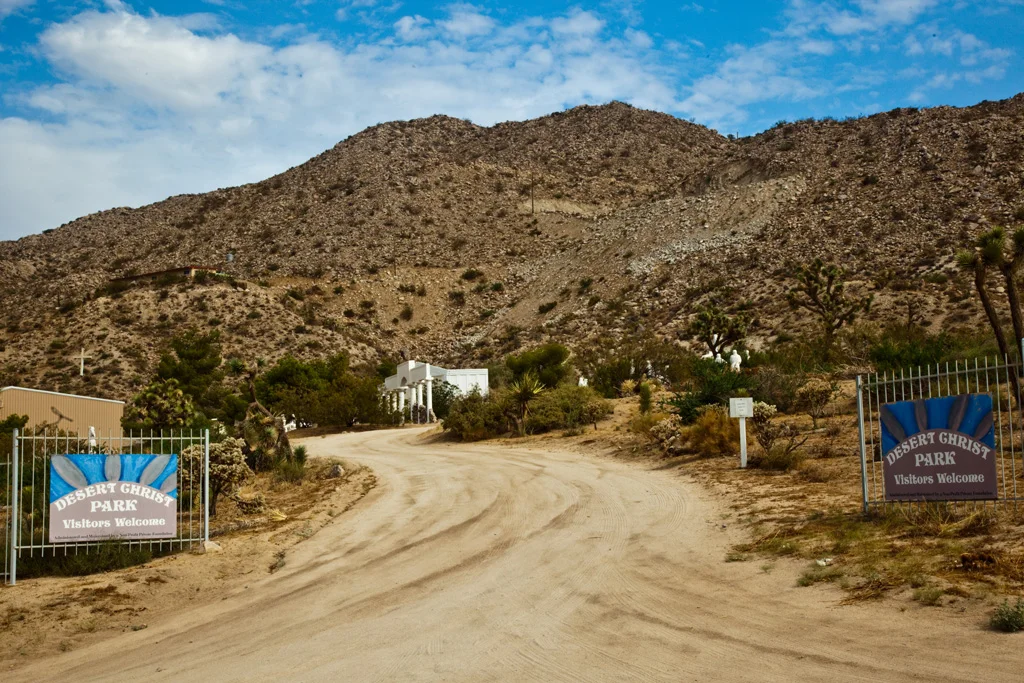

Desert Christ Park
The mid-1940s were not a comfortable time for faith in permanence. The atomic bomb had arrived, and with it the knowledge that cities could disappear in a moment. Into this anxiety, a man named Antone Martin climbed a hillside in Yucca Valley and began placing concrete figures in the desert. He was not a professional sculptor. He had worked in aircraft. But he had a vision of what the hillside should look like, and he had years ahead of him to make it real.
One Man's Commission
Antone Martin was 74 years old when he died in 1961, and by that point he had spent the better part of two decades building a sculpture garden on 3.5 acres of Yucca Valley hillside. The impulse behind it was explicitly religious and explicitly political: Martin wanted to create something that would inspire peace during a period when nuclear annihilation seemed genuinely possible. Steel-reinforced concrete was his medium, chosen for durability rather than tradition. The Twelve Apostles stand in groupings across the hillside. A 10-foot figure of Jesus watches over them — a form reminiscent of Rio de Janeiro's Christ the Redeemer, but built by one man with aircraft worker's hands rather than by an international team of engineers and artists.
Church, State, and the Desert Garden
For decades after Martin's death, the sculpture garden operated as an informal public attraction in a county that owned the surrounding land. In 1988, the American Civil Liberties Union filed suit against San Bernardino County, arguing that public ownership of land bearing explicitly Christian religious imagery violated the constitutional separation of church and state. The litigation lasted until 1996, creating uncertainty about the park's future and eventually leading to its transfer to a nonprofit foundation that now manages it. The legal dispute put Antone Martin's hillside sculptures at the center of a national conversation about religion in public space — a context their creator probably did not anticipate when he was mixing concrete in the California desert during the Truman administration.
Concrete That Outlasts Ideology
The sculptures themselves have weathered the legal battle and the decades since Martin's death with varying degrees of physical integrity. Desert conditions are difficult on outdoor art: temperature swings, UV radiation, and occasional moisture stress concrete and paint in ways that require ongoing attention. The nonprofit foundation that took over management has worked to preserve and restore the figures, maintaining the hillside park as a place of quiet contemplation open to anyone who climbs its paths. The Jesus figure, arms extended over the Yucca Valley, is visible from the road below — a reference point in the landscape that has become, through sheer longevity, a local landmark.
The Hillside as Testament
Desert Christ Park occupies a particular position in the landscape of American outsider art: created by a single individual without formal training, motivated by sincere religious conviction and genuine historical fear, and built to last in a medium that has largely survived. Martin's aircraft background gave him practical knowledge of structural reinforcement and material behavior, which is why the steel-and-concrete figures have persisted when works in less durable media would not. The park sits in Yucca Valley with Joshua Tree National Park nearby, a juxtaposition that makes the hillside sculpture garden feel both isolated and connected — an act of personal devotion placed within the large, mostly empty desert that has long attracted people with unconventional purposes.
From the Air
Located at 34.129°N, 116.44°W in Yucca Valley, Desert Christ Park is on a hillside visible from the road through town. From cruising altitude, Yucca Valley appears as a substantial community along the Highway 62 corridor northeast of Palm Springs, with the park's hillside in the residential portion of town. Joshua Tree National Park begins at the northern edge of the urban area. Nearest airports: KPSP (Palm Springs International, approximately 25 miles south-southwest), KTNP (Twentynine Palms, approximately 20 miles east-northeast). The distinctive boulder formations of Joshua Tree are visible extending north from the town.
Nearby Stories
- 2016 I-10 tour bus crash 2.5 km away
- Cholla Cactus Garden 7.9 km away
- Wonder Valley, California 13 km away
- Amboy Crater 23 km away
- San Bernardino Train Disaster 26 km away
- Hector Mine 32 km away
- Bell Canyon 47 km away
- Edwards Air Force Base 90 km away