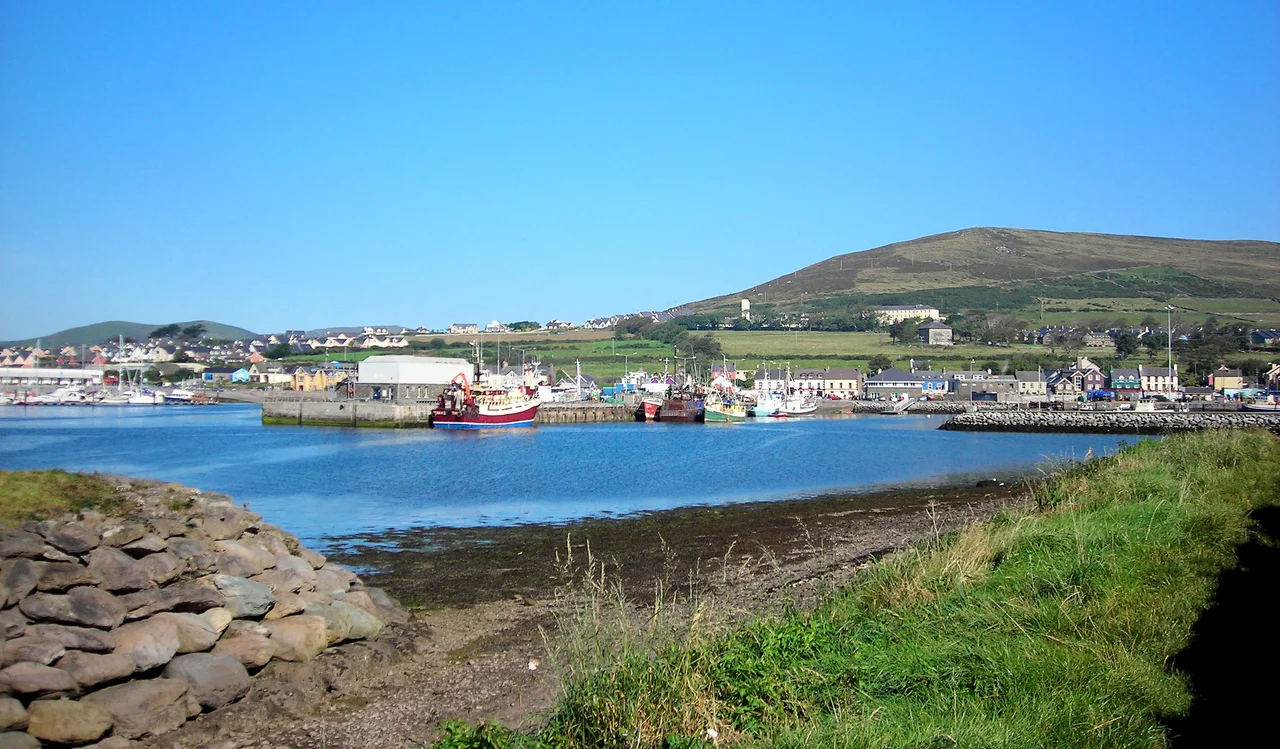

Dingle
Fungie arrived in Dingle Harbour in 1983, and for thirty-seven years he refused to leave. A solitary adult male bottlenose dolphin — exceptionally rare behaviour for a species that lives in pods — he met the fishing boats at the harbour mouth, swam beside the kayakers, leapt out of the wake of the tour ferries that ran on his account. Marine biologists never fully explained him. The town built statues to him, named ice creams after him, depended on him. In October 2020, he did not appear. He has not appeared since. A bronze figure on the pier still watches the water where he used to be, and Dingle has had to be Dingle without its most famous resident for the first time in nearly four decades.
Daingean Uí Chúis
The town's Irish name is Daingean Uí Chúis — 'the fort of Ó Cúis' — and the question of what to call it became, briefly, a national controversy. In 2005, the government announced that anglicised place names in Gaeltacht areas would no longer appear on official signs. 'Dingle' lost its legal status. The town, which depends on tourists who type 'Dingle' into their satnavs, protested. A 2006 plebiscite favoured a bilingual name. In 2011, legislation made Dingle the official English name and Daingean Uí Chúis the official Irish name. On signs within the Gaeltacht, however, only the Irish form appears — and some locals, taking matters into their own hands, spray-painted 'Dingle' onto road signs that bore only the Gaelic version.
A Port Older Than Limerick
By the thirteenth century, more goods passed through Dingle than through Limerick. Wine arrived from Bordeaux. Hides and fish left for the continent. King Henry III imposed customs duties on the port's exports in 1257, and by 1329 the Earl of Desmond was taxing the wine trade for his own purse. Spanish and French fleets based themselves here. The town became a major embarkation point for Irish pilgrims sailing to Santiago de Compostela, and the parish church was dedicated to Saint James under what local records call 'Spanish patronage.' In 1569, Dingle was named one of fifteen Irish ports with a monopoly on wine imports — a level of commercial importance hard to imagine standing in the modern town with its single main street.
Fishing, Then and Now
Modern Dingle's fishing industry dates from around 1830, but the 1870s changed everything: nobby fleets from the Isle of Man arrived in pursuit of mackerel, and Lowestoft herring trawlers joined them, extending the season into the autumn months. The pier was rebuilt by the Congested Districts Board, an arm of the state set up to relieve poverty along the western seaboard. When rail reached Dingle in 1891, fish could be sent the same day to Dublin and London, and canning and curing factories sprang up around the harbour. The trains are gone — the last narrow-gauge service ran in 1953 — but the boats still go out before dawn and come back with mackerel, hake, and shellfish for the restaurants along Strand Street.
Music, Murphy's, and the McDonald Connection
Traditional music spills out of pubs along the main streets most evenings of the summer — fiddle, accordion, bodhrán, sometimes a singer in seán-nós, the old unaccompanied Irish style. Dingle Distillery, founded in 2012, runs its still on the edge of town. Murphy's Ice Cream, made with milk from Kerry cattle, has expanded across Ireland but began here. Inside Saint Mary's church, six double-lancet stained glass windows by Harry Clarke — the great Irish Arts and Crafts artist — depict scenes from the life of Christ in saturated jewel colours that catch the morning light. And in a curiosity that few visitors notice, this small Atlantic town is also the ancestral home of the parents of Richard and Maurice McDonald, the brothers who founded the McDonald's hamburger restaurant chain in California.
After Fungie
When Fungie failed to appear in October 2020, the town initially refused to accept it. Search parties of boats combed the bay. Tourism operators told reporters they were certain he would return. He did not. A bottlenose dolphin's lifespan in the wild is typically thirty to forty years, and Fungie was already an adult when he first appeared. The likeliest answer is the most ordinary one: he died. What he left behind is not just a vacant slip of water but a town whose identity had been bound up with one extraordinary, unexplainable animal for two generations. People still come to Dingle. The bronze statue still waits. Now and then, locals say, a fin breaks the surface — though never the right one.
From the Air
Located at 52.14°N, 10.28°W on the north shore of Dingle Bay, on the south side of the Dingle Peninsula. Population around 1,671. Nearest airport is Kerry (EIKY), about 50 km east. The harbour is sheltered behind Beenbane Head and Eask Tower; the latter, a 19th-century signal tower, makes a useful visual fix from the air. Recommended viewing altitude 2,000–4,000 feet for the harbour, town, and the surrounding patchwork of stone-walled fields.
Nearby Stories
- Ballyheigue Castle 1 km away
- Killemlagh Church 2.8 km away
- Pouldergaderry Sinkhole 6.8 km away
- Derreen Garden 11 km away
- Kilkee 59 km away
- The Laki Eruption: The Volcano That Changed World History 1366 km away
- The Northern Lights: The Sky Show That Vikings Thought Was Bridge to the Gods 1469 km away
- Sao Miguel 1935 km away