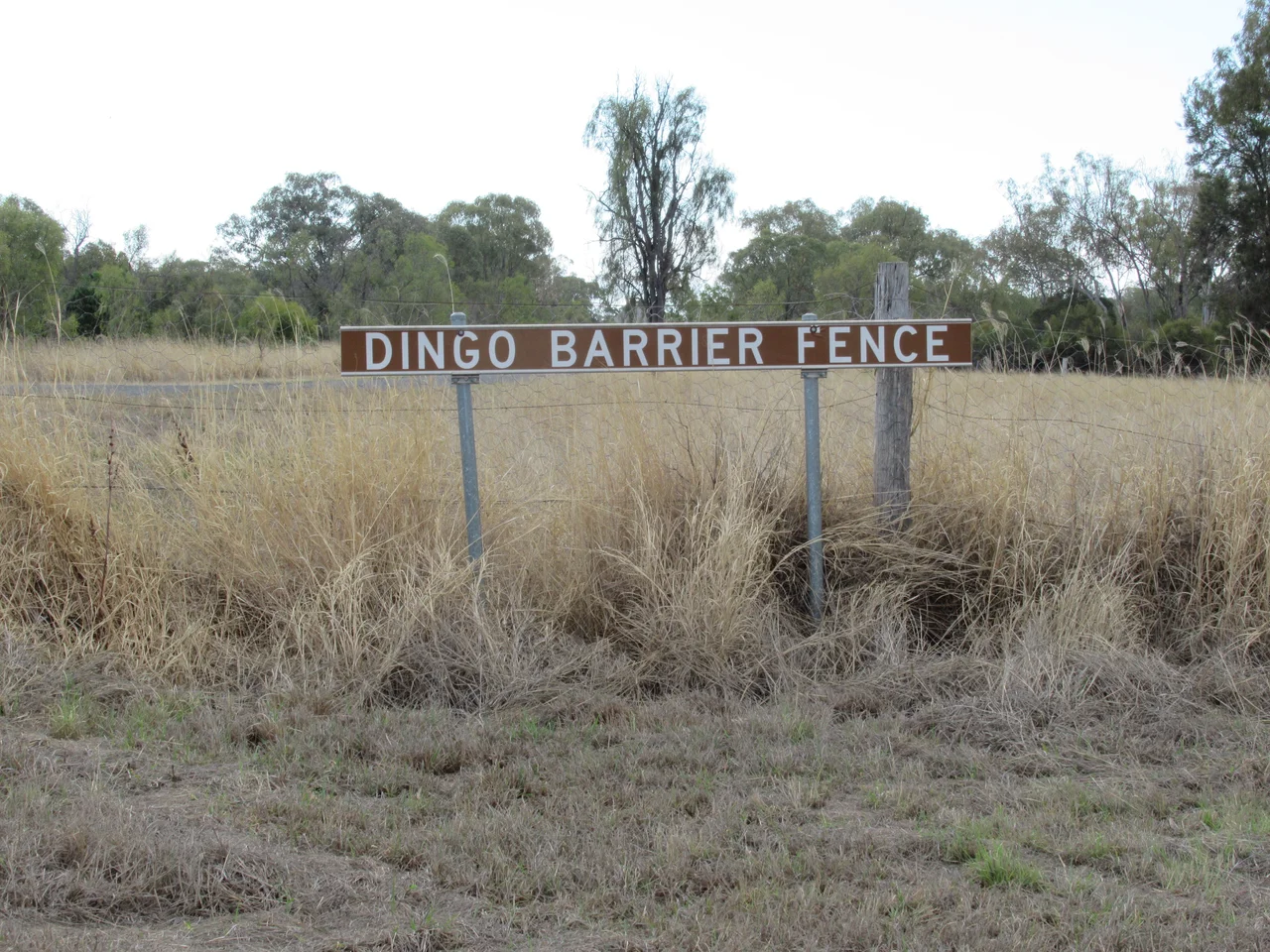

Dingo Fence
It runs for 5,614 kilometres, a thread of wire mesh stitched across the belly of Australia from the farmland of southern Queensland to the cliffs above the Great Australian Bight. You could drive for days and never reach its end. The Dingo Fence is one of the longest structures humans have ever built, longer than the Great Wall of China is in any continuous run, and it exists to keep one animal out of the southeast. What it has actually kept out, and what it has let run wild, is a story still being argued today.
The Longest Line in Australia
The fence begins at Jimbour on the Darling Downs near Dalby and ends west of the Eyre Peninsula, on the Nullarbor cliffs near Nundroo. Most of it stands about 180 centimetres of wire mesh, unremarkable up close, staggering in aggregate. It was once even longer. Until 1980 the barrier ran more than 8,600 kilometres before sections were retired, leaving today's 5,614. It is not one fence but a chain of them, knitted together: the Wild Dog Barrier Fence across Queensland, the border fences down the New South Wales boundary, and the long Dog Fence through South Australia. The whole thing passes through Cameron Corner, the point where three states meet, where the Queensland and South Australian fences join. Parts are even lit at night by red and white lamps, powered by sunlight banked in batteries during the day.
Keeping the Patrol
A barrier this long does not maintain itself. In Queensland the Wild Dog Barrier Fence is worked by crews including two-person teams who patrol 300-kilometre sections twice a week, running out from depots at Quilpie and Roma. On the New South Wales side, a team of around thirteen staff each take responsibility for stretches of sixty to a hundred kilometres, walking and checking their portions every Monday and Friday in some of the most punishing country on the continent. It is endless, repetitive, solitary labour: find the break, mend the wire, drive on. A single hole can undo months of work. Holes discovered in the 1990s let dingo pups through, a reminder that against a clever predator and a vast distance, the fence is only ever as strong as its weakest metre.
The Ecology of an Absence
The fence has reduced sheep losses, but the cost has been written into the land itself. Ecologist Mike Letnic has documented what happens where the dingo, Australia's top predator, is removed: biodiversity falls, and native mammals grow scarcer. Without dingoes to check them, kangaroos, emus and rabbits multiply and strip the pasture the fence was meant to protect. Stand on either side of the line in places and the difference is visible in the vegetation. The dingo's own status remains contested, native or introduced, pest or keystone, and the science increasingly suggests that the predator the fence excludes was holding the whole system in balance. By keeping dingoes out, the fence may have unleashed problems larger than the one it was built to solve.
A Barrier With a Shadow
The fence's history is not only ecological. When construction began in the 1880s, exclusion barriers like this one served the pastoral expansion that dispossessed Aboriginal people of their Country, and researchers such as Dr Justine Philip have argued that the fences also functioned to keep First Nations people off the land, a violent legacy rarely acknowledged in those terms. That past sits uneasily beside the fence's present. In late 2023, work began on a 32-kilometre extension to close the last gap between the New South Wales and South Australian fences, finished in 2024, even as ecologists called the project a step backwards. Officials defend the line as one tool among many against biosecurity threats. After more than a century, Australia is still asking whether the longest fence on Earth protects the country or scars it.
From the Air
At Cameron Corner the Dingo Fence crosses at roughly 29.00 degrees south, 141.00 degrees east, where the Queensland and South Australian border fences join the New South Wales line. From the air the fence is one of the most striking features in the outback: a perfectly straight cleared corridor of track and wire that runs arrow-straight to both horizons, slicing across red dunes, gibber plains and saltbush regardless of terrain. Follow it and it will lead you to Cameron Corner's store and tri-state golf course. Best traced from 2,000 to 5,000 feet AGL, where the line's relentless geometry against the chaotic desert reads most dramatically. Nearest strips are Cameron Corner and Tibooburra (YTIB), about 130 km southeast; expect severe summer heat haze and excellent low-sun definition in winter.
Nearby Stories
- Sturt National Park 28 km away
- Tibooburra 65 km away
- Lake Callabonna 79 km away
- Albert Goldfield Ruins 81 km away
- Strzelecki Creek 94 km away
- Strzelecki Desert 109 km away
- Innamincka Station 110 km away
- Wilson River (Queensland) 114 km away