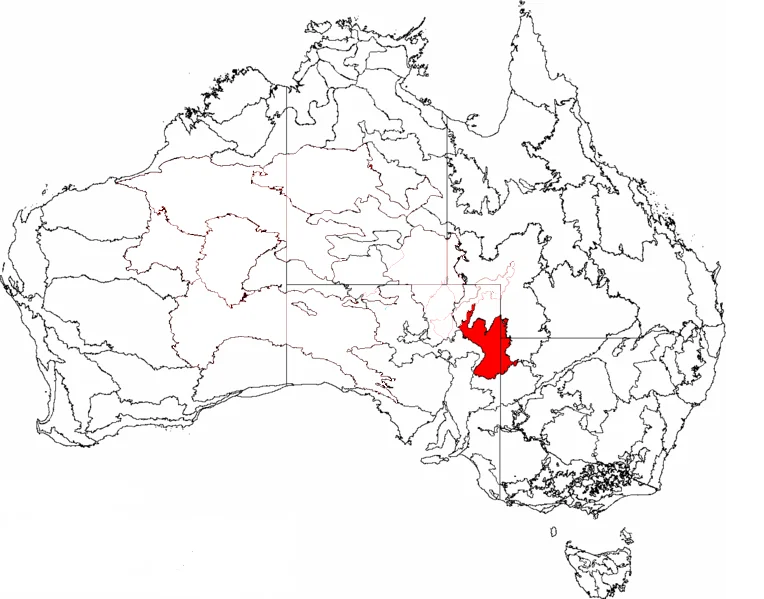

Strzelecki Desert
The man whose name marks this desert never set eyes on it. Pawel Edmund Strzelecki was a Polish explorer and geologist who roamed the eastern colonies in the 1840s, and it was Charles Sturt - the first non-Aboriginal explorer to push into this country, in late 1845 - who pinned his friend's tongue-twisting surname to the dunes. So the Strzelecki Desert wears the name of a man more than two thousand kilometres from where he made his reputation, across a wilderness of red sand he likely never imagined. It is a fitting irony for a place defined as much by who passed through it as by what is there.
A Sea of Dunes
The Strzelecki sprawls across the corner where South Australia, Queensland and New South Wales meet, covering some eighty thousand square kilometres - the seventh largest desert in Australia. It sits in the northeast of the Lake Eyre Basin, north of the Flinders Ranges, sharing that great inland drainage with the Tirari and the vast Simpson to its west. Its signature is sand: long parallel dunes marching for kilometres, sculpted by the wind into a corrugated landscape that early travellers found maddening to cross. Three formally recognised wilderness areas lie within it, and much of the South Australian portion is protected inside the Strzelecki Regional Reserve, with the eastern fringe guarded by Sturt National Park across the New South Wales border.
The Tracks Across the Sand
For a place so empty, the Strzelecki is crossed by an extraordinary number of famous lines. The Strzelecki Track and the Birdsville Track, two of the most storied outback stock routes in the country, run through it. So do the great desert watercourses - the Diamantina River, Cooper Creek and Strzelecki Creek - which carry water across the sand in the rare wet years and feed the life of the basin. And running through it all is the Dingo Fence, the longest fence on Earth, built to keep wild dogs from the sheep country to the south. To cross the Strzelecki is to trace these threads: a desert mapped not by towns but by the routes people cut to get through it.
Life Among the Knolls
The desert is harsh but not lifeless. Among the dunes survives a population of the endangered dusky hopping mouse, a tiny native rodent that bounds across the sand on oversized hind feet and can live without ever drinking free water, extracting what it needs from seeds. The country also throws up surprises in its terrain. Near Lake Blanche, the smooth dunes give way to the Cobbler Sandhills, a stretch where the sand is replaced by small eroded knolls capped with vegetation. The name carries a wry station-hand's joke: "cobblers" were the toughest, last sheep left in the shearing pen, the ones nobody wanted to tackle - and these broken hills were just as awkward to get through, defeating many an early attempt to cross the desert by car.
In the Explorers' Wake
Sturt came first, in 1845, dragging a boat across the sand in the doomed hope of finding an inland sea. He found dunes instead. Sixteen years later the Burke and Wills expedition passed through this same harsh country on its ill-fated journey, perishing not far away on Cooper Creek. The Strzelecki became fixed in the national imagination as a place that swallowed explorers, a blank and brutal interior. Yet the Aboriginal peoples of the region had read and lived in this country for thousands of years, finding water and food where the newcomers found only emptiness. The desert that broke European expeditions was, to those who truly knew it, simply home.
From the Air
The Strzelecki Desert spans the meeting point of South Australia, Queensland and New South Wales, centred near 27.7 degrees south, 140.4 degrees east, north of the Flinders Ranges. From the air the long parallel red dunes are the defining feature - a vast corrugated sea of sand, with the green ribbons of Cooper Creek and Strzelecki Creek cutting across in places. The dead-straight line of the Dingo Fence and the Strzelecki Track are useful navigation references. Nearest airstrips are Innamincka (YINN) to the north, Moomba (YOOM) within the desert, and Cameron Corner nearby; services are extremely sparse. Best viewing is 3,000 to 7,000 feet AGL. Expect severe summer heat, brilliant dry-season visibility, and sudden dust haze in wind.
Nearby Stories
- Oontoo, Queensland 5.6 km away
- Malkumba-Coongie Lakes National Park 34 km away
- Ballera gas plant 82 km away
- Koonchera Point Massacre 92 km away
- Diamantina River 112 km away
- Dingo Fence 117 km away
- Mungerannie 124 km away
- Cameron Corner Survey Marker 129 km away