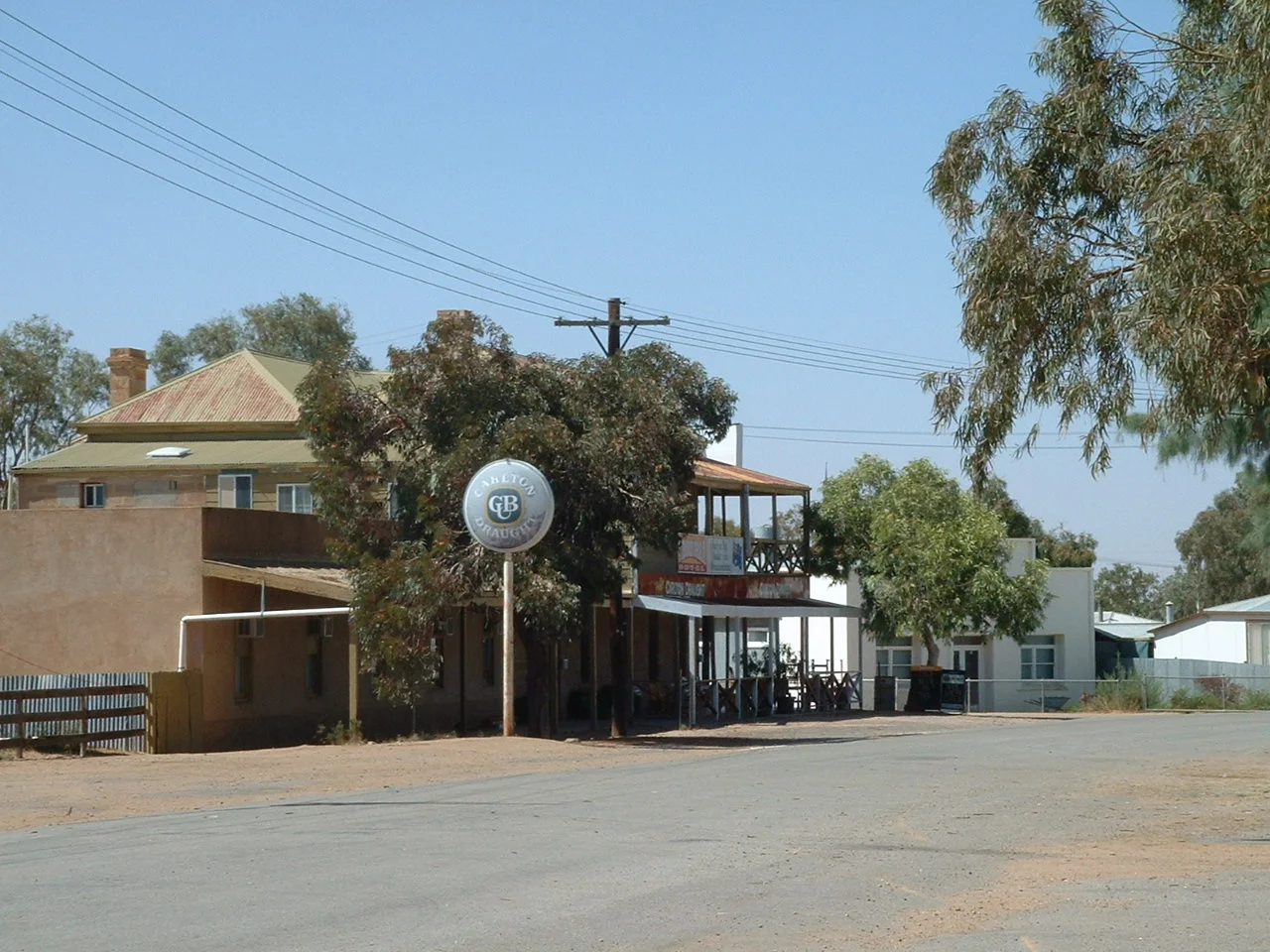

Tibooburra
The name means "heap of boulders," and the boulders are everywhere, great rounded domes of granite shouldering up between the houses and out into the streets themselves, as though the town were built on the back of some sleeping stone creature. Tibooburra sits 1,187 kilometres from Sydney, near the far northwest corner of New South Wales, and it is regularly the hottest town in the state. Fewer than a hundred people live here. Almost everyone passing through is on their way to somewhere even more remote.
The Granites
Before it had its current name, this place was simply called The Granites, and you only need to stand in the main street to understand why. The weathered tors that erupt among the buildings are the town's defining feature, a landscape so distinctive that artists made the long pilgrimage here to paint it. Tibooburra is the transliteration of an Aboriginal word for a heap of boulders, and the streets, named after European explorers by the surveyor who laid them out, run between rocks that long predate any of those names. The heat is the other constant. Summer temperatures climb above 40 degrees with grinding regularity, frosts bite on winter nights, and rain is so scarce that in 1919 the town saw barely 48 millimetres for the entire year. When the rare deluge does come, it can drop nearly twice the annual average in a single month.
Sturt's Gateway
In 1844, Charles Sturt and his men came through this country dragging a whaleboat across the desert, so certain of an inland sea that they had brought a vessel to sail it. Drought trapped them for six months at Depot Glen, south of here, before the land defeated their push northwest. Modern travellers who reach Tibooburra get the clearest sense of what that effort cost; it is hard country to cross even now, on sealed roads. The town later became a waypoint in the search for Burke and Wills, who had passed through in 1860, and it was those doomed rescue expeditions of 1861 that finally opened the region to the pastoral industry. Sturt's name is everywhere here still, on the national park, on the memorials, written across a landscape that very nearly killed him.
Gold in the Streets
In 1880, gold was found around Tibooburra, riding the wave of a rush to the nearby Albert Goldfields at Milparinka. It was said that after heavy rain, gold lay exposed in the streets. By 1887 nineteen gold-puddling machines were grinding away, and roughly 250 people had gathered at and around the diggings. The boom did not last. By 1900 the gold had mostly given out, and sheep stations, vast by necessity in such dry country, took over as the mainstay of local life. For more than a century rough unsealed roads kept Tibooburra isolated from the world; only with four-wheel-drive tourism and, finally, a sealed road completed in 2020 did the town come within comfortable reach. The drive-in theatre still stands on the main street, an unlikely relic of the outback.
Murals in the Family Hotel
The Family Hotel opened in 1882, and its walls hold the town's most surprising treasure. The painter Clifton Pugh, drawn like other artists to this remote corner, often stayed at the pub and covered an inside wall with murals, drawings and sketches that still draw visitors in for a drink and a look. Down the street, the more substantial two-storey Tibooburra Hotel offers its own welcome. But the town's deeper story is harder. This is Wangkumara Country, and in 1938 almost the entire remaining Aboriginal population of Tibooburra and the surrounding region was forcibly removed by the Aborigines Protection Board, scattered to places like Brewarrina, Menindee and Kempsey, hundreds of kilometres from home. The granite and the murals are easy to celebrate. The removals are part of this place too, and remembering them honours the people who were taken from a Country they had held for generations.
From the Air
Tibooburra lies at roughly 29.42 degrees south, 142.01 degrees east, in the Sturt Stony Desert of far northwest New South Wales. From the air the town is unmistakable for the cluster of granite tors that erupt among and around its streets, a scattering of grey domes in otherwise flat gibber and scrub. Tibooburra Airport (YTIB) sits about 3 nautical miles east of town with two runways and no scheduled service. Broken Hill (YBHI), the nearest major airport, lies roughly 290 km / 156 nm to the south. Best viewed from 1,500 to 3,000 feet AGL to pick out the boulders against the plain. Heat is the dominant hazard: severe convective turbulence and shimmer on summer afternoons over the dark gibber, with clearer, smoother conditions and sharp definition in the cooler months.
Nearby Stories
- Lake Pinaroo 14 km away
- Dingo Fence 59 km away
- Cameron Corner Survey Marker 86 km away
- Dr Ludwig Becker's Grave 120 km away
- White Cliffs, New South Wales 144 km away
- Mutawintji National Park 168 km away
- Beverley Uranium Mine 175 km away
- Noccundra Hotel 182 km away