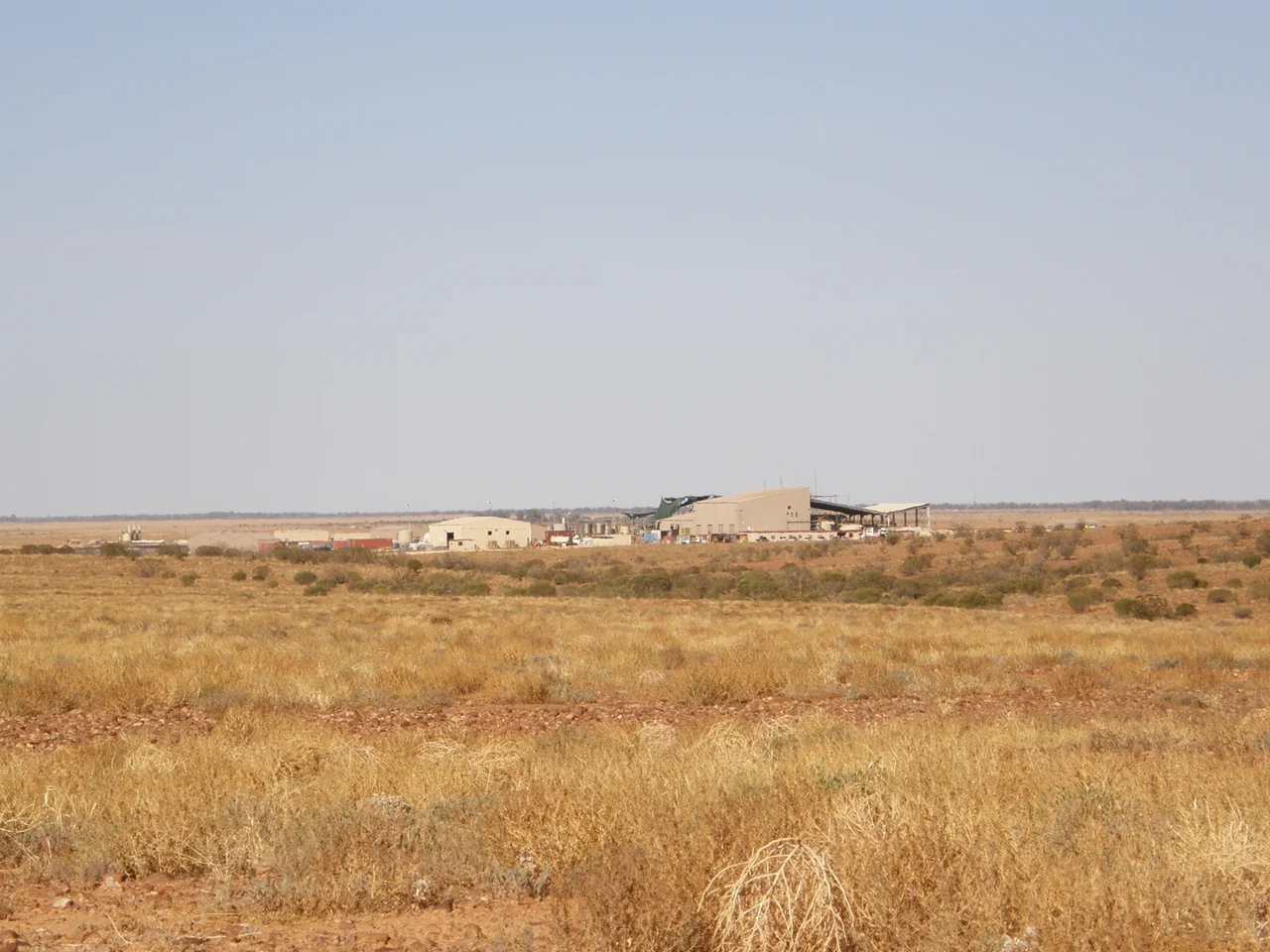

Beverley Uranium Mine
There is no great pit at Beverley, no towering headframe, no mountain of tailings. From the air, the northern Flinders plain looks almost undisturbed, scattered with low buildings and a grid of wellheads near the dry edge of Lake Frome. That is precisely the point. When commercial mining began here in November 2000, Beverley became Australia's first uranium operation to use in-situ leaching, a method that pulls uranium from the ground without ever digging it up. It was a first-of-type for the country, and from the very beginning it was contested. The deposit was discovered in 1969 by one of Bill Siller's exploration companies and named, like much in this region, for a person in his life: his wife, Beverley.
Mining Without a Mine
Beverley is what geologists call a palaeochannel deposit. The uranium, mostly in the mineral coffinite, sits in loose sands within the buried channel of an ancient river, 100 to 150 metres below the surface, trapped between impermeable layers of rock. Rather than excavate it, operators drill boreholes and pump down a mildly acidic, oxygen-rich solution that dissolves the uranium underground. The uranium-laden liquid is then drawn back up through other wells to a processing plant. The technique works only where the geology cooperates: a porous ore body sealed top and bottom. The deposit is estimated to hold around 21,000 tonnes of uranium oxide, enough for a mine life projected at 15 to 30 years. The mine is operated by Adelaide-based Heathgate Resources, a subsidiary of the American firm General Atomics.
The Promise and the Problem
Supporters argue in-situ leaching leaves a far smaller footprint than conventional mining: no open pit, no rock waste, less dust. Critics counter that injecting acid into an aquifer carries its own risks, and that what happens underground is hard to see and harder to undo. The record gives both sides material. Between 1998 and 2007, Heathgate reported 57 spill incidents to South Australia's mining regulator. The mine draws on the same arid landscape that the region's Aboriginal peoples and conservationists have long fought to protect, and Beverley sits close to the boundary of the Arkaroola Wilderness Sanctuary, where uranium prospecting was banned outright in 2011 after a sustained public campaign. The contrast is stark: extraction on one side of a line, permanent protection on the other.
The Container
In May 2000, opponents of the mine gathered to protest, and what happened next would take a decade to resolve in court. Ten protesters, the Supreme Court of South Australia eventually found, were subjected to unnecessary force, including batons and capsicum spray. Nine adults were locked inside a shipping container; one detainee, a cameraman, said he was held there for three hours. In April 2010, after the state government declined to settle, Justice Timothy Anderson awarded the plaintiffs $724,550, condemning their treatment as 'degrading' and a breach of human rights. He rebuked senior politicians for inflammatory comments, including a treasurer who had dismissed the protesters as 'a bunch of feral protesters.' One plaintiff, Lucinda White, said afterward she was stunned such a thing could happen in South Australia. The case became a landmark on the limits of policing protest.
An Expanding Frontier
Beverley did not stay alone for long. In 2005, the Four Mile uranium deposit was found just to the north-west, jointly held by a Heathgate subsidiary and Alliance Resources, and approved for development in 2009, with final processing planned at the Beverley plant. Further deposits at Beverley North were discovered in 2009 and approved for mining in 2011. Together they mark this stretch of the Frome embayment as one of Australia's significant uranium provinces, its riches locked in buried riverbeds laid down long before any human walked the land. Beverley remains a place where two visions of the outback meet and refuse to merge: one that sees value buried beneath the plain, and one that sees value in leaving the plain alone.
From the Air
The Beverley Uranium Mine lies at approximately 30.19 degrees S, 139.60 degrees E, in the gazetted locality of Wooltana at the northern end of the Flinders Ranges, about 35 kilometres from Lake Frome. From the air it is unobtrusive: a cluster of low processing buildings and a field of wellheads on the arid plain, with the salt expanse of Lake Frome to the east and the rugged Arkaroola ranges rising to the west. The site has its own airstrip for operational access. The nearest public airfield of significance is Leigh Creek Airport (YLEC) to the south-west. Recommended viewing altitude is 2,500 to 5,000 feet AGL over the plains. Conditions are typically clear and dry, with summer heat haze and dust the main visibility considerations; note this is an active industrial site and restricted airspace or operational activity may apply.
Nearby Stories
- Lake Callabonna 37 km away
- Ediacara Hills 46 km away
- Mount Chambers Gorge 77 km away
- Flinders Ranges 81 km away
- Farina railway station 91 km away
- Cameron Corner Survey Marker 121 km away
- Dingo Fence 146 km away
- Honeymoon Uranium Mine 153 km away