
Honeymoon Uranium Mine
Fly over Honeymoon and you might miss the mine entirely. There is no great open pit gouged into the earth, no towering headframe, no mountain of waste rock - just a scatter of pipework, ponds and a modest processing plant on the red plains northwest of Broken Hill. That is because Honeymoon does not dig its uranium out. It dissolves it. Wells pump a leaching solution down into the ore body, the solution strips the uranium from the sandstone in place, and the metal-rich liquid is pumped back to the surface. It is one of the quietest forms of mining there is, and Honeymoon's story is one of patience repeatedly tested: discovered in 1972, it took nearly four decades and several false starts to deliver its first uranium, and then promptly closed again.
Uranium in the Sandstone
Honeymoon is a sandstone-hosted paleochannel deposit, which is a precise way of saying the uranium lies in the buried bed of an ancient river. Long ago, groundwater carried dissolved uranium through porous sand until chemical conditions made it drop out and concentrate, lining the old channel with ore. The deposit was found in 1972 by a joint venture of mining subsidiaries - companies tied to CSR, Mount Isa Mines and the American firm United Nuclear - prospecting the Frome Embayment, a region that also hosts the Beverley and Four Mile uranium deposits. Geology made the mining method almost inevitable: because the uranium sits in permeable sand below the water table, it can be recovered by in-situ leach, sending fluids through the ground rather than carving the ground apart.
A Project Out of Time
Honeymoon kept arriving at the right place at the wrong moment. In 1981 the operator submitted a final environmental impact statement, and in 1982 built a $3.5 million demonstration plant - a small wellfield of three five-spot leach patterns feeding a processing unit designed to handle pregnant solution at 25 litres per second. Then politics intervened. A change of government in both the state and the Commonwealth saw approval to mine deferred, and in June 1983 the whole project was mothballed before the pilot had properly begun. Ownership passed through a chain of hands across the decades - MIM Holdings, Southern Cross Resources, and eventually Uranium One, itself a subsidiary of Russia's state atomic corporation, Rosatom. Commercial production finally began in 2011.
The Short First Honeymoon
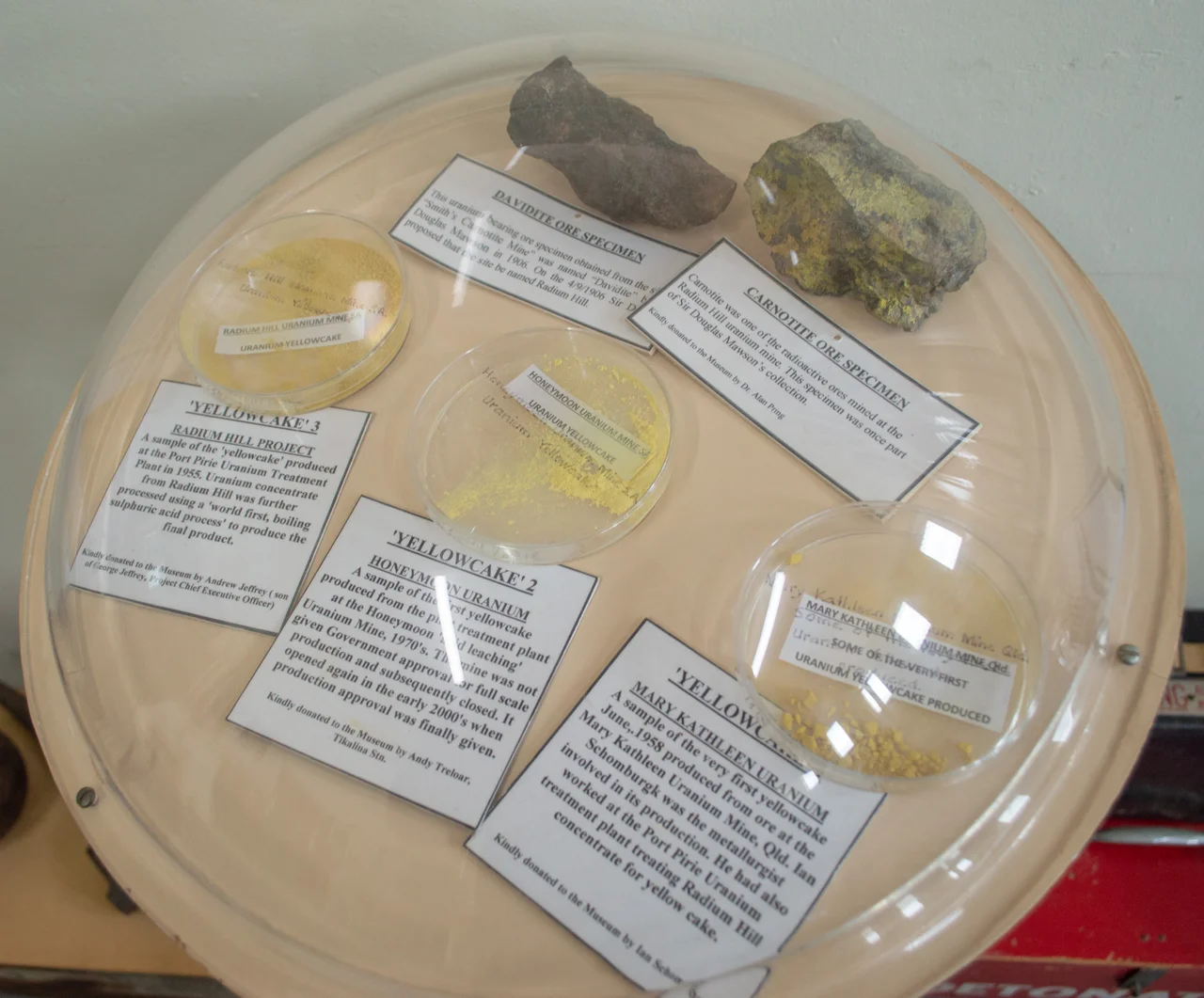
The mine's first life was brief and bruising. From 2011 to 2013 Honeymoon produced just 312 tonnes of uranium before the economics turned against it. In November 2013 Uranium One cited "continuing difficulties in the production process and issues in attaining design capacity, combined with high mine operation costs," and shut the operation down. With uranium prices sliding in the long aftermath of the Fukushima disaster, the mine was placed on care and maintenance - kept intact but idle, waiting for the market to recover. In September 2015, Rosatom's Uranium One sold the project to the Australian company Boss Resources for around nine million dollars, a fraction of what had been poured into it. For years afterward, Honeymoon sat silent in the desert, a finished plant with nothing to do.
Brought Back to Life
The wait finally paid off. Riding a renewed surge in uranium demand, Boss Energy rebuilt and restarted the operation, and in April 2024 Honeymoon poured its first drum of uranium in more than a decade. By January 2025 the mine had reached commercial production, this time pairing in-situ recovery with ion-exchange technology to lift its output. It is now Australia's second operating in-situ recovery uranium mine, supplying nuclear utilities a world away in Europe. Honeymoon's restart says something about the strange tempo of nuclear fuel: a deposit can lie known and untouched for fifty years, then come roaring back when the price is right. Out here on the plains 80 kilometres northwest of Broken Hill, the ancient buried riverbed is giving up its uranium at last - quietly, through a forest of pipes, leaving the surface almost untouched.
From the Air
The Honeymoon mine lies at 31.74 degrees south, 140.66 degrees east, on the arid plains of far-northeastern South Australia, about 80 km northwest of Broken Hill and near the Frome Embayment uranium province. Unlike conventional mines, there is little dramatic to see from altitude - no open pit or tailings mountain - so the visual signature is industrial geometry on flat red ground: the processing plant, a grid of wellheads and pipelines, and the rectangular sheen of evaporation and process ponds, all set against featureless saltbush and gibber plains. Nearest major airport is Broken Hill (YBHI), roughly 80 km southeast. Recommended viewing altitude 4,000-6,000 ft to resolve the plant and pond complex against the desert; higher and the low-profile facility blends into the plain. Visibility in this dry interior is typically excellent, with summer heat haze and dust storms the main factors that can reduce it.
Nearby Stories
- Day Dream Smelter 9.8 km away
- Radium Hill 37 km away
- Mutawintji National Park 106 km away
- Mount Chambers Gorge 109 km away
- Kinchega Woolshed 110 km away
- Paakantyi 154 km away
- Wilpena Pound 162 km away
- Pichi Richi Railway 214 km away