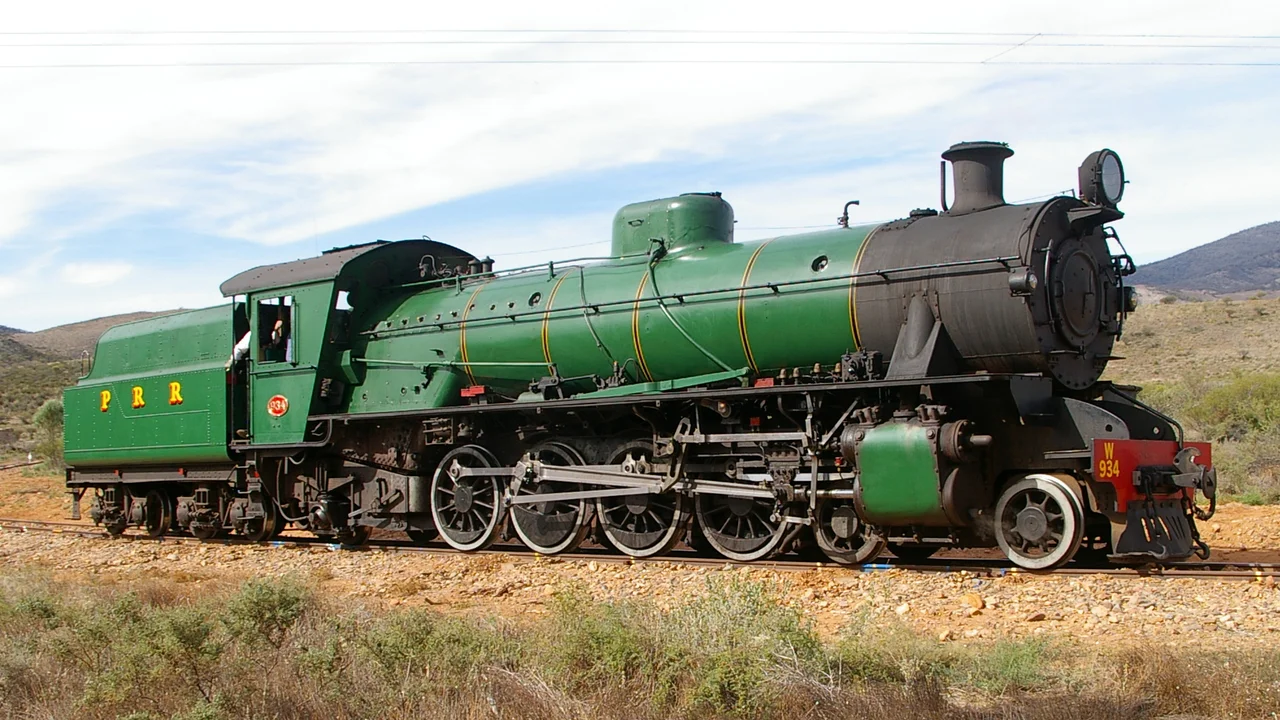

Pichi Richi Railway
When the Commonwealth Railways stopped running trains through Pichi Richi Pass in 1970, the plan was to tear it all out, the bridges, the rails, even the hand-built dry stone walls that had held the line against the hillsides since 1878. It was the end of a railway that had once been part of something epic: the slow push north from Port Augusta toward the Red Centre of Australia, the route that became the legendary Ghan. But a group of locals in the small Flinders Ranges town of Quorn refused to let it vanish. What they began in 1973 has grown into one of Australia's great preservation stories, a 39-kilometre heritage line where Edwardian steam still works its way through the pass.
The Line to the Red Centre
The railway was never meant to be a tourist attraction. It began in 1878 at Port Augusta as the South Australian Railways' line to service mining and to reach the inland, climbing through Pichi Richi Pass and opening at Quorn in 1879. From there it crept north for decades, reaching Government Gums, now Farina, in 1882, then Marree and finally Oodnadatta by 1891. Renamed the Great Northern Railway in 1882 and later the Central Australia Railway, the narrow-gauge line eventually stretched 1,225 kilometres to Stuart, the settlement renamed Alice Springs in 1933. It never reached the true centre of the continent, yet for a century it was a lifeline for isolated outback communities, a vital supply route in the Second World War, and the track that carried the famous passenger train, The Ghan.
A Name Older Than the Rails
The pass, and the railway, take their name from a word far older than any locomotive. Pichi Richi is thought to derive from the region's role as a traditional source of pituri, a preparation of native leaves and ash chewed as a stimulant by First Nations people, traded across vast distances of inland Australia. There was once a township called Pichi Richi in the pass itself, and the preservation society took its name from the place. To ride the line is to move through layers of history at once: an Aboriginal trading landscape, a colonial engineering feat, and the corridor that knitted remote settlements to the coast long before sealed roads existed.
Saved by Volunteers
On 22 July 1973 the not-for-profit Pichi Richi Railway Preservation Society was incorporated, its first purpose simply to protect the 1878 dry stone walls and the bridges of the pass from demolition. Restoring trains seemed a distant dream, yet just twelve months after they began, volunteers ran their first service up to Summit. Repair by repair, they pushed the working line onward, to Pichi Richi, to Woolshed Flat, back to Stirling North, and in 2001 completed a hard-won extension all the way into Port Augusta, threading the narrow gauge beneath an active coal line through a purpose-built underpass. More than fifty years on, the railway is still entirely run and staffed by its volunteer members, operating between March and November each year.
The Coffee Pot and the Old Ghan
The fleet itself is a rolling museum. Its rarest treasure is Steam Motor Coach No. 1, the beloved "Coffee Pot," an ornate self-propelled steam railcar whose engine was built by Kitson and Company of Leeds in 1905 and which entered service in 1906, today the last operating example of its kind anywhere in the world. The Afghan Express recreates Ghan travel of the 1930s and 1940s using 1920s carriages, often hauled by NM25, an original Ghan locomotive built in 1925 and one of only two of its class to survive. One restored carriage carries an astonishing wartime story: in 1942 it brought General Douglas MacArthur and his family south from Alice Springs after their escape from the Philippines, on the journey during which, changing trains at nearby Terowie on 20 March, he made his famous vow, "I came through and I shall return."
From the Air
Pichi Richi Railway runs through the southern Flinders Ranges between Quorn and Port Augusta, centred around 32.35 degrees south, 138.04 degrees east. From the air the line threads the distinct cleft of Pichi Richi Pass, with the town of Quorn at the inland end and the gulf-side port and power infrastructure of Port Augusta to the west marking the route's extremities. Port Augusta Airport (YPAG) lies immediately at the western end of the railway and is the obvious reference and access point; the broader Flinders ranges rise sharply to the north and east, offering dramatic relief. Best viewed on clear, still mornings when low light rakes across the folded ridgelines and the pass throws long shadows; a tell-tale plume of steam may mark a train on running days.
Nearby Stories
- Wilpena Pound 68 km away
- Redruth Gaol 115 km away
- Australian Cornish Mining Sites 140 km away
- Flinders Ranges 151 km away
- Mount Chambers Gorge 178 km away
- Acraman Impact Structure 190 km away
- Olympic Dam mine 228 km away
- Poochera, South Australia 246 km away