.jpg)
Mount Chambers Gorge
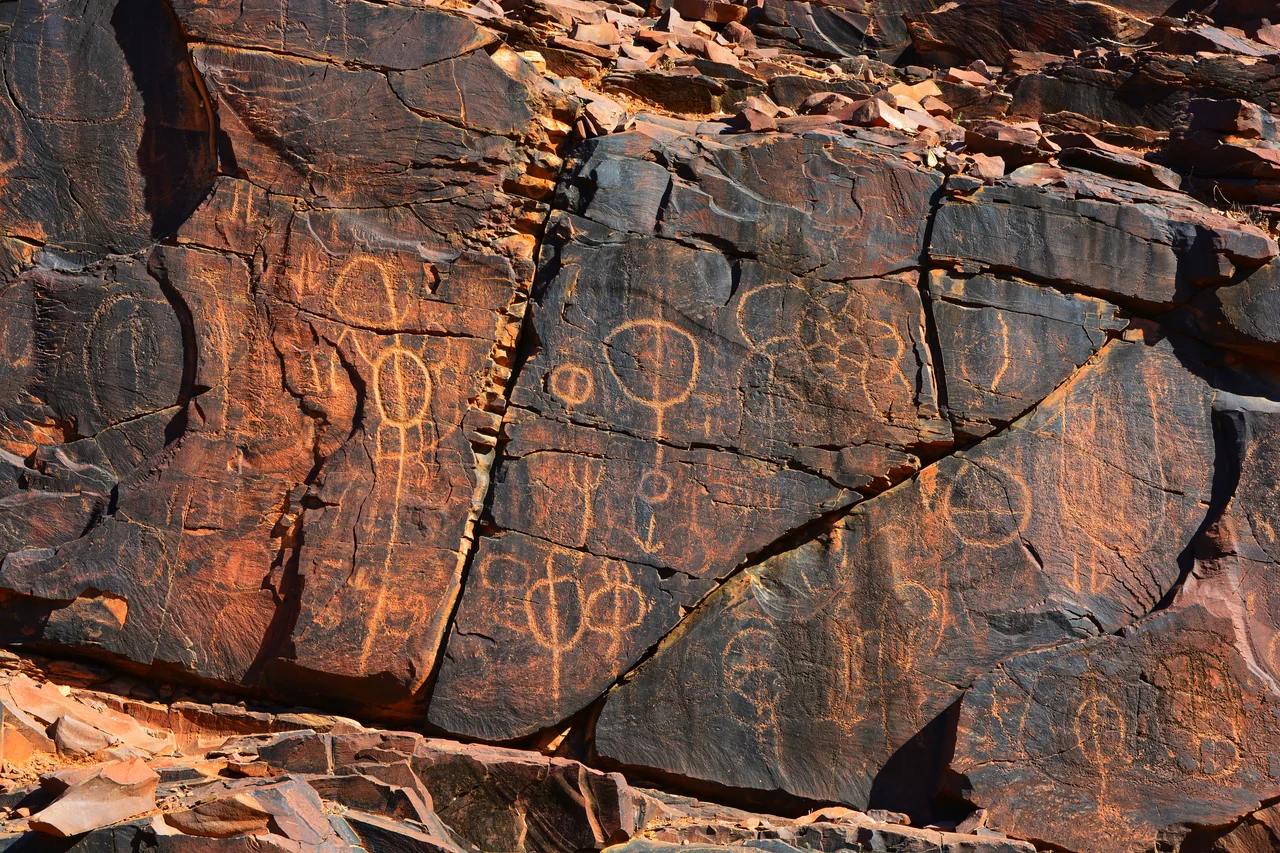
The carvings come into focus slowly. At first the cliff face of Marlawadinha Inbiri looks like any weathered outback rock, ruddy and cracked under a hard sun. Then the eye catches a circle. Then concentric rings, a line, a track, another circle, until the wall resolves into a crowded surface worked by human hands across an almost unimaginable span of time. This is Mount Chambers Gorge, a cleft in the eastern Flinders Ranges about 60 km north-east of Blinman, and it holds one of the most significant rock art sites in the region. To the Adnyamathanha, these are not decoration. They are Yura malka, the marks of country and law.
Marks on the Oldest Canvas
Around two hundred motifs line the gorge, both engraved into the stone and painted onto it. The engravings, petroglyphs pecked and scratched into the rock, run to the spare geometric vocabulary that defines the Panaramitee tradition: circles, concentric circles, lines, animal tracks, simple shapes that read like a language we have only partly learned to hear. This style takes its name from a site between the Flinders Ranges and Broken Hill, the heartland of one of the most widespread art traditions on the continent. Archaeologists place it among the oldest forms of art in Australia, with the engravings here likely belonging to the late Pleistocene or early Holocene, made many thousands of years ago. The motifs spoke of ceremony, of animals and campsites, of the movements of people who knew this dry country intimately. They are at once art and archive, a record kept in stone long before any written word reached this continent.
Why Here
Gorges matter in the Flinders Ranges because water matters. The walls of Mount Chambers are capped by a hard limestone that resists erosion while softer rock beneath wears away, leaving the mesa ringed by precipitous cliffs and cut through by a chasm only two to three metres wide at the top. Such places hold shade and, after rain, water, drawing both wildlife and people into the same shaded corridors for generation upon generation. The concentration of engravings here is no accident. A gorge that reliably offered relief from the heat became a gathering place, and a gathering place became a canvas, layered over centuries by everyone who passed through and paused.
Naming and Renaming
The English names arrived in the colonial mid-nineteenth century. Captain Edward Frome's party came across the gorge and mountain in 1843, and in 1855 the Scottish explorer and surveyor John McDouall Stuart attached the name Chambers, after the pastoralist brothers John and James Chambers, early backers of his expeditions into the interior. John Chambers held the leases until 1863. But the older name endured alongside the new one. Marlawadinha Inbiri still identifies this place in Adnyamathanha country, and today the gorge can be visited on cultural tours led by Adnyamathanha guides, who read the carvings as their own inheritance rather than a curiosity for outsiders to puzzle over.
The Long Way In
Reaching the gorge takes commitment. There is no sealed road, only four-wheel-drive tracks across the stony country east of Blinman, and free camping for those willing to make the trip and carry what they need. That remoteness is part of why the engravings have survived as well as they have, and part of what visitors are asked to honour when they arrive. Walk the gorge quietly. Look, but do not touch the carvings, whose grooves are fragile despite their age, and whose meanings belong to the Adnyamathanha rather than to those passing through. The reward is a rare kind of stillness. To stand in a narrow corridor of ancient rock, among messages left by people who walked here when the last ice age was barely loosening its grip on the world, is to feel time stretch in a way few places allow. The hard sun overhead, the silence, the marks on the wall: it lands as something closer to reverence than sightseeing.
From the Air
Mount Chambers Gorge lies at approximately 30.97 degrees south, 139.28 degrees east, in the eastern Flinders Ranges about 60 km north-east of Blinman, South Australia. From the air, look for the prominent flat-topped mesa of Mount Chambers, its upper limestone cap ringed by steep cliffs, with the narrow chasm slicing across the eastern end of the plateau. The terrain is rugged and remote; there are no nearby major airports. The closest general-aviation strip is Hawker (Wilpena Pound) Airport, ICAO YHAW, roughly 130 km to the south-west; Leigh Creek Airport, ICAO YLEC, lies to the west and is the main regional field for the northern Flinders. Recommended viewing altitude is 3,000-5,000 ft AGL for the mesa and gorge detail. Expect clear, dry conditions much of the year, strong daytime heating and associated turbulence, and very limited services across this stretch of outback.
Nearby Stories
- Flinders Ranges 26 km away
- Wilpena Pound 41 km away
- Leigh Creek, South Australia 49 km away
- Arkaroola 50 km away
- Honeymoon Uranium Mine 86 km away
- Lake Callabonna 121 km away
- Mundi Mundi 143 km away
- Radium Hill 165 km away