.jpg)
Australian Cornish Mining Sites
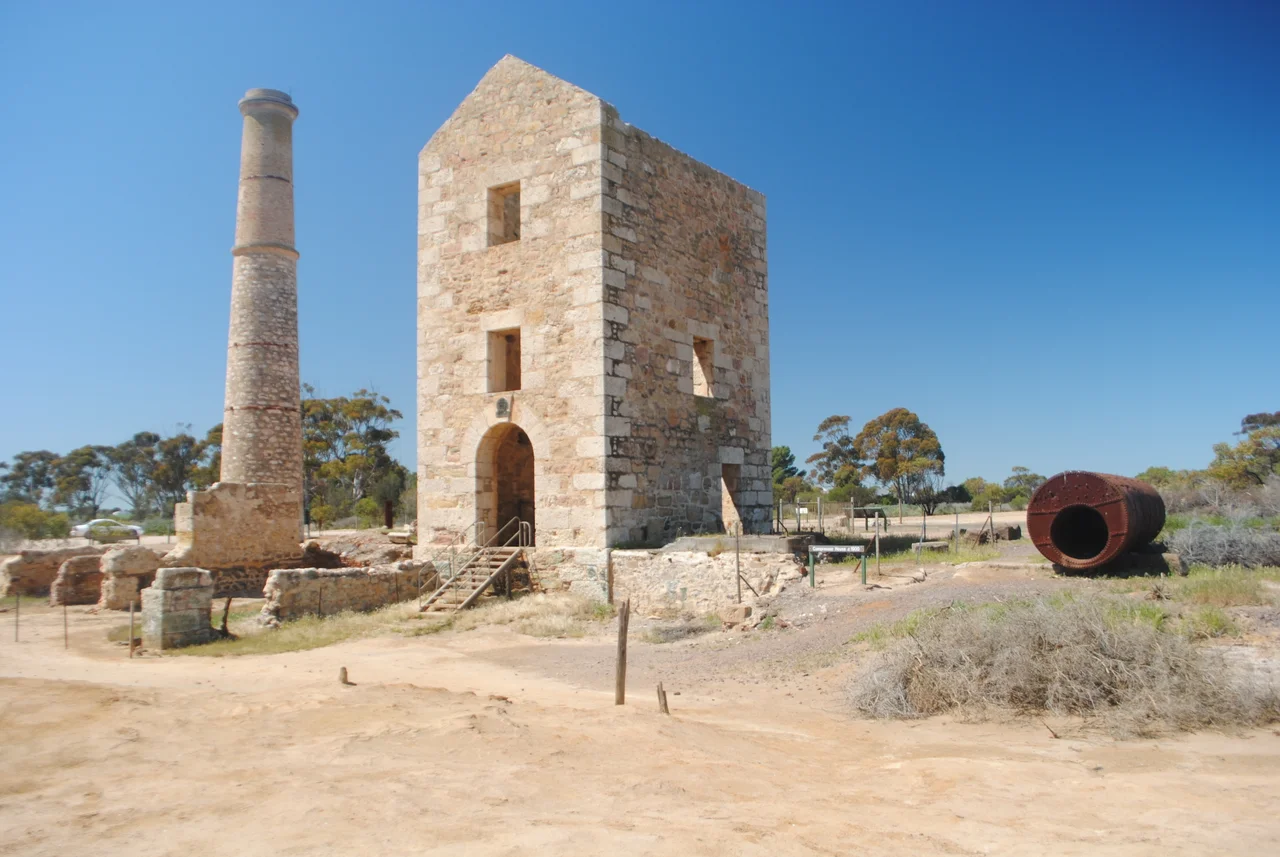
Stand on the edge of the old Burra mine and the engine houses look misplaced, as if a chunk of Cornwall had been lifted from the Atlantic coast and dropped into the dry, ochre hills of South Australia. That is almost exactly what happened. When copper was found here in the 1840s, the people who knew best how to dig for it lived eleven thousand miles away, in a corner of England whose own mines were beginning to fail. They came in their thousands, bringing their pumps, their chapels, their pasties and their accents, and they built two of the richest copper districts the British Empire ever knew. The Australian Cornish Mining Sites, Burra in the mid-north and Moonta on the Yorke Peninsula, were jointly inscribed on Australia's National Heritage List on 9 May 2017.
The Monster Mine
Copper was identified around Kapunda and Burra in 1841, but it was Burra's strike that became legend. Worked from 1845, the Burra deposit was so vast that locals simply called it the Monster Mine, and for the first decade of its life it was the largest mine in Australia. The numbers still impress: between 1850 and 1860 it produced roughly five per cent of the entire world's copper, and by 1850 the colony as a whole had become the third-largest copper producer on the planet. A struggling young settlement suddenly had an export that mattered globally. Capital, machinery and people flowed in, and a string of company and squatter towns grew up around the open workings, their character shaped less by Adelaide than by the granite villages of the Cornish coast.
Why Cornwall Came
The migration was not romance but necessity. In the 1840s the potato blight that devastated Ireland also struck Cornwall, and through the following decades the Cornish economy, dangerously dependent on tin and copper, began to collapse as its own ore ran out and prices fell. When fresh copper was discovered on the Yorke Peninsula in 1859 and mines sprang up almost overnight at Moonta, Kadina and Wallaroo, unemployed Cornish miners had somewhere to go. They carried with them an edge no one else in the colony possessed. The Cornish steam engine, used to pump water and lift ore, let miners reach depths that had been impossible before, and generations of inherited skill suited the conditions perfectly. By 1865 it was reckoned that Cornish settlers made up more than forty per cent of South Australia's immigrant population.
Little Cornwall
Around the three towns of the Yorke Peninsula, the Cornish presence grew so dominant that the area earned a nickname it still carries: the Copper Triangle, or Little Cornwall. Moonta itself became extraordinary. In its first year the mine produced nearly 5,000 tons of ore worth more than 67,000 pounds, and by 1875 it had overtaken Cornwall to become the largest copper-producing region in the British Empire. It was the first mine in Australia to pay a million pounds in dividends. The Copper Triangle mines would yield around 350,000 tonnes of copper, an amount approaching half of all South Australia's mineral output up to 1924. Beneath the production figures lay an entire transplanted culture of Methodist chapels, brass bands and Cornish wrestling that endures in the towns today.
Fevers and Fair Pay
The boom exacted a heavy human price. In 1874 a measles epidemic tore through the Moonta district; by December an estimated 2,400 cases had been reported, with five or six deaths a day, most of them infants and children. Death certificates show the toll was compounded by dysentery and diarrhoea in a community plagued by unsanitary conditions and impure water, grim enough that the Central Board of Health took control of the mineral leases to intervene. The miners were not passive. As early as September 1848, Burra's workers struck against the powerful South Australian Mining Association and the formidable Henry Ayers, first over disputed ore assays and then in solidarity with the surface labourers, the so-called grass workers, when their wages were cut. The first strike favoured the miners; the second was broken. It was, in its way, a very Cornish kind of defiance, carried across the world along with the picks and the pumps.
From the Air
The two listed districts lie apart. Burra sits at roughly 33.68 degrees south, 138.92 degrees east in the mid-north, while the Moonta Mines and the wider Copper Triangle of Moonta, Kadina and Wallaroo lie to the west on the Yorke Peninsula, about 165 kilometres north-west of Adelaide. From the air, Burra reveals itself through the open scars of the old workings and surviving stone engine houses in dry, treeless country; the Copper Triangle shows as three towns ringing former mine sites near the gulf coast. Useful airfields include Burra's local aerodrome and, for the peninsula, the Wallaroo and Kadina airstrips, with Adelaide (YPAD) the nearest major airport to the south. Clear, low-humidity days give the best contrast between red earth, white mullock heaps and the pale stone townscapes.
Nearby Stories
- Barossa Valley 68 km away
- Port Augusta 123 km away
- Pichi Richi Railway 150 km away
- Radium Hill 159 km away
- Kangaroo Island 236 km away
- Honeymoon Uranium Mine 237 km away
- Baudin expedition to Australia 296 km away
- Avenue Range Station massacre 314 km away