
Kangaroo Island
At the western tip of Kangaroo Island, a cluster of giant granite boulders sits balanced on a bare dome above the Southern Ocean, hollowed and scooped by 500 million years of wind and salt into shapes that look deliberately carved. They are called the Remarkable Rocks, and the name does not exaggerate. The island that holds them is Australia's third largest, after Tasmania and Melville Island, a 4,400-square-kilometre slab of bushland and farm lying 13 kilometres off the South Australian coast across the aptly named Backstairs Passage. For tens of thousands of years it has been a place apart, and its isolation has made it both a sanctuary for rare life and, in the summer of 2020, a trap.
Island of the Dead
Kangaroo Island was not always an island. Until about 10,000 years ago, as the last ice age ended and the seas rose, it was joined to the mainland, and Aboriginal people lived here. Stone tools and shell middens prove it. Then the rising water closed Backstairs Passage, and at some point the population vanished from the archaeological record, perhaps as recently as 2,000 years ago. Mainland Aboriginal peoples remembered the island as Karta Pintingga, the Island of the Dead. A Ngarrindjeri story tells of the ancestor Ngurunderi, who pursued his fleeing wives to the coast and, in his anger, called up the waters to drown them as they waded across the channel, the flood that severed the island from the shore. By the time Europeans arrived, the land was empty of people but teeming with animals utterly unafraid of them.
Sealers, Sea Lions, and a Hard History
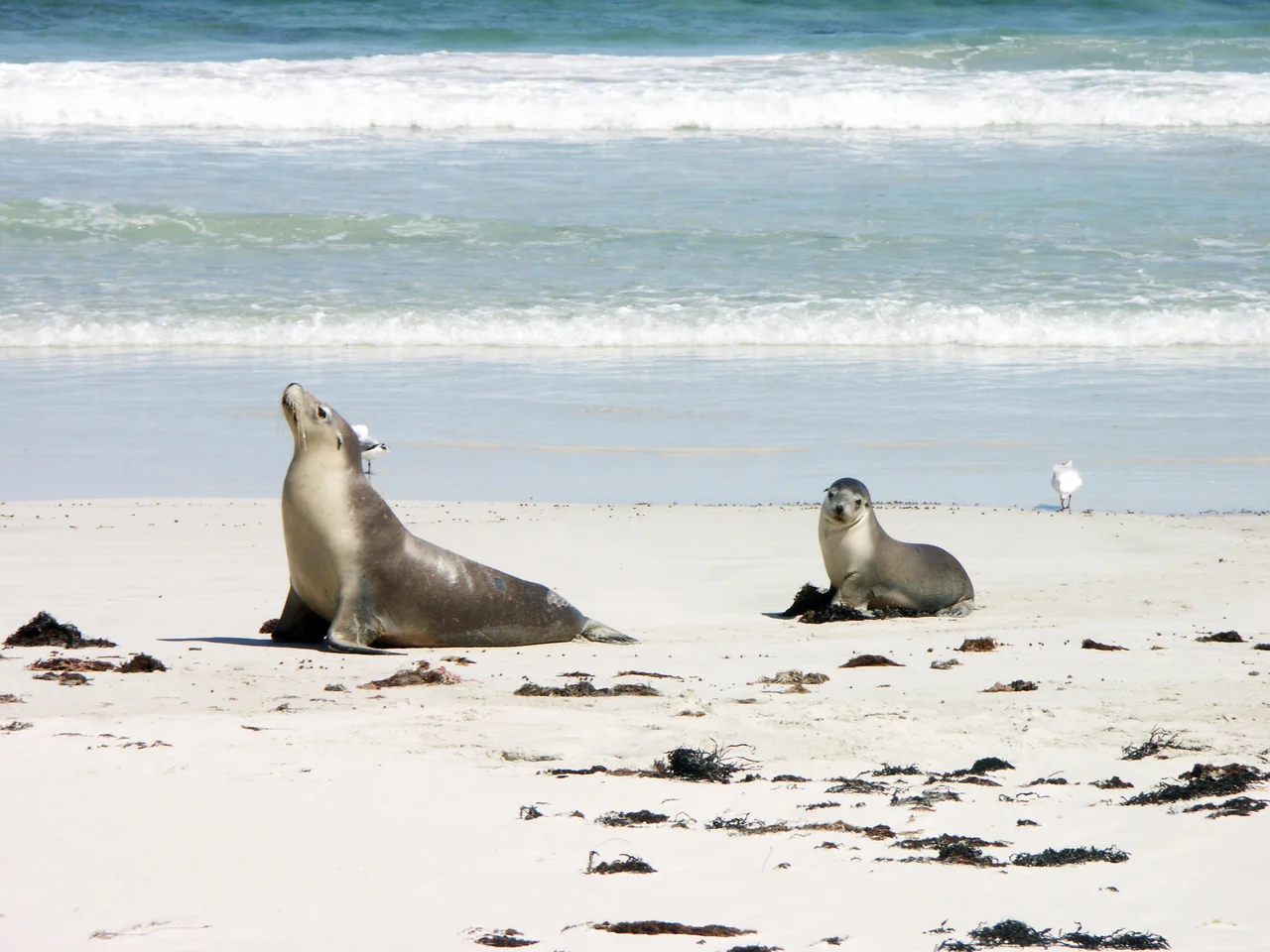
European Kangaroo Island began as a lawless frontier. From 1802, two decades before the colony of South Australia was founded, the island sheltered a rough community of sealers and escaped convicts. Their story is not a romantic one. Several of these men kidnapped Aboriginal women from Tasmania and mainland South Australia and held them captive as labourers — enslaved people in all but legal name. Contemporary accounts record women so desperate to escape that they attempted to swim the treacherous Backstairs Passage to the mainland; one was said to have made it in 1835, while a woman and her baby were found dead on the beach after an attempted crossing in 1871. Today the island's most celebrated residents are gentler. At Seal Bay, hundreds of Australian sea lions, one of the rarest sea lion species on Earth, haul out and bask on the sand while visitors walk among them with rangers.
The World's Last Pure Bees
Kangaroo Island's isolation has turned it into a living vault. It holds the world's only pure-bred, disease-free population of Ligurian honeybees, a strain originally brought from Italy in the 1880s and preserved here, free of the pathogens that have corrupted bee populations everywhere else. The colony is the oldest bee sanctuary on the planet, and strict quarantine laws forbid bringing any bee products or equipment onto the island to keep it that way. The same isolation protects other species. Foxes and rabbits have never gained a foothold, and the island's koalas, introduced last century, are so genetically clean that they lack the chlamydia infection that plagues mainland populations. That purity is precisely what makes any threat, whether a parasite slipped past quarantine or a fire out of control, so dangerous here.
Black Summer
In late December 2019, lightning struck the island's north, and within days fire was tearing through Flinders Chase National Park at the western end. Before it was contained on 21 January 2020, the blaze had burned more than 2,100 square kilometres, roughly half of the entire island. Two people died. The wildlife toll was staggering: an estimated four in five of the island's roughly 48,000 koalas perished, and species found nowhere else on Earth, like the tiny Kangaroo Island dunnart, were pushed toward the edge of extinction. Flinders Chase, the island's natural crown, was almost entirely scorched. The fire did not spare the famous places; it ran right up to the Remarkable Rocks and Admirals Arch. And yet the granite endured, the park has reopened, and the koala population has begun, slowly, to climb back.
A Working Island
For all its wildness, Kangaroo Island is a lived-in place, home to roughly 4,900 people across a handful of small towns. Kingscote, the largest, was South Australia's very first colonial settlement, founded in 1836 and briefly considered as the site for the colony's capital before Adelaide won out. The economy still runs on the land and the sea: sheep and cattle, grain and canola, honey from those famous bees, and some of the finest southern rock lobster pulled from the rugged south coast. A wine industry has taken root since the 1970s, and tourism draws visitors to the sea lions, the sand dunes of Little Sahara, and the limestone caves. The island lives, as it always has, by the rhythms of an environment that is generous and unforgiving in equal measure.
From the Air
Kangaroo Island lies off South Australia at roughly 35.8 degrees south, 137.3 degrees east, about 112 km southwest of Adelaide and separated from the Fleurieu Peninsula by the 13.5-km Backstairs Passage. It is a large, distinct landmass, 145 km long west to east, an excellent coastal waypoint. Kingscote Airport (YKSC) on the northeast is the main field; Adelaide (YPAD) is the nearest major hub on the mainland. Key visual landmarks include Cape Borda and Cape du Couedic lighthouses, the Remarkable Rocks and Admirals Arch at the western tip in Flinders Chase, and the sand dunes of Little Sahara on the south coast. The south coast faces the open Southern Ocean with strong winds and big swell; expect changeable visibility and fresh westerlies.
Nearby Stories
- Baudin expedition to Australia 16 km away
- The Beaumont Children 87 km away
- Hindmarsh Island Bridge Controversy 93 km away
- Adelaide Gaol 135 km away
- Coorong National Park 157 km away
- Waterloo Bay Massacre 267 km away
- Avenue Range Station massacre 268 km away
- Chatham Islands 4030 km away