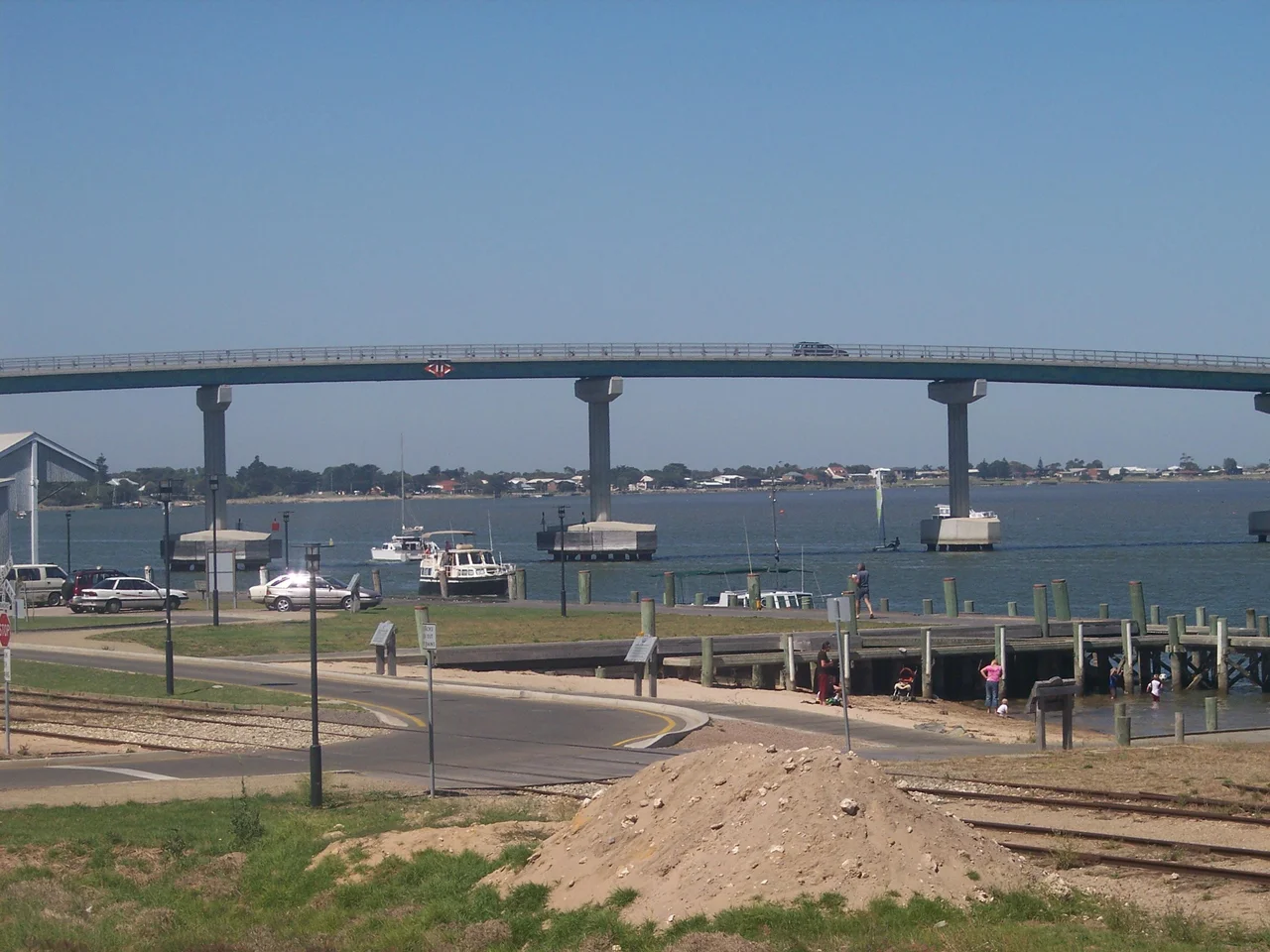

Hindmarsh Island Bridge Controversy
The bridge itself is unremarkable. A gentle curve of concrete spans the Goolwa channel where the Murray River loses itself in lagoons and barrages before reaching the sea, carrying a quiet road from the mainland to Hindmarsh Island. Yet for most of the 1990s this stretch of South Australia held the nation's attention, because the question of whether it should be built had become a question about something far larger: whether the sacred knowledge of Ngarrindjeri women could be taken seriously by a court, a commission, and a country. The Ngarrindjeri call the island Kumarangk. To understand why a marina developer's bridge became one of Australia's most painful cultural disputes, you have to start with the water.
The Meeting of the Waters
At the western mouth of the Coorong, the Murray finally arrives at the ocean. Salt and fresh water mingle in the Goolwa estuary, a place the Ngarrindjeri have known and named for thousands of years. They are one of some thirty to forty clan-groups that lived across this region before British settlement, and remarkably, the only Aboriginal people whose country lay within 100 kilometres of an Australian capital to survive as a distinct, recognised nation. In 1994, a group of Ngarrindjeri women elders made an extraordinary statement: the island was sacred to them, bound up in knowledge passed only to initiated women, knowledge they could not reveal in public. A permanent link to the mainland, they said, would be as harmful as joining two organs of a living body. The waters needed to mix; the sky above them, including the Seven Sisters star cluster of the Dreaming, needed to stay open.
Secret Women's Business
The claims became known, in the language of the dispute, as "secret women's business," and they collided with a development already years in motion. Adelaide developers Tom and Wendy Chapman had bought island land in 1977 for a marina, and the existing cable ferry could not serve their expanding plans. When the federal minister halted construction to investigate, the matter escalated through reports, courts, and headlines. Then other Ngarrindjeri women came forward to dispute the claims, and a Royal Commission ordered by South Australian Premier Dean Brown concluded in 1995 that the secret knowledge had been fabricated. The finding was devastating for the women who had spoken, and it hardened into common belief. But the women who asserted the sacred knowledge had refused to testify at all, holding that a public inquiry into restricted spiritual matters was itself a violation. They would not, even to defend themselves, hand women's knowledge to men.
A Question of Belief
What makes Kumarangk so difficult is that it forces a hard question: how do you prove a belief that is, by its own rules, secret? The Royal Commission saw fabrication. Others saw something stranger and more troubling. When the Howard Government passed a 1997 Act clearing the way for construction, and the bridge opened in March 2001, the story seemed settled. It was not. Later that year, Federal Court Justice John von Doussa heard the developers' damages claim and reviewed evidence the Commission never had. He found that the late emergence of sacred knowledge was exactly what one would expect of genuine restricted tradition, that the various accounts of the Seven Sisters story were consistent, and that he was not satisfied the women's knowledge had been fabricated. One museum expert who had testified against the women was found to have quietly been helping their opponents' lawyers.
Listen to Ngarrindjeri Speaking
The years since have bent toward the Ngarrindjeri. In 2002, redevelopment of the nearby Goolwa wharf unearthed the remains of an Aboriginal woman and child at a site the proponent women had described as a burial ground. The Alexandrina Council, which had let construction proceed, formally apologised and entered a Kungun Ngarrindjeri Yunnan agreement, the phrase meaning "Listen to Ngarrindjeri Speaking." On 7 July 2010, at the foot of the bridge, the Government of South Australia endorsed the finding that the secret women's business was genuine, and Ngarrindjeri elders led a symbolic walk across the span. They will use the bridge now, to reach their own land and waters. Culturally and morally, they still reject it. A theatre work titled Kumarangk, made by Ngarrindjeri women and guided by those who lived the events, now carries the story forward, told at last on Country and in their own voices.
From the Air
The Hindmarsh Island bridge crosses the Goolwa channel at roughly 35.50 degrees south, 138.79 degrees east, where the Murray River breaks into the lagoons and barrages of its mouth near Goolwa, South Australia. From the air the geography is the story: the long thread of the Coorong to the south-east, Hindmarsh Island sitting between the channel and Lake Alexandrina, and the thin opening to the Southern Ocean. Best appreciated at 1,500 to 3,000 feet in clear morning light, when the salt and fresh water show different colours. Goolwa Airport (YGWA) sits just north-west of the town a few kilometres away; Adelaide Airport (YPAD) lies about 75 km to the north-west. Watch for variable coastal winds and sea breezes off the Southern Ocean.
Nearby Stories
- Hahndorf 19 km away
- Coorong National Park 51 km away
- Kangaroo Island 79 km away
- Baudin expedition to Australia 149 km away
- Avenue Range Station massacre 167 km away
- Naracoorte Caves National Park 241 km away
- Port Augusta 299 km away
- Radium Hill 345 km away