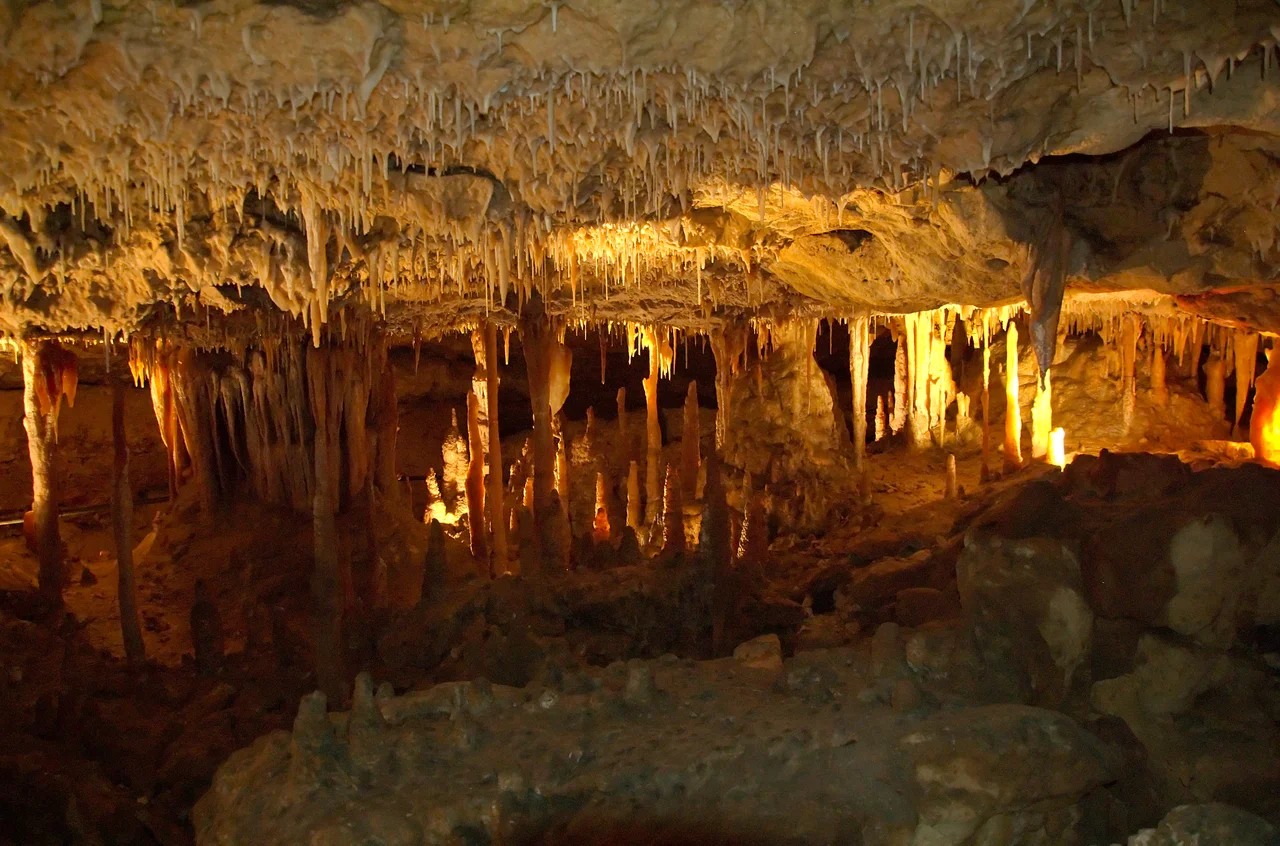

Naracoorte Caves National Park
For half a million years, the caves at Naracoorte were traps. A wallaby grazing too close to a hidden opening, a marsupial lion stalking it, a giant wombat the size of a car wandering the scrub at night - one wrong step, and the ground gave way. They fell into the dark and could not climb out. Layer by layer, the silt washing in behind them sealed their bones into the floor. The result, in the flat farmland near Naracoorte, is one of the richest fossil archives on Earth: a continuous record of Australian wildlife stretching back through ice ages to a time when this continent was ruled by creatures out of a dream.
The Bones Beneath
The star of the collection is Thylacoleo carnifex, the marsupial lion - a powerful, pouched predator with bolt-cutter teeth and a thumb claw, unrelated to any lion alive. Alongside it, the caves have yielded Diprotodon, the largest marsupial that ever lived, a wombat relative the size of a rhinoceros; kangaroos that stood taller than a person; and the thylacine, the striped marsupial wolf that survived into the twentieth century elsewhere before vanishing entirely. Victoria Fossil Cave alone has produced the remains of more than five thousand individual animals across nearly a hundred species. The fossil-bearing silt in places lies twenty metres deep, and dating it traces the assemblage from roughly 530,000 years ago up to the present.
An Australian Story, Written in Stone
Australia drifted away from Antarctica around 35 million years ago and has been an island ever since. Its animals evolved in isolation into forms found nowhere else, and Naracoorte captures that experiment in deep time better than almost anywhere. The caves also straddle one of the continent's great mysteries: the extinction of the megafauna. Within this record sits the moment, around 46,000 years ago, when the giants disappear - close to the window in which people first arrived on the continent. Was it climate, hunting, fire, or some combination? The bones at Naracoorte are central evidence in that unresolved debate, which is part of why, in 1994, UNESCO inscribed the park as a World Heritage site - one half of the Australian Fossil Mammal Sites, shared with Riversleigh in Queensland. It remains the only World Heritage site in South Australia.
Cathedrals of Limestone
The fossils would be reason enough to come, but the caves are also simply beautiful. The limestone formed underwater from coral and marine creatures, then was lifted and slowly dissolved by groundwater into chambers hung with stalactites and flowstone. Of the 28 known caves in the park, only four are open to visitors; the rest are reserved for research. The most famous chambers were transformed by a single discovery in 1969, when explorers broke into the vast fossil deposit in Victoria Cave and turned a regional tourist curiosity into a site of global scientific weight. Specially trained guides still lead adventure-caving trips into passages normally sealed to the public, helmet lamps swallowed by the dark.
Life in the Dark
Naracoorte is not only a tomb for the dead. Deep in the caves lives a colony of the southern bent-wing bat, a small, critically endangered species that breeds here in numbers and emerges at dusk to hunt. A purpose-built tour lets visitors watch the colony by infrared without disturbing it, and the bats' fortunes are followed closely, because their populations have been falling for reasons not yet fully understood. Above ground the park is unremarkable - flat, dry scrub where kangaroos, wallabies and emus graze. The wonder is all below, in the cool, still air of caves that have been quietly collecting the dead and sheltering the living for longer than our species has existed.
From the Air
Naracoorte Caves National Park lies at 37.04°S, 140.80°E in the Limestone Coast region of south-east South Australia, just off the Riddoch Highway south of the town of Naracoorte. The country here is notably flat, so there are few terrain features from the air - the park reads as bushland set in surrounding farmland, with the highway and the township of Naracoorte to the north as the clearest landmarks. Naracoorte Airport (YNRC) sits about 2 nautical miles south of the town, a short hop from the park; Mount Gambier (YMTG) lies roughly an hour's drive (and a short flight) to the south. Conditions are typically dry and clear, with cold nights in winter and summer highs that can reach the low 40s Celsius.
Nearby Stories
- Avenue Range Station massacre 10 km away
- Mount Arapiles 53 km away
- Mount Gambier 63 km away
- Coorong National Park 124 km away
- The Twelve Apostles 215 km away
- Hindmarsh Island Bridge Controversy 227 km away
- Echuca 313 km away
- Chatham Islands 3688 km away