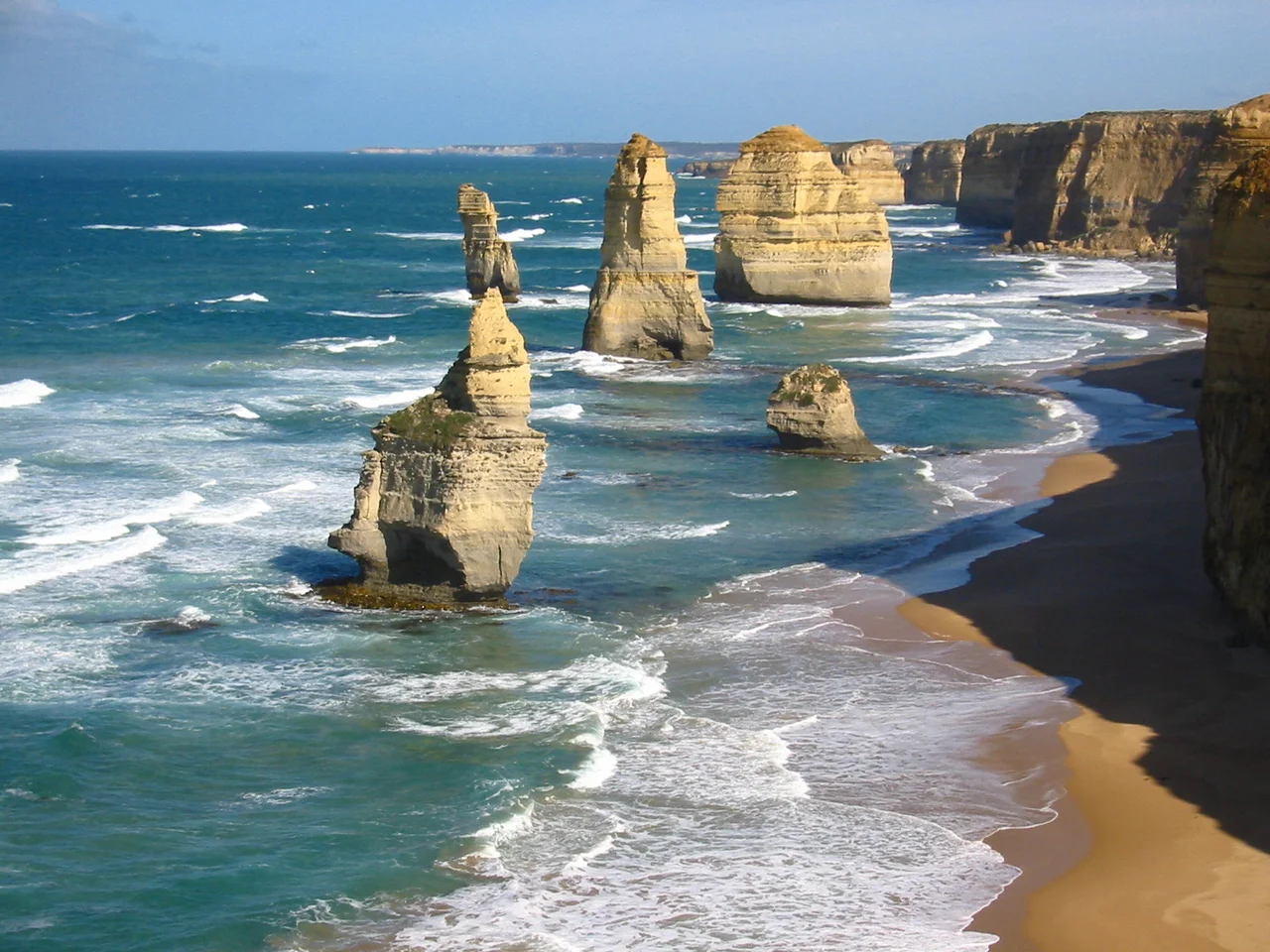

The Twelve Apostles
There were never twelve. The name is a piece of marketing genius from the 1920s, borrowed from the apostles of Jesus to lure tourists to a wild stretch of Victorian coast that had been getting by under humbler labels: the Pinnacles, and the Sow and Piglets. At their peak the formation counted nine limestone stacks. Today, off the shore of Port Campbell National Park, seven remain - golden columns rising as much as 45 metres straight out of the Southern Ocean, lit gold at dawn and dusk, each one a clock counting down.
How the Sea Carves a Cathedral
Every Apostle began as part of the mainland cliff. The limestone itself is the compressed remains of an ancient seabed - shells, coral and the skeletons of marine creatures, laid down and hardened over millions of years before the land rose to meet the air. The Southern Ocean, with nothing to slow it between here and Antarctica, throws its full weight against that soft stone. Water finds a weakness and works it into a cave. The cave deepens into an arch. The arch, undermined, collapses - and what survives is a stack, stranded offshore, the last fragment of a headland the sea has otherwise dismantled. The process never stops. The waves that built these towers are the same waves erasing them, surrendering the cliff face a couple of centimetres at a time, year after year. Watch long enough and you are watching geology happen in human time.
When One Falls
In July 2005, a fifty-metre stack simply gave way, dropping into the sea in a matter of seconds and leaving eight standing where there had been nine. In 2009, another collapsed, bringing the count to seven. No one was hurt either time, though visitors at the platform that July day felt the impact and watched the column dissolve into rubble and spray. The losses are not the end of the story. Along the cliffs, the ocean is already hollowing out the next generation of caves and arches. The headlands you see today are the Apostles of some distant tomorrow - a coastline forever rebuilding itself by falling apart.
Country Returned
Long before any of these stacks had a Christian name, this was the Country of the Eastern Maar people, whose connection to the south-west Victorian coast runs back thousands of years. That connection was formally recognised in March 2023, when the Federal Court of Australia determined native title over more than 8,500 square kilometres of land and sea, including the Twelve Apostles. It was the first native title ruling in Victoria in a decade, the product of more than ten years of patient legal effort. The towers tourists photograph by the millions sit, once again in the eyes of the law, on Eastern Maar Country.
The Coast Around the Corner
The Apostles anchor a coastline that rewards anyone who keeps driving. A short way east, Gibson Steps cut down through the cliff to a beach where you stand at the base of the stacks and feel their true scale. Further on lies Loch Ard Gorge, named for the clipper wrecked here in 1878. Of the 54 people aboard, only two survived: an apprentice named Tom Pearce, who clung to an overturned lifeboat, and a young Irish passenger, Eva Carmichael, who held to a floating spar for hours in the dark until Pearce heard her cries and swam back out through the surf to pull her into the gorge. Nearby, London Bridge lost its landward span without warning in 1990, stranding two startled visitors on the newly created island until a helicopter lifted them off. This is the Shipwreck Coast - beautiful, and never quite safe.
From the Air
The Twelve Apostles sit at 38.64°S, 143.05°E on Victoria's south-west coast, immediately south of the Great Ocean Road and Port Campbell. From the air the stacks read as a cluster of pale columns standing just offshore against the dark Southern Ocean, with the parallel ribbon of beach at Gibson Steps just to the east. Best viewed at low altitude in clear morning or late-afternoon light, when low sun turns the limestone amber. The nearest airfield is Warrnambool (YWBL) about 55 km west-southwest; Mount Gambier (YMTG) lies further west, and Avalon (YMAV) and Melbourne (YMML) sit to the east. Expect strong, gusty onshore winds and rapidly changing visibility off this exposed coast.
Nearby Stories
- Great Ocean Road 27 km away
- Disappearance of Frederick Valentich 67 km away
- Geelong 83 km away
- Sovereign Hill 118 km away
- King Island 145 km away
- Mount Gambier 150 km away
- Mount Arapiles 210 km away
- Chatham Islands 3447 km away