
Disappearance of Frederick Valentich
"It's not an aircraft." Those were among the last words anyone heard from Frederick Valentich. It was the evening of Saturday 21 October 1978, and the twenty-year-old was alone in a Cessna 182 over Bass Strait, bound for King Island. For minutes he had been telling Melbourne air traffic control about something pacing him, a craft with bright lights that swept over him again and again "at speeds I could not identify." His engine, he said, was running rough. Then a strange metallic sound came over the radio, and the transmission cut out. The aircraft and the young man flying it were never found. Decades later, no one can say for certain what happened in those final minutes.
The Young Man at the Controls
Frederick Valentich wanted, more than anything, to fly for a living. He had logged around 150 hours and held a class-four instrument rating that let him fly at night, but only in clear visual conditions. The dream kept slipping out of reach. The Royal Australian Air Force had twice turned him down on educational grounds, and his commercial-licence exams were going badly; he had failed all five subjects twice over, with more failures the month before he vanished. He had been warned for straying into controlled airspace and faced possible prosecution for deliberately flying into cloud. His father, Guido, would later say Frederick was a devout believer in UFOs who feared being attacked by them. He told officials he was flying to King Island to collect friends, and told others he was going for crayfish. Investigators found neither reason was true.
Delta Sierra Juliet
The transcript of Valentich's final minutes is one of the most unsettling documents in aviation. Identifying himself by his call sign, Delta Sierra Juliet, he reported an aircraft above him, then four bright lights, then a large object that seemed to be "playing some sort of game," hovering and orbiting in a way no ordinary plane should. He asked Melbourne whether there was military traffic in the area. There was none. He described the thing as having a shiny metal surface and a green light. His engine began to stutter and run rough. "It is hovering and it's not an aircraft," he said. Then came seventeen seconds of an open microphone carrying a strange, scraping metallic noise, and after that, silence. The whole exchange had lasted only minutes.
Searching an Empty Sea
The response was immediate and thorough. A Royal Australian Air Force P-3 Orion joined eight civilian aircraft and passing ships to comb more than a thousand square miles of Bass Strait. They found nothing. The search was called off on 25 October, four days after the disappearance, without a trace of wreckage, fuel, or the pilot. Almost five years later, on 16 May 1983, an engine cowl flap washed up on Flinders Island, to the east. Examiners determined it came from a Cessna 182 within a serial-number range that included Valentich's VH-DSJ. It was a tantalising thread, but not proof: other Cessnas had shed the same part, and the discovery raised as many questions as it answered. The strait kept its secret.
Theories for the Unexplained
Most aviation specialists believe the answer lies not above the aircraft but inside it. A 2013 analysis by astronomer and former Air Force pilot James McGaha and investigator Joe Nickell argued that the inexperienced Valentich, disoriented at night, mistook a tilting horizon for level flight and slid into a "graveyard spiral," a tightening dive whose increasing g-forces would have starved the engine and produced exactly the rough running he described. The fixed lights overhead, they suggested, were the planets Venus, Mars and Mercury and the star Antares; the mysterious craft, his own confusion. Others noted a meteor shower over the strait that night. Skeptic Brian Dunning observed that Valentich's dialogue echoed the film Close Encounters of the Third Kind, then newly popular, and wondered whether the young UFO enthusiast was performing for the radar before losing control. None of it can be confirmed. The Bass Strait has swallowed enough aircraft to earn the nickname the Bass Strait Triangle, and into that catalogue of the unexplained, Frederick Valentich quietly disappeared.
From the Air
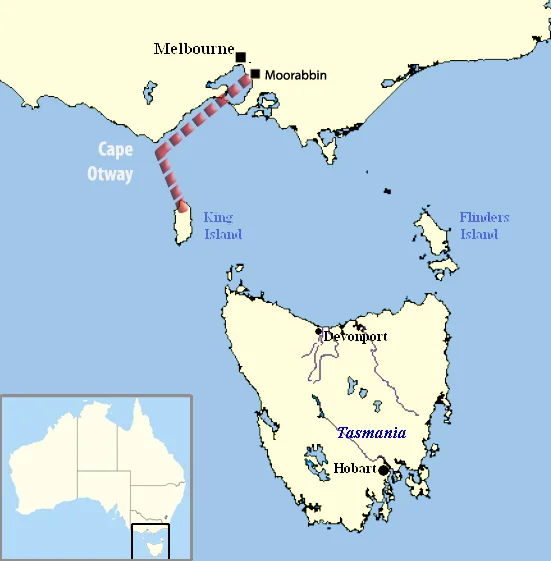
Valentich's flight tracked south across Bass Strait from Moorabbin, near Melbourne, toward King Island, last reported in the vicinity of Cape Otway on the Victorian coast. His position when contact was lost is commonly placed near 39.40°S, 143.75°E, in open water north-east of King Island. The crossing today is flown by regional traffic between Moorabbin (YMMB) and Currie (YKII) on King Island, with Cape Otway lighthouse a key coastal landmark on the mainland side. Bass Strait at night offers almost no visual horizon over water, the very condition implicated in spatial disorientation; the strait is also known for rapidly changing weather and strong westerlies. It remains demanding, lonely airspace, best treated with full instrument discipline and respect for how easily the sea below hides what falls into it.
Nearby Stories
- King Island 35 km away
- Great Ocean Road 52 km away
- Loch Ard Gorge 61 km away
- The Valentich Disappearance: 'It Is Not an Aircraft' 76 km away
- The Twelve Apostles 92 km away
- The Disappearance of Harold Holt: The Prime Minister Who Vanished Into the Sea 101 km away
- Cape Grim Massacre 115 km away
- Chatham Islands 3354 km away