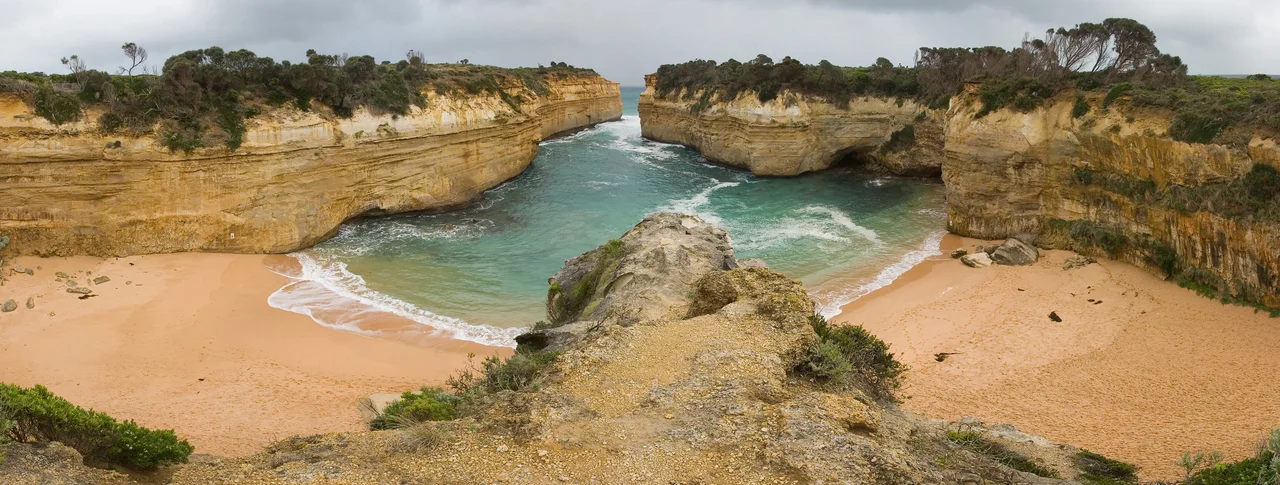

Loch Ard Gorge
They were within sight of land, almost home. After three months at sea from England, the passengers and crew of the clipper Loch Ard were close enough to Melbourne to expect arrival within a day. Then, on the night of 1 June 1878, fog lifted to reveal sheer cliffs dead ahead, too close to avoid. The ship struck near Mutton Bird Island on Victoria's Shipwreck Coast and went down fast. Of the fifty-four people aboard, fifty-two drowned. Only two survived, both of them nineteen years old, washed into the narrow inlet that has carried the ship's name ever since. The gorge is beautiful, a slot of turquoise water between limestone walls. It is also a grave.
The Last Night
The Loch Ard had left Gravesend in Kent on 1 March 1878, commanded by Captain George Gibbs, carrying 36 crew and 18 passengers bound for a new life in Australia. The voyage was nearly over. On its final night, the ship came upon the cliffs of the Shipwreck Coast in poor visibility, far too close to turn away in time. She struck and foundered quickly in the cold June water. There was little time and less hope. Most of those aboard, families emigrating together, sailors near the end of a long contract, never reached the shore. Fifty-two lives ended within sight of the country they had crossed the world to reach. The sea gave up only some of them; the bodies of many were never found.
Two Who Lived
Thomas Pearce, a young ship's apprentice, clung to the upturned hull of a lifeboat and was carried into the gorge, washing ashore alive. Eva Carmichael, an Irishwoman emigrating with her family, held to floating wreckage in the freezing water for hours. Pearce, already on the beach, heard her cries and went back into the sea to pull her from it. Then he climbed the cliff and ran for help, raising the alarm with local pastoralists who came quickly to her rescue. Both were nineteen. For Eva, survival came wrapped in grief: the wreck had killed seven members of her family, her mother and a sister among at least four Loch Ard passengers buried near the gorge. Three months later she returned to Ireland.
The Hero and the Aftermath
Thomas Pearce was hailed across the colony as a hero. The Victorian Humane Society awarded him its very first Gold Medal for going back into the sea to save a stranger. Popular imagination wanted a romance between the two young survivors, and the story was told and retold that way for generations, but no romance followed; Eva returned home to Ireland and the two never reunited. Pearce went back to sea, the life he knew, and died at forty-nine. He is buried far from the gorge, in Southampton Old Cemetery in England. Eva lived to seventy-three. The graves near the gorge hold others: Reginald Jones, Arthur Mitchell, Eva's sister Raby, and her mother Rebecca, a small cemetery on the cliff above the water that took them.
Tom and Eva
The coast itself keeps changing, sculpted by the same sea that wrecked the Loch Ard. Just beside the gorge stood the Island Archway, a natural limestone bridge that had framed the inlet for as long as anyone remembered. In June 2009 its span collapsed into the ocean, leaving two unconnected rock pillars standing alone in the water. Authorities gave them names: Tom and Eva, after the two teenagers who lived. So the survivors are memorialised not in stone monuments but in the living, eroding rock of the place that nearly killed them, two pillars facing each other across the gap where the arch used to be, slowly wearing away like everything else on this coast.
Walking the Gorge
Today the gorge sits a short drive west of the Twelve Apostles, reached by the Great Ocean Road, one of the most visited stretches of coastline in Australia. Stairs lead down to a sheltered beach inside the inlet, where the water is improbably calm and clear given what happened here, and a path runs along the eastern rim. Plaques and a small museum tell the story; the cliff-top cemetery holds the dead. The uncommon rufous bristlebird is often seen darting through the coastal scrub. It is an easy place to enjoy as scenery, and many do. But the name on every sign is the name of a ship, and the quiet beach is the place where, on a winter night in 1878, almost everyone aboard her drowned.
From the Air
Loch Ard Gorge lies at 38.647 degrees south, 143.070 degrees east, on Victoria's Shipwreck Coast within Port Campbell National Park, about 3.5 kilometres west of the Twelve Apostles along the Great Ocean Road. From the air the coastline is dramatic and unmistakable: a line of limestone cliffs and sea stacks where the Southern Ocean meets the land, the gorge itself a narrow inlet cut into the cliffs. The nearest sizeable airport is Warrnambool Airport (ICAO YWBL), roughly 60 kilometres west, and Avalon Airport (YMAV) near Geelong is about 140 kilometres east; Melbourne's airports lie further northeast. This coast is exposed and weather can change fast, with sea fog and strong onshore winds common. Best viewed from one to two thousand feet on clear days, when the turquoise water of the gorge contrasts sharply with the pale cliffs.
Nearby Stories
- Great Ocean Road 27 km away
- Disappearance of Frederick Valentich 67 km away
- Geelong 83 km away
- Sovereign Hill 118 km away
- King Island 145 km away
- Mount Gambier 150 km away
- Mount Arapiles 210 km away
- Chatham Islands 3447 km away