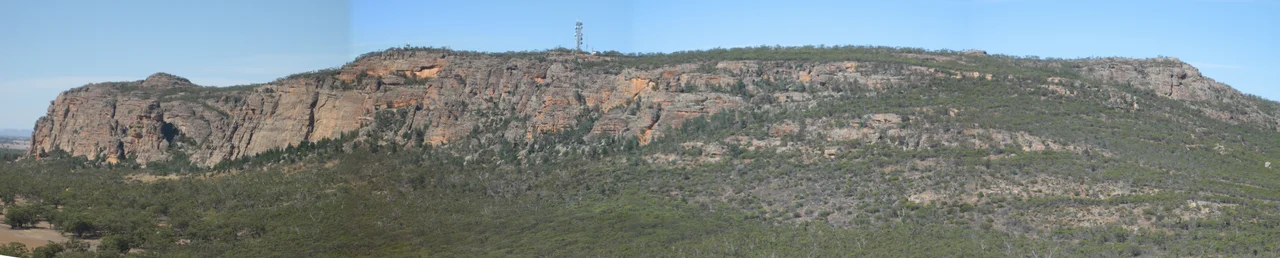

Mount Arapiles
From the wheat plains of western Victoria it appears alone, an orange wall of rock heaved up out of flat farmland with nothing else for miles to match its height. To the Wotjobaluk people it is Dyurrite, a place lived in and worked for thousands of years. To rock climbers it is simply 'Araps' - one of the finest crags on the planet, where a single chunk of quartzite barely 140 metres high holds thousands of climbing routes and a slab of climbing history. The European explorer Thomas Mitchell, the first colonist to record an ascent in 1836, looked out from the top and wrote that the country below 'rather resembled that of the moon as seen through a telescope.'
Dyurrite, First
Long before any of this was about climbing, the Dyurrite Baluk clan of the Wotjobaluk people lived in the gullies and caves of the mountain and quarried its hard stone for tools. A 1992 survey recorded no fewer than 42 Aboriginal archaeological sites here - stone quarries, scarred trees, and rock art - making Dyurrite one of the most significant cultural landscapes in the region. That history was nearly severed in a single generation. Following European settlement in the 1840s, disease, loss of the mountain's resources, and violent clashes with settlers forced the clan apart; by the early 1870s the last of its families had been moved to mission stations. Some of their descendants still live in the area, and Dyurrite's cultural standing now shapes how the mountain is managed and which parts of it stay open.
Why the Rock Is So Good
Climbers travel across the world for Arapiles because of what the rock is. It is quartzite - sandstone and conglomerate laid down by rivers some 420 million years ago, then baked hard from below when a body of granite intruded beneath it and welded the grains together. That cementation is also why the mountain still exists: the softer, un-baked rock around it eroded away, leaving Arapiles standing as the stubborn survivor. The result is stone that is tough, grippy, and laced with cracks, edges and pockets - the iron oxide in it lending the cliffs their warm red-orange glow. For a climber, it means rock you can trust, and a near-endless supply of natural lines to follow up the wall.
The New Wave
Recreational climbing arrived almost by accident in 1963, when two brothers came to scramble on nearby Mitre Rock and realised the hill behind it dwarfed everything around. The first routes went up that November, and within a year a father and son had printed the first guidebook - fifteen climbs run off a school duplicating machine. The place exploded in the 1970s. When the American climber 'Hot' Henry Barber arrived in 1975 and began climbing hard lines with barely any protection, he rewired what locals thought possible. The young climbers who followed him became known as the New Wave, putting up hundreds of routes. In 1985 the German Wolfgang Güllich climbed Punks in the Gym, straight up a blank orange wall, and graded it 32 - at the time, the hardest rock climb in the world, and Australia's arrival on the global climbing map.
Trad, Ethics, and the Long Game
Arapiles is, above all, a traditional climbing ground. Climbers carry their own gear - nuts, cams, wedged metal - slot it into the cracks for protection, and take it all out again, leaving the rock as they found it. The culture here runs deep and slightly contrarian: routes are often 'sandbagged,' deliberately under-graded so the next person finds them harder than billed, a local tradition as much as a joke. Chipping holds to make a climb easier is treated as vandalism. And the ethic now reaches beyond climbing itself. As the cultural weight of Dyurrite has been more fully recognised, sections of the crag have been closed to protect rock art and archaeological sites - a reminder that the wall climbers love so fiercely was someone's home, and someone's gallery, first.
From the Air
Mount Arapiles / Dyurrite stands at 36.75°S, 141.83°E on the Wimmera plains of western Victoria, about 10 km west of the town of Natimuk. Because the surrounding country is almost dead flat, the crag is a striking and isolated landmark from the air - a single orange-walled ridge roughly 140 metres above the plain, with the smaller outcrop of Mitre Rock just to its north. The nearest sizeable centre is Horsham to the east; Horsham Airport (YHSM) is the closest airfield, with Hamilton (YHML) and Mount Gambier (YMTG) further south-west. The mountain's bulk can generate local wind and turbulence on an otherwise calm day; conditions are usually dry and clear, with hot summers and cool winters.
Nearby Stories
- Grampians National Park 13 km away
- Naracoorte Caves National Park 53 km away
- Mount Gambier 95 km away
- Ballarat 154 km away
- Coorong National Park 169 km away
- Sovereign Hill 186 km away
- Echuca 217 km away
- Hindmarsh Island Bridge Controversy 300 km away