
Ballarat
In 1858, twenty-two Cornish miners working a tunnel 55 metres beneath Bakery Hill struck something enormous. The Welcome Nugget weighed nearly 69 kilograms of gold and remains, to this day, the second-largest gold nugget ever found. It was sold to the Royal Mint and melted into sovereigns, but it tells you what kind of place Ballarat was in those years. Six years earlier this had been a sheep run on a basalt plateau; the Wadawurrung name Balla-arat meant a resting place. Then gold was found, and within months one of the richest goldfields on Earth had erupted out of the Victorian bush.
The Golden City
The first gold was found nearby in August 1851, only months after Victoria separated from New South Wales. Within days the rush was on. The earliest diggers could pull half an ounce to five ounces of alluvial gold from the ground in a single day, more than a labourer earned in a week, and word of it raced around the world. Immigrants poured in from Ireland, China, and the played-out goldfields of California, where some had already chased one rush and now chased another. They called them Ballafornians. By 1858 the population had swollen toward 60,000, mostly men, living in a sprawl of tents and shanties along the creeks. When the surface gold ran dry, most boomtowns died. Ballarat did not. Its deep underground reefs kept yielding for decades, and the diggers became citizens.
A Fortune Cast in Stone
That sustained wealth is why Ballarat looks the way it does. Confident the gold would never stop, the early citizens built on a grand scale: the Town Hall, the Art Gallery of Ballarat — the oldest and largest regional gallery in Australia — and Her Majesty's Theatre of 1875, the oldest intact and operating lyric theatre in the country. Lydiard Street holds one of Victoria's finest concentrations of Victorian-era architecture, all cast-iron lace and ornate facades. Boosters dubbed the city the 'Athens of Australia.' Sturt Street runs for two kilometres with a central garden of bandstands, fountains and statues, and the city claims the greatest concentration of public statuary of any in Australia. The Ballarat Botanical Gardens, established in 1858, display bronze busts of every Australian prime minister along the Prime Ministers Avenue.
Honour and Hardship
The 20th century was harder. As the gold slowed, growth all but stopped, and the city was overtaken by the port of Geelong. Ballarat's losses in World War I were severe, and the city's response became one of its most moving features: the Avenue of Honour, a corridor of nearly 4,000 deciduous trees stretching some 22 kilometres, each tree bearing a bronze plaque naming a local soldier who enlisted. The grand Arch of Victory, opened in 1920, frames its entrance. Later in the century Ballarat reckoned with darker chapters honestly recorded in its history — the Aboriginal children taken to the Ballarat Orphanage during the era of the Stolen Generations, and the institutional abuse uncovered by a Royal Commission. The city does not hide these from its visitors; remembrance here includes the painful as well as the proud.
Sovereign Hill and the Living Past
Ballarat has made its history its livelihood. Sovereign Hill, opened in 1970, is an open-air museum that recreates a 1850s gold-mining settlement — costumed townsfolk, a working main street, and visitors panning for real gold flecks in the creek. It is consistently rated among the best outdoor museums in the world and draws around 450,000 people a year. The wider city is a service centre of more than 110,000 people, the third-largest in Victoria, with Mars and McCain factories, a growing technology park, and one of the windiest, frostiest climates in the country — locals are said to wear puffer jackets almost year-round. Gold still lingers in the rock beneath the streets, and a single deep mine still works it. But the real fortune Ballarat kept was the city the gold built, standing intact a century and a half later.
From the Air
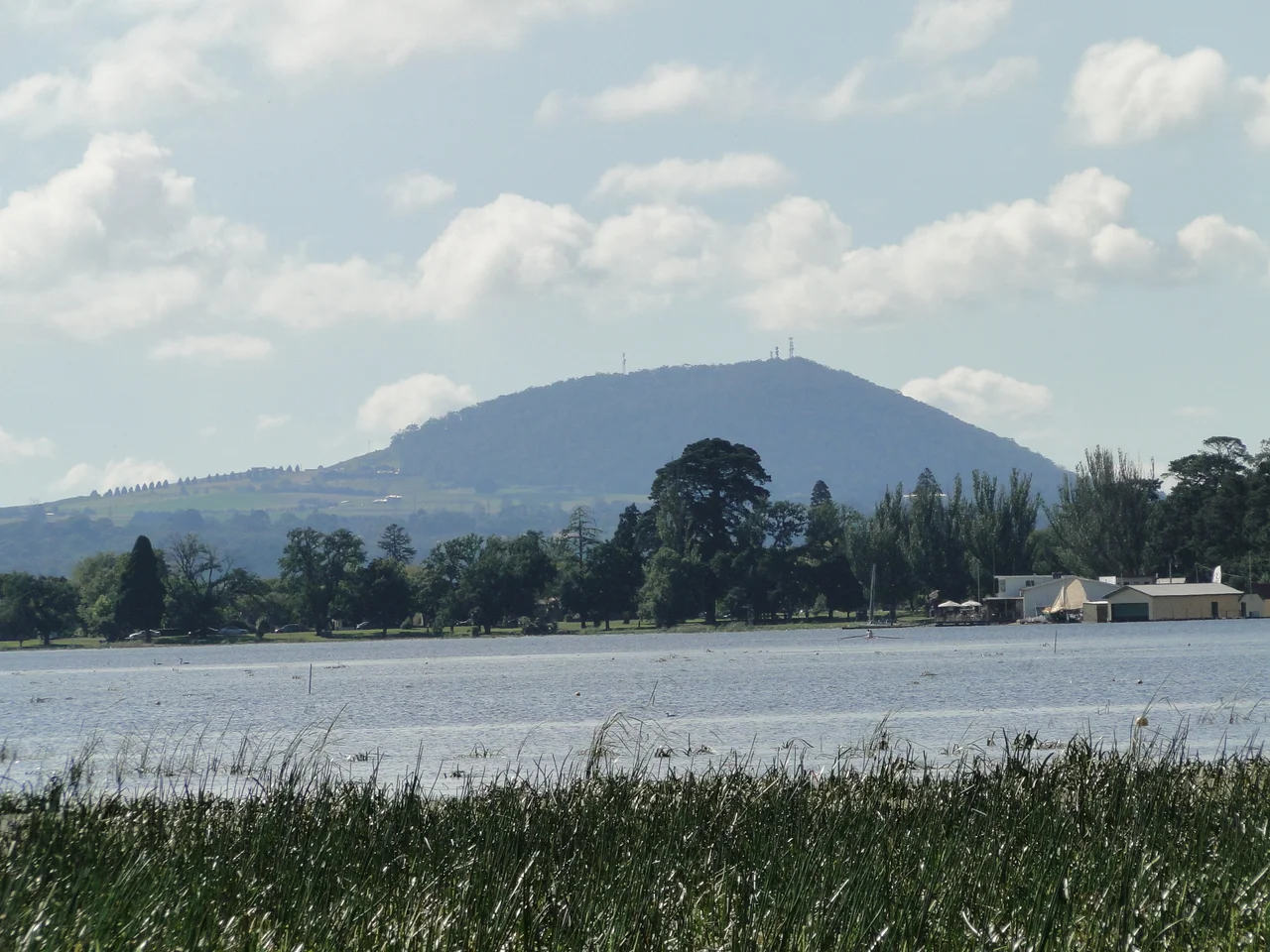
Ballarat lies inland at roughly 37.56 degrees S, 143.86 degrees E, about 105 km west-north-west of Melbourne on the elevated volcanic plains of the Central Highlands, between 400 and 500 metres above sea level. From the air, Lake Wendouree on the western side and the grid of wide, tree-lined boulevards mark the city, with the extinct cones of Mount Buninyong and Mount Warrenheip rising just to the south-east. Ballarat Airport (YBLT) sits about 7 km west of the centre at Mitchell Park; Melbourne Airport (YMML) is the nearest major field, roughly 90 km east. Recommended viewing altitude is 2,500 to 4,500 feet. Ballarat is among the coldest, windiest cities in Australia — expect strong winds, winter frost and fog that usually clears by mid-morning, and even occasional snow on the surrounding peaks.
Nearby Stories
- West Gate Bridge 36 km away
- Waterloo Plains massacre 46 km away
- Melbourne Cup 47 km away
- Geelong 53 km away
- Grampians National Park 92 km away
- The Twelve Apostles 100 km away
- Echuca 128 km away
- Loch Ard Gorge 128 km away