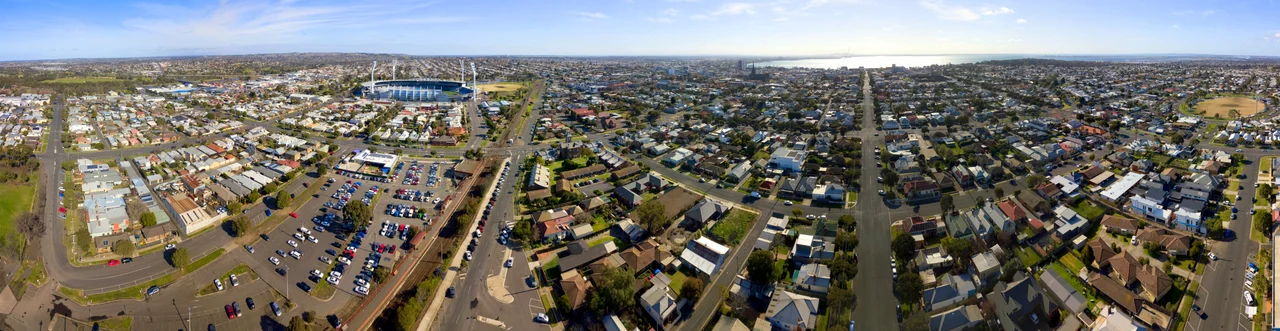

Geelong
The Wadawurrung people called this curve of land Djilang, a word taken to mean a tongue of land or a place by the cliffs. The English ear softened it into Geelong. For most of the 20th century, the name meant one thing: work. Wool mills, ropeworks, paper mills, and later the great Ford engine plant gave the city its identity and its old nickname, 'The Pivot' — the hub through which the wool and gold of western Victoria swung on its way to the world. Then the factories closed, one by one, and the city that had been defined by making things had to decide what it would become.
Gateway to the Goldfields
Geelong sits on Corio Bay, the western pocket of Port Phillip, about 75 kilometres south-west of Melbourne. On a clear day you can see Melbourne's towers shimmering across the water from the higher streets. Europeans surveyed the site in 1838, just three weeks after Melbourne itself. The town's fortunes turned in 1851, when gold was found at Ballarat inland. Suddenly Geelong was the nearest port to one of the richest goldfields on Earth, and prospectors poured through it — its population leaping from a few thousand to more than 20,000 in a handful of years. The gold built fine streets and grand buildings, but it also moved on. As Ballarat and Bendigo swelled, Melbourne's critics sniffed that Geelong had become a 'Sleepy Hollow,' a port that had missed its moment.
The City That Made Things
Geelong answered by building. Through the late 19th and 20th centuries it became one of Australia's great manufacturing centres: wool scoured and spun here, paper milled at Fyansford, ships loaded at the docks. In 1925 Ford established its Australian engine works in the city, and for decades the rhythm of shift whistles set the rhythm of Geelong life. The National Wool Museum, housed in a handsome 1872 bluestone store, still tells that story — the lanolin smell of the fleece, the clatter of the looms, the fortunes made on the backs of sheep. But manufacturing in Australia could not hold. Ford ended engine production, and by 2017 every car plant in the country had closed, taking thousands of Geelong jobs with them.
Reinvention on the Waterfront
What came next surprised the doubters. Geelong turned to its bay. The Eastern Beach foreshore, restored from its 1930s heyday, became the heart of a reborn waterfront, complete with a carousel and a promenade of cheerful bollards painted as the figures of the city's past. Deakin University planted a campus on the water; healthcare and education replaced the assembly lines. In 2017 UNESCO named Geelong a City of Design, recognising a long local tradition of making and shaping. Today it is one of Australia's fastest-growing cities, its gentrified inner suburbs and rising apartment towers a long way from Sleepy Hollow.
Cats, Culture and Corio Bay
No account of Geelong survives contact with a local without mention of the football. The Geelong Football Club, the Cats, was founded in 1859, making it the second-oldest club in the Australian Football League and one of the oldest football clubs anywhere in the world. On match days at Kardinia Park, more than 20,000 fill the stands — extraordinary loyalty for a city of this size. Beyond the footy, Geelong nurtures a serious arts life, from the renowned Back to Back Theatre, an internationally acclaimed company of performers with disability, to the festivals that fill Pako Festa each February. The city is also the launch point for two of Victoria's great escapes: the Bellarine Peninsula's beaches and wineries to the east, and the Great Ocean Road unspooling to the west.
From the Air
Geelong lies at roughly 38.15 degrees S, 144.36 degrees E, wrapped around the western end of Corio Bay at the head of Port Phillip. From the air the bay, the curving waterfront, and the You Yangs granite peaks to the north are the obvious landmarks. Avalon Airport (YMAV) sits about 15 km north-east of the city centre between Geelong and Melbourne and is the closest field; Melbourne Airport (YMML) is roughly 50 km north-east, and Moorabbin (YMMB) lies across the bay. Recommended viewing altitude is 2,500 to 4,000 feet for the waterfront and bay; the distant Melbourne skyline is often visible across the water in clear conditions. Westerly winds dominate, and Geelong is one of the driest cities in Australia thanks to the rain shadow of the Otway Ranges.
Nearby Stories
- The Disappearance of Harold Holt: The Prime Minister Who Vanished Into the Sea 2.4 km away
- Brighton Bathing Boxes 14 km away
- Great Ocean Road 28 km away
- St Kilda 42 km away
- West Gate Bridge 53 km away
- Loch Ard Gorge 78 km away
- The Valentich Disappearance: 'It Is Not an Aircraft' 107 km away
- Grampians National Park 149 km away