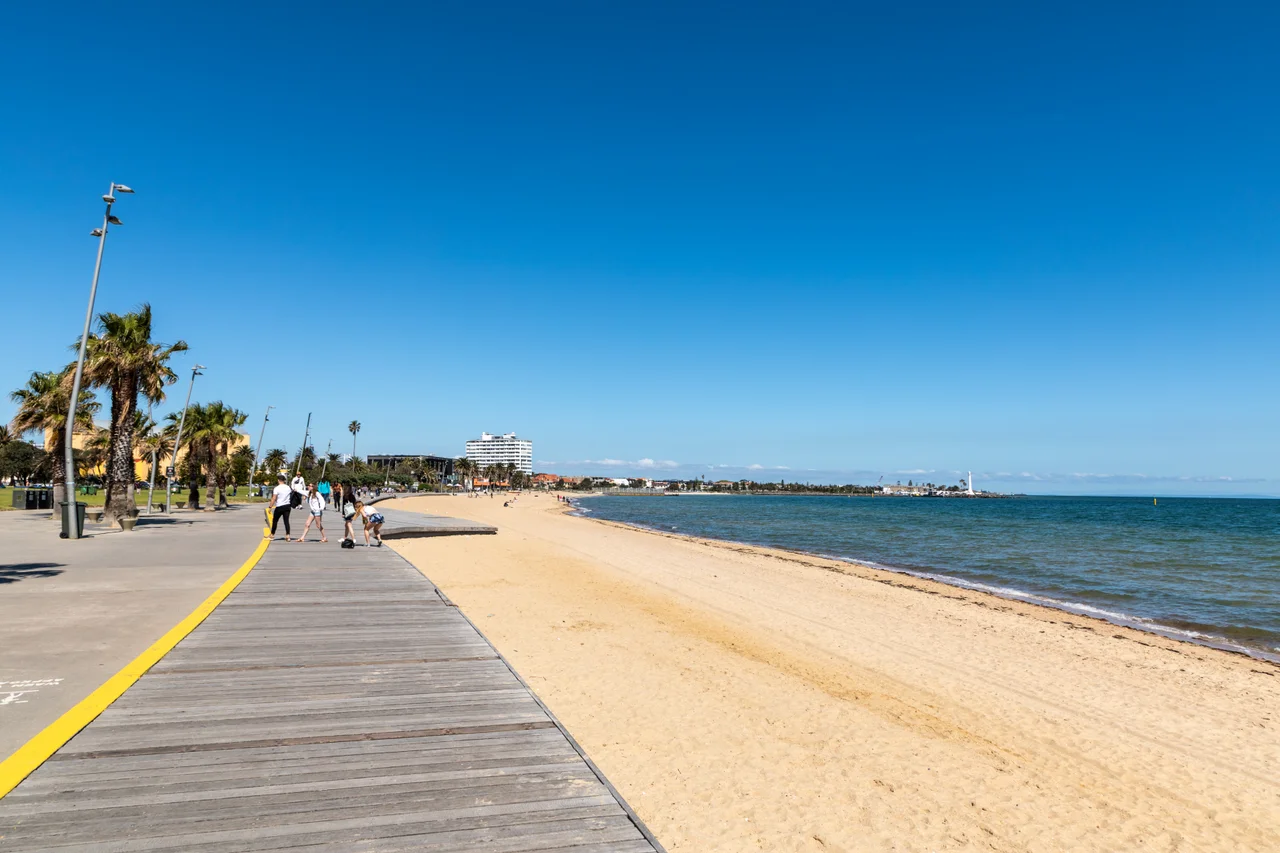
,_St_Kilda_Beach_--_2019_--_1590.jpg)
St Kilda
A giant clown's face grins out over the foreshore, its open mouth the gateway to a roller coaster that has been running since 1912, making it the oldest continuously operating one on Earth. That face belongs to Luna Park, and it has become the unofficial emblem of St Kilda, a seaside suburb six kilometres from the centre of Melbourne that has spent its whole life refusing to be just one thing. St Kilda has been the playground of the gold-rush rich and the haunt of the desperately poor, a Jewish heartland and a punk-rock crucible, a place of grand hotels and grim reputations. It takes its name, improbably, from a schooner that was named for a remote Scottish island most of its residents will never see. And out past the end of the pier, in the rocks of a breakwater, live the smallest penguins in the world.
Named for a Ship, for an Island, for a Captive Lady
The name travelled a long, strange road to this beach. Before 1842 the spot went by Green Knoll, or Punt Town, or the Village of Fareham. Then Charles La Trobe, superintendent of the Port Phillip District, named it after a schooner, the Lady of St Kilda, which lay moored off the main beach through the early months of 1842. The ship in turn carried the name of the St Kilda archipelago off Scotland's western edge, the last truly remote outpost of the British Isles. And that island had borne witness to a quiet cruelty: it was where Lady Grange was imprisoned by her own husband from 1734 to 1740, marooned to keep her from exposing his politics. A grinning seaside suburb thus owes its name to a kidnapped woman on a windswept Scottish rock.
The Suburb the Gold Rush Built
When gold transformed Melbourne in the 1850s, the newly wealthy went looking for sea breezes, and they found them on the high ground above St Kilda Beach. By the 1880s the suburb glittered with mansions and grand terraces; palatial hotels rose to meet them, the Esplanade Hotel in 1878 looking out over the water. The railway arrived in 1857, then cable trams, and the beach became reachable for everyone. But the land boom ended in the bank crashes of the 1890s, ruining many of the newly rich, and the mansions began their slow descent into boarding houses. The wealthy retreated to Toorak and Brighton, and St Kilda set off on its long second act as something more democratic and more dangerous.
Coney Island of the South
In the early twentieth century St Kilda became Melbourne's pleasure beach, what Coney Island was to New York. The Italian-born engineer Carlo Catani redesigned the foreshore into promenades, gardens, and palm-lined avenues, and the amusements came thick and fast: the St Kilda Sea Baths, Luna Park with its Moonface gate in 1912, the Palais de Danse, and in 1927 the Palais Theatre, still standing as one of the grandest cinemas of its era. Servicemen flocked here during two world wars, and with the crowds came a racy reputation that hardened, through the Depression, into something rougher. By the 1960s the streets around Fitzroy Street were known for sex work and strip clubs, and the same cheap apartments that drew the bohemians also drew the city's social troubles.
Refuge, Bohemia, and the Sound of Post-Punk
From at least the 1950s St Kilda was the heart of Melbourne's Jewish community, swelled by refugees who found the small flats familiar and affordable; Cafe Scheherazade on Acland Street served eastern European borscht and latkes for decades. The cheap rooms and late-night venues also made the suburb an artists' colony. In the late 1970s it became a hotbed of dark, noisy post-punk: the Birthday Party, with Nick Cave and Rowland S. Howard, played the legendary Crystal Ballroom at the George Hotel, alongside Hunters and Collectors and Paul Kelly, whose song From St Kilda to Kings Cross swapped all of Sydney Harbour for one sweet promenade. Acland Street's cake shops still draw queues; the music still spills from the Espy's stages.
The Penguins of the Breakwater
The breakwater that shelters the little harbour was built for the 1956 Melbourne Olympics, to give the sailing events calm water. Almost at once, something unexpected moved in. A colony of little penguins, the smallest penguin species in the world and standing barely thirty centimetres tall, took up residence among the boulders, and they have nested there ever since. Today the colony numbers around 1,400 birds. At dusk they waddle ashore from a day's fishing in Port Phillip Bay, and visitors line the pier in the half-dark to watch, kept back by rangers and red-filtered torches that spare the birds' eyes. It is one of the city's most beloved sights: wild seabirds raising their young in the heart of a metropolis of five million people.
From the Air
St Kilda lies at roughly 37.86 degrees south, 144.98 degrees east, on the eastern shore of Port Phillip Bay about 6 km south of central Melbourne. From the air the suburb reads as a crescent of beach backed by dense low-rise development, with two unmistakable landmarks: the curving St Kilda Pier reaching into the bay with its dog-leg breakwater, and the bright facade of Luna Park set just back from the foreshore. Albert Park and its lake lie immediately north. The CBD towers stand to the north-northeast; Brighton's beaches continue south. Melbourne Airport (ICAO YMML) is about 27 km to the north-northwest, and Essendon Fields (YMEN) about 20 km north. A sightseeing altitude of 1,500 to 2,500 feet AGL frames the pier, beach, and amusement park together. Afternoon onshore sea breezes off the bay are common; haze can soften the light over the water.
Nearby Stories
- Geelong 12 km away
- The Disappearance of Harold Holt: The Prime Minister Who Vanished Into the Sea 41 km away
- Eureka Rebellion 54 km away
- Yarra River 55 km away
- Sovereign Hill 65 km away
- Waterloo Plains massacre 73 km away
- Glenrowan, Victoria 142 km away
- Bass Strait 210 km away