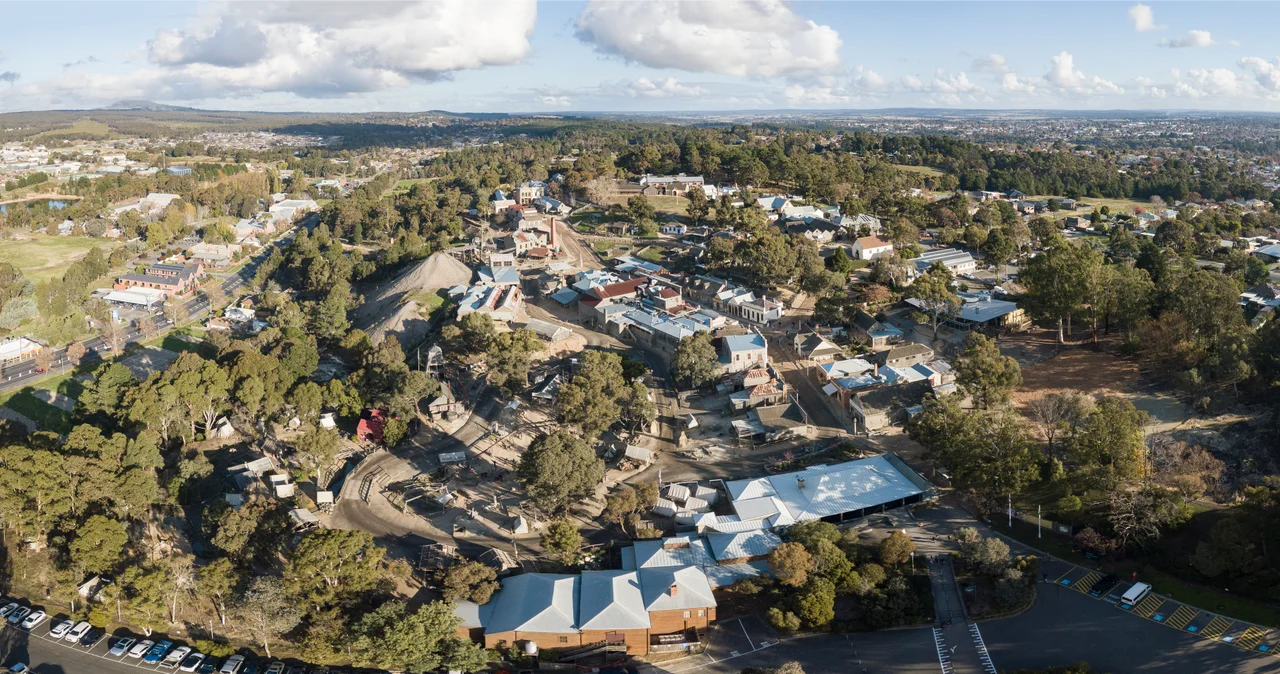

Sovereign Hill
Pan long enough in the creek that runs through Sovereign Hill and you will find gold. Not fool's gold, not a souvenir flake glued to a card, but actual specks of the metal that turned a Victorian sheep paddock into one of the most feverish places on Earth. That single detail tells you what this museum is. It does not put the gold rush behind glass. It hands you a tin dish, points at the water, and lets you crouch in the cold the way a hundred thousand hopefuls did in the 1850s, when Ballarat sat on top of the richest alluvial goldfield the world had ever seen.
A Town Built to Be Believed
Sovereign Hill is not a row of dusty exhibits. It is a working settlement of more than sixty recreated buildings spread across a twenty-five-hectare site, and the people in it stay in character all day. The blacksmith actually beats hot iron. The confectioner pulls boiled sweets by hand in the lolly shop. There are stables, a tinsmith, a tentmaker, an apothecary, two hotels and a theatre lining a loose reconstruction of the old Main Street of Ballarat East, the original timber heart of the diggings that burned in a great fire in the 1860s. Children arrive in school groups, dress in period clothes, and sit through a lesson as a child of the 1850s would have. The effect is not a tour. It is closer to time travel that talks back.
The Nugget That Made the Legend
The story Sovereign Hill exists to tell has a single golden anchor. On 9 June 1858, a group of Cornish miners working the Red Hill Mining Company's claim at Bakery Hill struck a single lump of gold weighing roughly sixty-nine kilograms, more than two thousand troy ounces and over ninety-nine percent pure. They named it the Welcome Nugget. For eleven years it was the largest gold nugget ever found, surpassed only by the nearby Welcome Stranger in 1869, and it remains the second largest in history. The original was sold, shipped to London, displayed at the Crystal Palace, and finally melted into coins. At Sovereign Hill the Red Hill Mine is recreated underground, where the tale of those Cornishmen and their impossible piece of luck is told in the dark, a few metres from where the real thing came out of the ground.
Going Underground
Above ground there is theatre. Below it there is weight. Two mines run guided tours, and an inclined mine tram, opened in 2008, carries visitors down through a flap and into a genuine dark tunnel toward the workings. In the Sovereign Quartz Mine, steam-driven machinery still pumps and grinds as it once did to crush ore. The newest attraction trades wonder for grief. Called Trapped, it retells the New Australasian mine disaster at Creswick in December 1882, when miners broke into the flooded old workings of a neighbouring shaft and water poured in. Of forty-one men on the shift, twenty-seven were caught underground for three days. Five clawed their way out. Twenty-two did not. It remains one of the worst mining disasters in Australian history, and the exhibit refuses to let the gold rush be remembered only as a lark.
Whose Land, Whose Story
For decades the museum told the rush as a tale of diggers and luck. It now tells more. The old Chinese Camp has been rebuilt as the Chinese Protectorate Camp, with new buildings and gathering spaces that reckon with the experience of the Chinese miners who were a large and frequently mistreated part of the goldfields. A Wadawurrung Cultural Precinct, made with the Traditional Owners of this country, sets the gold decade against the far deeper time the Wadawurrung have spent on this land. The Australian Centre for Gold Rush Collections holds over 150,000 objects from the era. The gold built fortunes, but it also scarred a landscape and the people who already lived on it, and Sovereign Hill has slowly grown honest enough to say so.
The Spectacle Still Pulls
For all the new gravity, Sovereign Hill knows how to dazzle. Several times a day a furnace heats a crucible until a bar of pure gold worth well over half a million dollars is poured glowing into a mould, a three-kilogram ingot cooling before a crowd that always gasps. After dark the hills above the diggings host AURA, a ninety-minute sound and light show that throws the story of gold across the slopes in fire and projection. It is loud, theatrical and unashamed. The rush, after all, was never quiet. People sold everything they owned, crossed oceans, and gambled their lives on a dish of gravel and the chance of a glint. Sovereign Hill lets you feel why they thought it was worth it.
From the Air
Sovereign Hill sits at 37.575 degrees south, 143.866 degrees east, in Golden Point on the southern edge of Ballarat, Victoria, roughly 105 kilometres west-northwest of Melbourne. From the air the city reads as a tight Victorian grid threaded by Lake Wendouree to the northwest, with the museum's open diggings and timber rooftops tucked into the hills south of the centre. Recommended viewing altitude is 2,500 to 4,000 feet AGL for the townscape and surrounding goldfield country. The nearest field is Ballarat Aerodrome (ICAO YBLT), a few kilometres north; Melbourne's Avalon (YMAV) and Essendon (YMEN) lie to the southeast, with Melbourne Tullamarine (YMML) the major gateway. Expect clear inland visibility in summer and low cloud, fog and frost on winter mornings in this elevated part of the Central Highlands.
Nearby Stories
- West Gate Bridge 36 km away
- Waterloo Plains massacre 46 km away
- Melbourne Cup 47 km away
- Geelong 53 km away
- Grampians National Park 92 km away
- The Twelve Apostles 100 km away
- Echuca 128 km away
- Loch Ard Gorge 128 km away