
Echuca
An ex-convict bought a punt, and a city grew from it. In 1850, Henry Hopwood paid for a small ferry to carry people and goods across the Murray River near where the Campaspe joins it. There was nothing here then but a river crossing on Yorta Yorta country, at the point where the Murray swings closest to Melbourne. Hopwood's Ferry became a settlement, the settlement became a town, and within two decades Echuca was the busiest inland port in the country. Its name comes from a Yorta Yorta word meaning meeting of the waters, and everything that happened here flowed from that geography: three rivers converging, and a hungry colonial capital just a short haul to the south.
Meeting of the Waters
The riverine plains where the Goulburn, Campaspe, and Murray rivers meet are the traditional lands of the Yorta Yorta nation, whose population before European contact is estimated at around 2,400. They had read this country for generations, the seasonal rhythms of flood and fish along the meeting of the waters. Colonisation tore that apart. The Yorta Yorta were dispossessed of their lands and pushed to the margins of the new settlements, left to hold on at the edges of a town built on their river. The name Echuca is itself Yorta Yorta, a daily reminder in plain sight that this place was named, and known, long before Hopwood's punt ever touched the water.
Australia's Inland Port
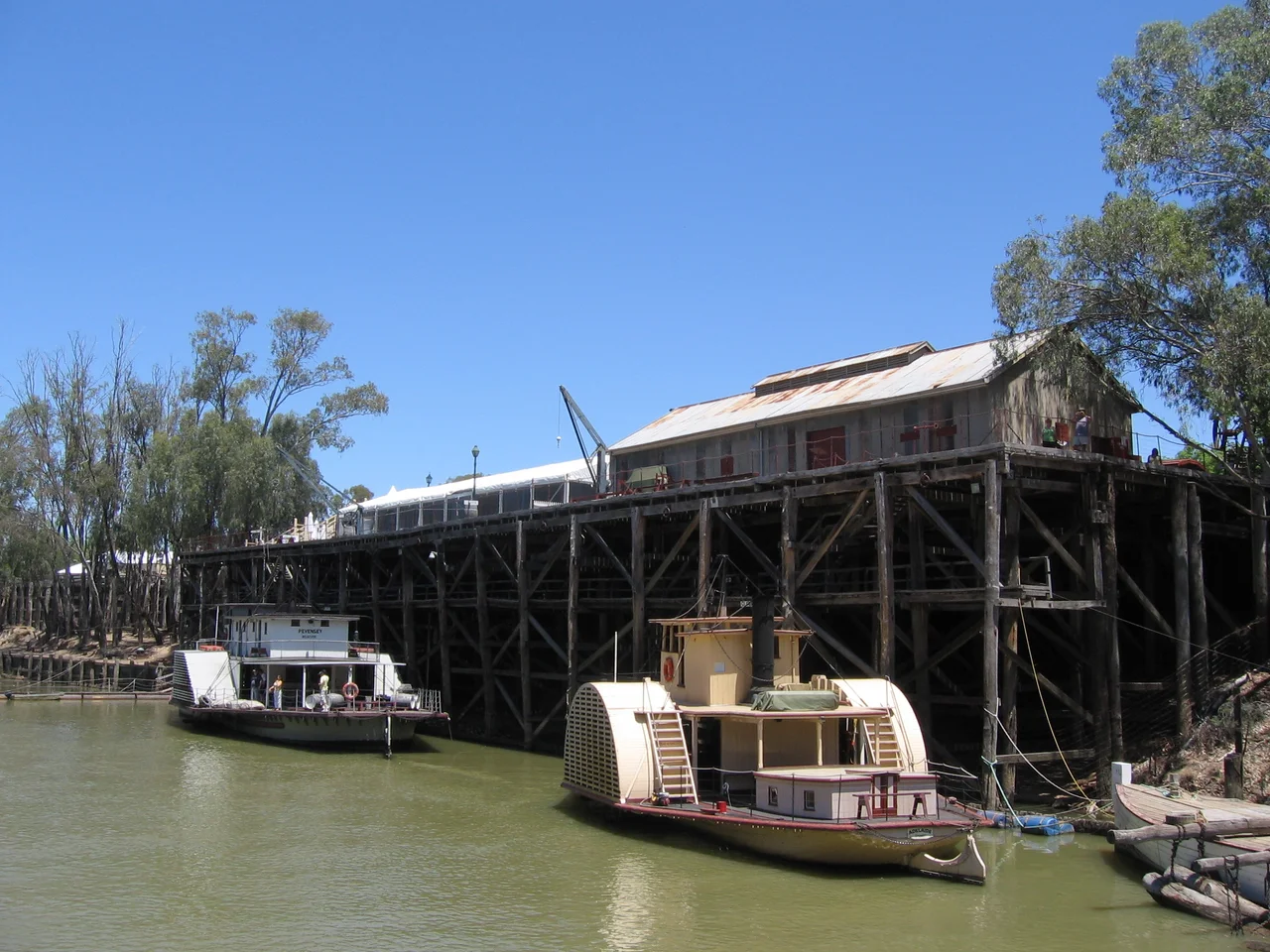
By the 1870s, Echuca had become Australia's largest inland port, a river town that ran on timber, wool, and steam. The reason was distance: of all the points along the vast Murray, this was the closest to Melbourne, making it the natural hinge between river and railway. Paddle steamers nosed up to the Echuca Wharf, a colossal structure built from local red gum stretching 332 metres along the bank. Cranes swung wool bales and wheat onto the deck of the wharf, and trains carried them south to the city. The population exploded from 26 people in 1854 to nearly 4,800 by 1871. More than 80 pubs and hotels served the boom, and rumour held that the sly-grog shops and unlicensed wine shanties outnumbered even those.
When the Railways Won
What the railway built, the railway also undid. As lines spread from Melbourne into every corner of Victoria, and as roads improved, the river lost its monopoly on freight. The Murray itself was a fickle partner, its depth rising and falling with the seasons. By the 1890s the paddle-steamer fleet was already fading, and when economic depression and a wave of bank collapses swept the colony, Echuca's role as a major commercial centre effectively ended. The town that steam had inflated began to deflate, its population dispersing, its wharf falling quiet. For decades the river port slipped toward the status of a backwater, its grandest days seemingly behind it.
The Oldest Steamer Still Running
Then the past became the attraction. Echuca is now home to the largest operating fleet of paddle steamers in the world, and among them runs the PS Adelaide, built here in 1866 and recognised as the oldest operating wooden-hulled paddle steamer anywhere on Earth. Remarkably, it still turns under its original engines. Alongside it work vessels like the PS Pevensey, built in 1911, and the PS Alexander Arbuthnot, built in 1923, conducting cruises daily from the historic wharf. The fleet's revival owes much to a 1980s television miniseries, All the Rivers Run, adapted from Nancy Cato's novel and filmed here, which sent visitors flocking to the riverbank. Tourism now earns the local economy roughly 250 million dollars a year.
Two Towns, One River
Stand on the wharf and look across the Murray, and you are looking at another state. Echuca sits in Victoria; its twin, Moama, sits on the New South Wales bank opposite. The two have been stitched together since 1878, when the NSW Railways Department threw an iron bridge across the river, its riveted spans riding on cast-iron pillars. That old bridge still carries road traffic, joined in 2022 by a second crossing named Dhungala, the Yorta Yorta word for the Murray itself. Each February the river roars back to life for the Southern 80, billed as the world's largest water-ski race, drawing around 100,000 people to the meeting of the waters where a convict's ferry once made the only crossing for miles.
From the Air
Echuca lies at approximately 36.13 degrees south, 144.75 degrees east, on the Murray River at the Victoria-New South Wales border. From the air, look for the broad sweep of the Murray and the junction where the Campaspe River joins it, with the town on the Victorian (southern) bank and Moama directly opposite in NSW. The river corridor's dark line of red gum forest stands out against the surrounding flat, pale agricultural plains. Echuca Airport (a small regional aerodrome) sits just outside town; larger options include Bendigo Airport (ICAO YBDG) to the southwest. The region's flat terrain and clear inland skies make the winding river and its forested banks easy to trace, especially in the dry warmth of summer.
Nearby Stories
- Bendigo 54 km away
- Glenrowan, Victoria 92 km away
- Eureka Rebellion 133 km away
- Beechworth 136 km away
- Warangesda Aboriginal Mission 159 km away
- Ballarat 162 km away
- Mungo National Park 259 km away
- Willandra National Park 273 km away