
Bendigo
Bendigo wears its luck on its streets. Walk Pall Mall, the broad central avenue, and you pass an ornate fountain crowned with granite dolphins and unicorns, a Gothic post office, law courts and hotels built with a confidence that seems excessive for an inland city of a hundred thousand. There is a reason for the swagger. The ground beneath Bendigo gave up roughly 777 tonnes of gold, around twenty-five million ounces, over a single century. For a stretch of the 1800s this was the most productive goldfield in Australia, and the city it funded still looks like money.
From Sheep Run to Boomtown
Before the rush this was a sheep station on Dja Dja Wurrung country, near a creek that some say took its name from a local shepherd nicknamed for an English bare-knuckle prizefighter, William Abednego Bendigo Thompson. Gold was officially found on Bendigo Creek in October 1851, and within a year the quiet run had been overrun by tens of thousands of diggers from Europe, China and across the colonies. The town was briefly called Sandhurst, and stayed officially so from 1853 until 1891 before reverting to the name everyone actually used. The transformation came at a cost the city is now more willing to name. The mining tore up the country and shattered the careful network of channels, weirs and soaks the Dja Dja Wurrung had built over generations to manage scarce water, displacing the people who had shaped this land long before the first claim was pegged.
Gold That Went Deep
Bendigo's first gold lay in the creeks, easy alluvial pickings that any newcomer with a pan could chase. But the real fortune was locked in quartz reefs running far underground, hosted in folded ancient rock. When the surface gold thinned, the city did not empty. Instead it followed the gold down, sinking deep shafts and building the heavy machinery, foundries and engineering works needed to haul ore from hundreds of metres below. The railway arrived in 1862 and growth accelerated. This shift from lone diggers to industrial deep mining is what separated Bendigo from the rushes that flared and died. Geologists still estimate that at least as much gold remains in the field as was ever taken out, defeated for now by depth and the water that floods the lowest workings.
A City the Chinese Helped Build
Among the largest groups drawn to the diggings were miners from China, who at times made up a fifth of Bendigo's population and arrived as miners and merchants carrying their own customs and faiths. Much was taken from them, including the dignity that the era's prejudice denied; much of what they built endured. Their most quietly remarkable survival is the Bendigo Joss House, a temple of locally made brick painted in protective red, raised in the 1860s on the outskirts of the goldfields. It is the only building of its kind left in regional Victoria, and it is still a working place of worship. To stand inside it is to feel the presence of a community that history too often reduced to a footnote, insisting instead on its own continuity.
The Dragon and the Easter Parade
That heritage becomes spectacle every Easter, when Bendigo throws one of the oldest continuous festivals in the country and parades a Chinese ceremonial dragon through streets packed with tens of thousands. For decades the star was Sun Loong, recognised as the longest imperial dragon in the world at over a hundred metres, now retired and displayed at the Golden Dragon Museum alongside Loong, believed to be the world's oldest. A newer giant, Dai Gum Loong, longer still, now leads the procession. Bendigo's appetite for grandeur did not stop at gold. The city is home to the Great Stupa of Universal Compassion, the largest stupa in the Western world, which houses the Jade Buddha for Universal Peace, carved from the largest piece of gem-quality jade yet found.
The Vienna of the South
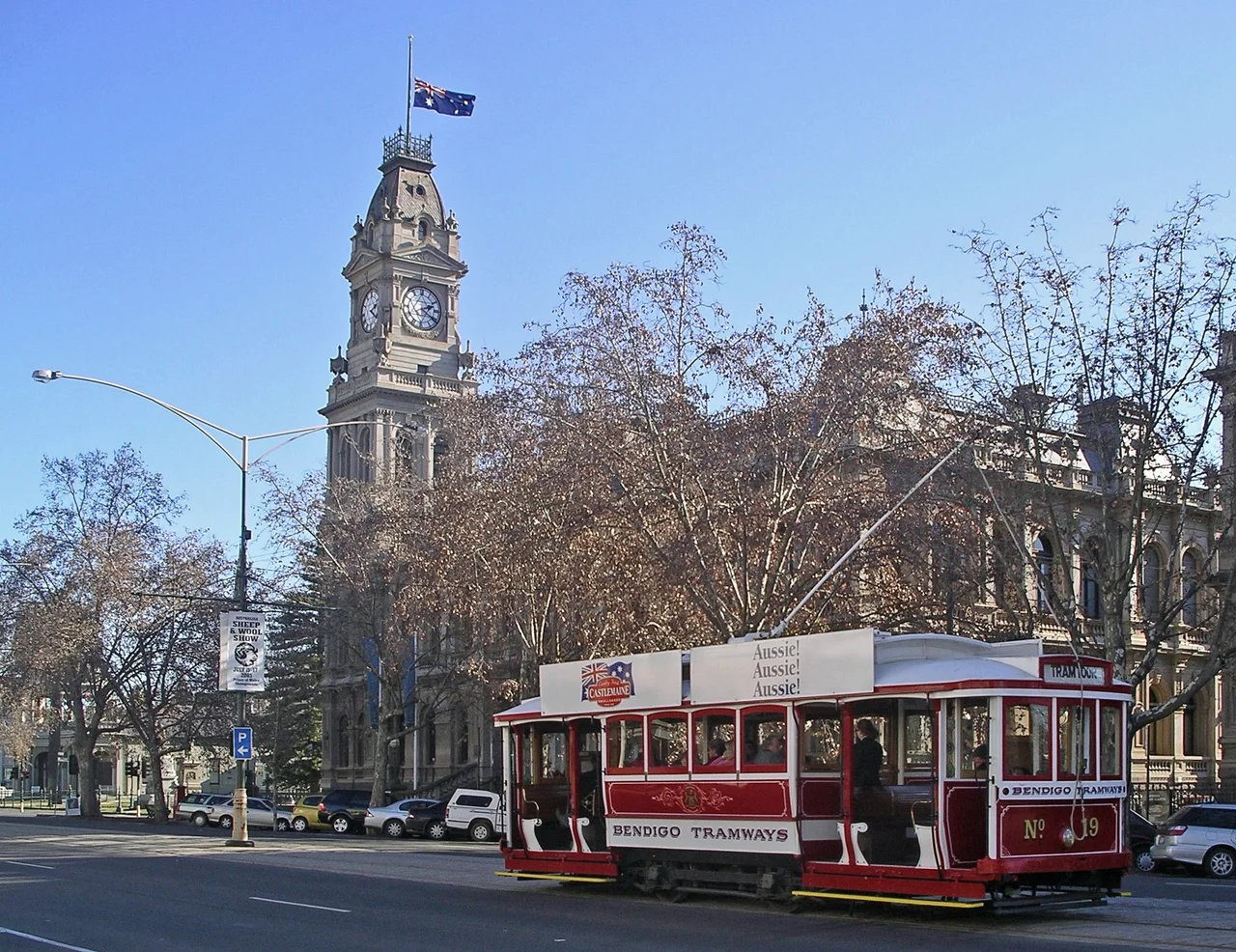
Bendigo's wealth bought architecture, and one man shaped much of it. The German-born architect William Vahland, who landed on the goldfields and never left, designed more than eighty buildings and dreamed of turning the city into a Vienna of the South, encouraging European artisans to settle and decorate it. His Alexandra Fountain still anchors the Charing Cross intersection. His signature iron-laced cottages spread across Victoria. The same boom raised Sacred Heart Cathedral, a vast sandstone church among the largest in the Southern Hemisphere, its spire not finished until the late twentieth century. Trams that once served a working network now carry tourists past it all. Gold mining never entirely stopped, but Bendigo long ago became something more durable than a mining town: a regional capital that the rush merely paid for in advance.
From the Air
Bendigo lies at roughly 36.75 degrees south, 144.27 degrees east, near the geographic centre of Victoria and about 150 kilometres northwest of Melbourne in the Bendigo Valley. From the air the city is a compact grid set in dry box-ironbark country, with old mine poppet heads, Lake Weeroona and the green of Rosalind Park marking the centre, and the Calder Freeway running southeast toward Melbourne. Recommended viewing altitude is 2,500 to 4,500 feet AGL for the townscape and goldfield terrain. The local field is Bendigo Airport (ICAO YBDG) just north of the city, upgraded with a 1.6-kilometre runway and once served by flights from Sydney. Melbourne Tullamarine (YMML) and Essendon (YMEN) lie to the south. Expect warm, hazy summers, cool cloudy winters, and frequent winter frost and morning fog in the valley.
Nearby Stories
- Waterloo Plains massacre 14 km away
- Echuca 62 km away
- Melbourne Cup 79 km away
- Melbourne Museum 109 km away
- Glenrowan, Victoria 124 km away
- Grampians National Park 124 km away
- Mount Arapiles 174 km away
- Mungo National Park 323 km away